





Your email address is required to begin the subscription process. We will use it for customer service and other communications from Milk Street. You can unsubscribe from receiving our emails at any time.
Episode 818
August 22, 2024
August 22, 2024
Refrigerator Revolution: The Surprising Art of Keeping Cool!
This week, it's all about food inventions and innovations. Nicola Twilley reveals the secret history of refrigeration, from ingenious fridge designs to Rwanda’s pioneering “coldscape.” Plus, meat scientist Chris Calkins invents new cuts of steaks, and Dan Pashman wonders if the food tech takeover is actually a bust. Finally, we share a recipe for the pope’s spaghetti.
Questions in this episode:
"I heard on an earlier episode that a caller’s soup went bitter because it had kale in it. Do you think it would taste better if the kale were organic?"
"I'm following up with the results of my experiments with moonshine peaches."
"I’m comparing bread recipes. Why do some recipes tell you to hold the salt until the final step?"
Christopher Kimball: This is Milk Street Radio from PRX. I'm your host. Christopher Kimball. In the early 20th century, New York City was full of skyscrapers, and yet we were still harvesting natural ice to keep our food cold.
Nickey Twilley: America was seen as like the Saudi Arabia of natural ice. We had so many ponds. People were like, oh, this is a huge wealth.
CK: But then a few years later everything changed.
NT: That's when General Electric got in the game. And they were like, wow, if we can put a fridge in every home, think of all the electricity we'll sell.
CK: Today, we're investigating food innovations like how refrigeration changed our lives, but first it's the hunt for new or flavorful cuts of beef. If you've ever grilled a flat iron steak, you can thank meat scientist Chris Calkins in the 1990s he was tasked with rethinking the way we divide up a cow. Chris, welcome to Milk Street.
Chris Calkins: It's a pleasure to be here.
CK: I've spent a little time in …it was used to be slaughterhouses down on 14th Street in New York and had an opportunity to spend some time down there with a butcher friend of mine. But I'm still, like everybody else, totally confused about primal cuts and sub primal cuts. So, let's take a side of beef, and could you just simplify this for us so we get the basic roadmap.
CC: A little bit of a challenge without a nice drawing board and a pen. But on one end, we have the back leg, that primal cut is called the round. On the opposite end, we have the shoulder, and that primal cut is called the chuck, and then between the two, we have the rib. And so, we usually get steak cuts out of the rib and the loin, we call those middle meats. And for a long time, we thought that the only real use for the chuck and the round was roasts or hamburger. But in fact, there are muss in there that are quite tender, quite flavorful and really unique.
CK: I don't think many people, most people think about muscles when they think about steaks. So, a tenderloin is a muscle. Many steaks have, you know, a shell muscle and a tenderloin. The big piece of meat is one muscle, the small is another. And when you get a chuck roast, let's say, if you had a five- or six-pound chuck roast, there are a lot of muscles in that roast, right? So, so a cut of meat may just be one muscle, like the tenderloin, or it could have a variety of muscle all in that one cut,
CC: You're absolutely right, and there is that level of knowledge at supermarkets, but to take that whole carcass and bring it down to individual muscles, that's actually a bit of a lost art these days. And what was happening was they were grinding cuts that had better value than just ground beef.
CK: And you were involved with the Beef Checkoff Program in the late 90s, which was a search, I gather, for other cuts that people might want to buy they don't know about. So, what did you do, what were you looking for and what did you find?
CC: Well, our question was, let's create the book of knowledge about every one of the muscles that are in the round and in the chuck. And based on that knowledge, we'll know which one should go in the grinder and which ones are better handled in other ways, by giving them specific definitions, unique names, things that consumers can recognize.
CK: So, in this study you did, you evaluated many, many muscles or pieces of the animal. What are the criteria for assessing a particular cut or muscle?
CC: Right. We tried to measure every possible characteristic we could think of of each muscle that we studied. So, for every side of beef, we identified 39 different muscles and and we sampled those 39 muscles on over 100 carcasses. And so, you can think of a small mountain of meat on the table by the time we had all of the samples pulled together. So trained panelists that are highly sensitive to differences in texture and flavor and juiciness also created muscle ratings for those cuts as well. Beyond that, we also collected dimensions, weight, length, color characteristics. We characterized the acidity or the pH of the muscle. There is a mechanical measure of tenderness that's called a shear force, how much energy is required to shear a bite of meat into two pieces, and in fact, the second most tender muscle in the carcass is found in that chuck region. And once we identified that, it became clear that it was a grave mistake to grind a really tender, flavorful muscle just because it happened to come into the chuck region of the carcass in the same way in the muscles in the round, there's a muscle there that's probably third most tender muscle in the carcass, and we always tend to overlook it.
CK: You can't continue without telling us what those two cuts are. So, what, what was the cut from the chuck? Was it the eye round in the round? What was it in the round?
CC: No, that the chuck muscle is called the flat iron steak these days. And adjacent to that muscle in the chuck is another muscle it’s sometimes called the petite tender. And then in the round region, there's a muscle called the pectinius, a very, very tender, flavorful muscle that has been called the round petite tender. And so there were about a dozen opportunities that we saw to be able to use these cuts of meat. Some of those were successful, the flat iron steak, the petite tender, the Denver cut, for example, were quite successful. Others less so there's there was a ranch cut, and there was a Santa Fe cut. But the uptake for those new cut names wasn't the same extent as what we see with flatirons, for example.
CK: So how does this work. It's like the fish industry, like you take a really ugly fish with a terrible name and call it something else. So how do you launch a new cut?
CC: Well, that's a really good question. And the first part of the challenge is, how do you make a new cut? What kind of effort does it take? And so, there's always this challenge of which of those muscles can we reach efficiently and which of them require more energy and effort and labor than we can really afford to put into it. And so, the flat iron, the petite tender out of the chuck, are very easy muscles to access, easy to cut. But if you go to a bonanza cut or the Las Vegas steak, they weigh less than one pound, and the efficiency versus cost didn't make for a very attractive process. But also, in the early 2000s there was a huge economic crisis, and what happened was a lot of people couldn't, frankly, afford to pay for those T bones and rib eyes and so on. But then there was another tier of stakes that was more suitable for their pricing consciousness. And so it was a real win for consumers, and then, of course, a win for the industry and for beef producers themselves, because it helped regain the value that was there all along and just not recognized.
CK: Chris, it's been it's been education, definitely, and it's also been a pleasure. Thank you so much.
CC: Well, I've enjoyed it, Chris. I appreciate the time today.
CK: That was Chris Calkins. He's a professor of fresh meat at the University of Nebraska Lincoln. Now it's time to take your calls with my co-host, Sara Moulton. Sarah is, of course, the star of Sara's Weeknight Meals on public television and author of Home Cooking 101, so Sara, we're going to be talking about refrigerators later in the show. Do you like your refrigerator? What kind of relationship do you have with your refrigerator? Well, it's
Sara Moulton: Well, it's interesting. You should ask, because we've just had two debacles, one at my family's farmhouse and one at our home in New York City, and both of them involved a freezer on the bottom situation, here's what the problem is, if you don't close that freezer door, and then you're not home for a while, it sort of shuts down the whole refrigerator, because the freezer reacts, and then everything else reacts, and then everything defrosts, and then the refrigerator is a mess, and you have to get somebody in,
CK: Doesn't it beep after a while when it's not closed?
SM: Well, people had left the house. And they didn't notice, because it's hard to push that door closed. You tend to overstock it. So, they came back in this dead freezer. They had to throw everything out. They had to get somebody in to defrost the back of it. I don't know what happened. Likewise, we came back from Thanksgiving and our refrigerator. I thought it was just old, 17 years and so I just thought, oh, we need to get a new one. I threw all the food out. We got a new refrigerator. Now, I had the freezer on the top. I love it, but it wasn't until the second refrigerator died that I realized the problem was the freezer on the bottom, model the drawer. It's a drawer. You pull it out, you push it in, and sometimes you don't push it in enough.
CK: The problem with refrigerators, they have, like, little tiny shelves, and they have medium shelves, like, there's only one shelf you can put a big thing, like a quart of milk on, like, forget all these shelves. And who needs them? Three big compartments that are deep and high is so much better. And so it goes out of the category of, you know, the world is going backwards. It's not getting better. It's sort of like when they changed on the car from a knob to turn for on and off and tuning, which was by far the best system to buttons and stuff, is just ridiculous.
SM: I know. I agree. No more improvement, please.
CK: Well, my theory is, you know, one of my theories is that cultures have a beginning, a middle and an end, and there is a peak period when things are really good. We are past the peak period, at least when it comes to technology, sometimes, so right anyway
SM: All right, let's take a call. Welcome to Milk Street. Who's calling?
Caller: This is Terry V___,
SM: Terry, where are you calling from?
Caller: Hartford, Wisconsin.
SM: How can we help you?
Caller: A couple of months ago, I was listening to your radio show, and someone had called in to say that they had made this soup that they had at a restaurant, and they were trying to replicate it. It had kale in it, and although it was good the day she made it, the next day, it had turned so bitter that she couldn't eat it. She had to throw it away. Now your reply was, it was the kale. I'm an organic vegetable farmer, and we have raised kale for the last 22 years, and I have never had that happen to me. I've had it raw, I've had it cooked, I've had it the next day, two days later, and I've never had that happen so I'm wondering, do you think it was because she used conventional kale and not organic kale?
SM: I don't know if it's the difference between the two. I have read that when you chop kale, it does break down the cell walls of a couple of compounds that are in kale and that that can become bitter with prolonged cooking, you know, bitter to begin with, and then getting worse, I myself have never experienced bitter bitter kale in a recipe the day later. So maybe I was lucky, and maybe you're right. Maybe it's organic. I don't know. Let's see what Chris has to say.
CK: I would think the pH of the soup that this person was cooking may have had something to do with it. It might have been, you know, whether it was too acidic or too base or alkaline or whatever, that may have affected the kale. I would say, however, there are a couple things I would never put in a pot of soup, pasta and greens, right? Those I would do in a separate pot for whatever I'm going to serve that day.
Caller: I agree with you on pasta
CK: The kale I just think it gets kind of nasty sitting in that liquid for a day or two.
Caller: Nasty how?
CK: Well, the color is not great. I get a texture that I think is not as nice as when it's first cooked. Maybe nasty was a little strong, but okay, I know you're an organic health farmer, so anything that cooks really quickly, I would tend to add just before serving, right, but I think it's probably the pH of whatever's the soup or stew was that probably affected it, but I think, I don't think it's conventional versus organic.
Caller: Okay, but you wouldn't say kale is quick cooking would you it's not like spinach.
CK: I'd say if you cook it for 15 or 20 minutes, it's probably fine. It depends how old the kale is, (yeah) you know, if it's pretty fresh and it's not huge leaves, it depends also how you cut it up. If you or something, you know, it'll cook faster, yeah. So let me ask you, though you obviously love kale. Tell me your best recipe for kale. What would you do with it?
Caller: Oh, oh, this is so hard. I like to chop it up in a salad, you know, pulling off the stems and leave it for a couple of hours mixed in with the dressing, and then I add everything else.
CK: Oh, that’s good, that’s interesting.
Caller: I love it that way. Yeah, a vinaigrette. There's no need to massage unless you're doing this at the last minute, in my opinion. But if you make your dressing, put your kale in there, and you mix it up and leave it for two hours it absorbs the flavors of your dressing and it gets tender.
CK: That's a good idea. I'd like to try that.
SM: Yeah,
Caller: I also chop it up and I put it in garlic, onion and some butter,
CK: At least you didn't say a smoothie. I was waiting for that.
Caller: I have friends who love smoothies
CK: I know, I know I'd rather have a steak personally, but anyway, that's a whole other matter,
Caller: but not in a smoothie, right?
CK: But not in a smoothie. You're right.
SM: Oh gosh, what a thought.
CK: a lab grown smoothie. Terry, I appreciate the call.
SM: Yes, thank you for calling.
Caller: You're very welcome. Thank you. It's been delightful and I’m honored to talk to you.
CK: Well. Thank you. Thank you. We loved it too. Thanks. You're listening to Milk Street Radio after the break the refrigerator revolution that's up in just a moment. Hi Milk Street radio listeners this year for our Thanksgiving episode, I'm taking calls with Jet Tila from size to Turkey, please send us your biggest Thanksgiving cooking questions, simply email us at [email protected]. One more time, please send your Thanksgiving Questions to [email protected] and we'll be in touch. Thanks. This is Milk Street Radio. I'm your host. Christopher Kimball, right now it's the history of the cold rush. Refrigeration is a relatively recent invention, but Nicky Twilley says it's radically changed the way we cook, eat and live. Nicky is the co-host of the gastropod podcast. Her new book is called Frostbite Nikki. welcome to Milk Street.
Nicky Twilley: Thank you for having me.
CK: So, we're going to talk about refrigeration. Now you say that three quarters of the food on our plates today here in America is shipped or stored or processed under refrigeration. Obviously, over 1000s of years, we've dried, salted, cured, etc. So, when and why did cold storage really become a central thing?
NT: Well, yeah, so food has always gone bad. Anything that can nourish us is equally fertile ground for nourishing bacteria, and not all of those bacteria and fungi are good for us, so that's something we have been dealing with since the dawn of time, but it wasn't such a huge problem until lots and lots of us started living in cities. Because if you live close to where your food is grown, or you're hunting catching it yourself, you can usually avoid some of the time in which the fungi and the bacteria would grow and make you sick.
CK: But there were ice houses, for example, in my town in Vermont, you know, people were cutting out blocks of ice, and they packed them with sawdust, right and they would keep dairy products and other things there. So, the need for refrigeration, even if you lived in the country, was always present. I think, and you also talk about in your book going back to, like the Euphrates River, right, when there was Syrian ice houses, so that the icehouse had been a feature of civilization for a long time, right?
NT: It certainly had. Yeah, we it goes back an incredibly long way. The the ancient Greeks and Romans used ice to preserve food, but it was not the most common method of preservation. In fact, it was much more likely to turn your dairy into something portable, preservable, fermented, you know, cheese, butter, yogurt, because you couldn't access cold reliably natural ice was the only option for most of human history.
CK: So, there was this whole infrastructure of harvesting ice in the winter, transporting it, storing it, and that that must have been a highly complex, very sophisticated system, right? Because any food moving around had to be iced, or food storage at home, you had an ice box. My father, you know, was born, I think in the early 20s, still remembers the Iceman, you know, cometh exactly provide the blocks of ice. So that wasn't that long ago. So, I assume in a period of a few years that whole infrastructure just fell apart. Or was it a slow transition?
NT: Yeah, even in 1907 I think is the last year that New York City, which already had skyscrapers, was still totally dependent on ice harvested from ponds and rivers. America was seen as like the Saudi Arabia of natural ice. We had so many ponds. People were like, oh, this is a huge wealth like Saudi oil today. So, the global infrastructure of the natural ice trade that then sort of vanished is astonishing. Some places still do use it. There are places in the in the north of Japan that rely on ice cooling, northern Finland too. I mean, if you have the resource, why not? But it wasn't something that you could use to get, you know, all the meat that people in cities eat to them keeping it fresh.
CK: Yeah, but they had a better system for that, which is you'd walk the beef into the center of town, like in Boston, on Washington Street, the beef would, you, know, walk in, under their own steam, into a butcher shop, so that you didn't have to transport meat. You were transporting animals that were living,
NT: Yeah, and there are amazing stories of even trying to, kind of herd turkeys along the road into town. I mean, some, some animals were even kept in the city. I mean, as recently as the 1800s there were pigs living in Central Park. That's where the pork came from.
CK: Oh, I didn't know that well, I guess. I guess how it made Central Park very different than is today. So, okay, so how did the meat industry start to incorporate refrigeration? What was that transition like, and when did it happen?
NT: So, we have really one person to thank for this, a guy called Gustavus Swift. And the thing about him was that he just hated any form of waste. He's actually the guy who's responsible for the expression, you know, “using every part of the pig but the squeal” that comes from him.
CK: I thought wait a minute I thought my mother invented that.
NT: No, she she has Gustavo Swift to thank, but he set himself up in Chicago as a butcher, and he was like, I'm paying the railroad companies to ship all my cattle to New York City to sell but only 50% of it is sellable meat. So, his big thing was to design a rail car in which you could ship a slaughtered carcass and keep it cold all the way to New York. And by 1870 he had transformed American meat eating, American meat growing everything to do with the meat industry, and meat was shipped that way for decades. It wasn't until an African American race car driver who had taught himself how to be an engineer invented a mobile unit to put on trucks to keep them cold. In the 1930s that the ice packed rail car kind of gradually fell out of fashion.
CK: That's amazing. Okay, so we have refrigeration for industry, for cattle cars, et cetera, but then we have to transition over to home refrigeration. So how did that technology end up in a, let's say, a Frigidaire?
NT: The real big breakthrough is actually just widespread electrification. So, you know, these prototype refrigeration machines, they were huge, and companies started to experiment with, you know, you could put one in the basin and have a pipe bringing up cold to your house, kind of like the way we get electricity through the wall these days. You could have got cold through the wall. And actually, weirdly, those pipelines still exist. They dig them up in Boston sometimes.
CK: Well, I still have in Vermont an old four door Frigidaire from the 20s. I think (amazing) you know and those are, I have to say, they're much better in terms of how the space is organized than the current refrigerator.
NT: No, it actually happened. It was a guy in Fort Wayne, Indiana, a guy called Alfred Mellows, who was the first person to build like a self-contained electric fridge.
CK: And when was about, what year is this?
NT: Oh, yeah, this is about 1918 again, really pretty recent, and it didn't become something that you would buy in the in the store, I guess, until the late 1920s that's when General Electric got in the game, and sort of they, they were really excited about this, because they were like, wow, if we can put a fridge in every home. Think of all the electricity we'll sell.
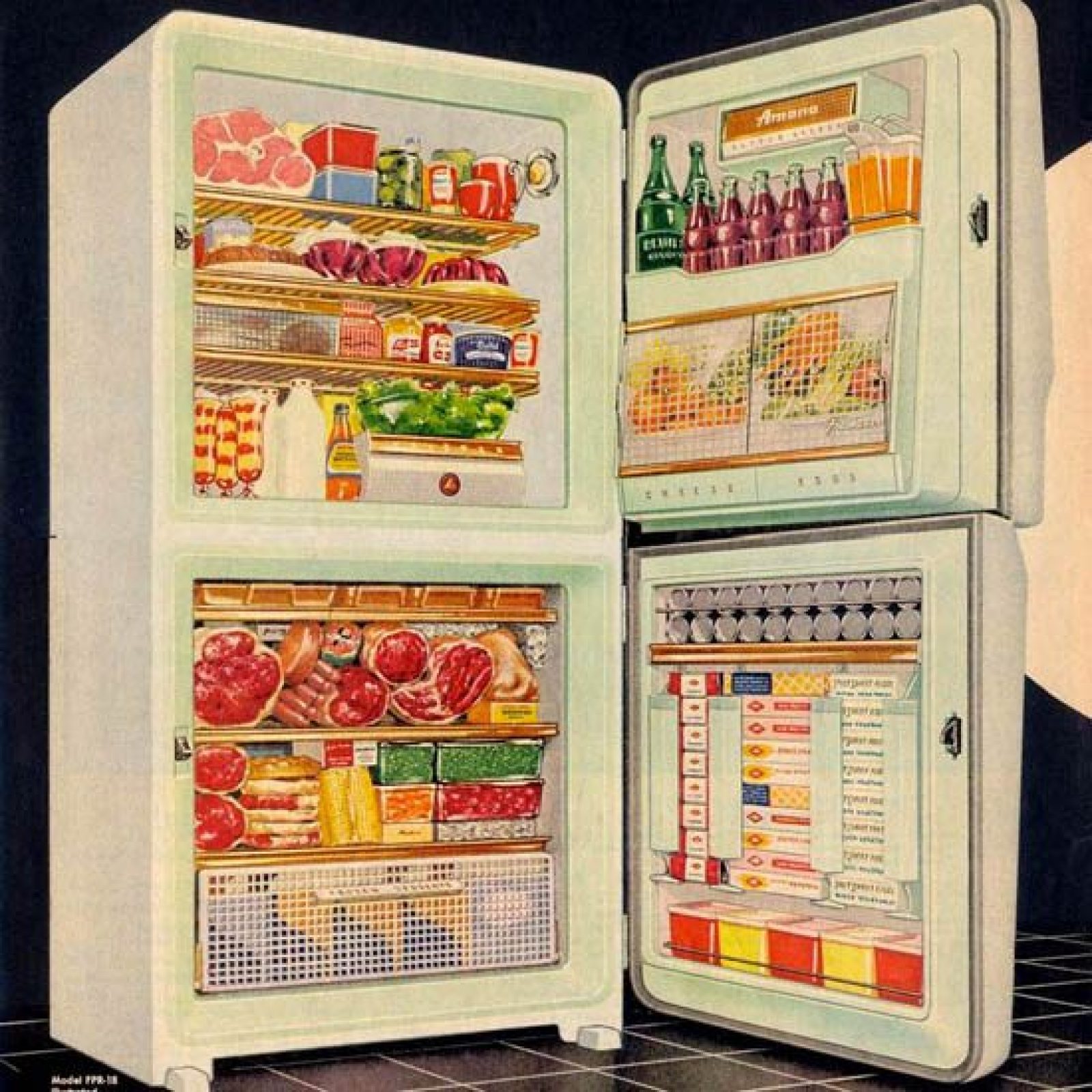
CK: You know, I saw an ad from the 1950s I think for a Frigidaire. That refrigerator, I it was jaw dropping. It was so much smarter and better designed than the cookie cutter things we have today.
Ad: Let's start with the most ingenious store in any refrigerator, it has special places for bottles spreadable butter
CK: On the door in the middle was a large vegetable, fruit area.
Ad: It tilts down to show you your supply at a glance, and it also lifts out so you can take it over to the sink when there's a fresh supply to be washed and put away.
CK: It also had, it had ice cube trays at the bottom of the freezer, and you put them in the slot and push, and all the ice cubes would be automatically punched out into a drawer underneath.
Ad: You just take out a tray, turn it over and push. You get a shower of ice cubes, all frosty, dried and ready to use.
CK: It's interesting that those refrigerators from the 50s had so many more useful gadgets than what we have today. I can't believe refrigerators don't have pull out shelving. I mean, because it's always you know, you see that little yogurt container in the back, or the thing that one of your kids is hiding from you, like the chocolate pudding or whatever. I mean, you’re getting stuff from the back of a shelf out of the fridge is really hard. I mean, things get, you know, get hidden in there. I can imagine, if you and I sat down for an hour, we could come up with 12 interesting things you could do with the design of a refrigerator.
NT: And people have come up with these ideas. That's the crazy thing. There was, I remember one thing I really wanted was a door mounted kind of butter conditioning dish so that would keep your butter spreadable.
CK: That's a great idea
NT: Isn't that amazing? Then there were, people have come up with thawing drawers so that it catches the drip if you're if you're thawing a piece of meat or fish. I mean, people have done all of these things, and they just haven't caught on. When I talked to fridge designers, they were like, the thing people care about is filtered water and ice makers through the door. That's all they want. So, you know, they blame us?
CK: Well, you know, somebody should go out there and just not listen to all these focus groups and just go do a great fridge so okay, so moving on now. The issue for you now is, okay, you know, three quarters of what we put on our plates have been through some sustained refrigeration storage or transportation, but your your basic take is, without realizing it, we're reducing the quality of our food because of this.
NT: Oh, yeah, definitely a mixed blessing. I think anyone who loves to eat ice cream and drink cold beer as much as I do could never be fully against refrigeration. But the argument I make is that you really just haven't thought about it, and it's this invisible kind of black box between the farm and the table, and so we've just sort of blindly accepted refrigeration's benefits without questioning its costs, and those costs are real. One of the scenes in my book is from 1911 is this world's first cold storage banquet, and it's a huge hoopla, front page news all around the country. The only food that is going to be served at this meal, at this elaborate five course meal, has been kept in refrigerated warehouses. All of it has been refrigerated. And at the time, that was like shock, horror. People were even afraid to eat that food, even at the time, there's a Chicago newspaper who says, listen, what's going to happen is that everyone will forget that this food actually tastes worse than what we were eating before, and they're just going to buy it. And eventually, the people who remember what good food tastes like will die or forget, and this will be the new norm, and that's where we're at. People are all like, oh, but think we can have, you know, blueberries all year round, but those blueberries have lower nutrition levels, and because we're eating fresh fruits and vegetables all year round, we're not eating the fermented, preserved foods that we ate before that we now know are really good for us. So, you can argue about the health benefits all you like, but you cannot argue about the environmental issues, and that is where refrigeration's true cost lies.
CK: So, I guess the question is, where's the tradeoff here? Because I don't think you're saying, let's only grow local foods, because then most foods are not available most of the time. What is your recommendation for next steps, like, I get it, I get this is not a good thing. I get it, and I'm on your side. I just don't know what we do next.
NT: So, we don't have to put everything on the consumer to eat differently. And you know, it's always tempting to reach for the technological solution, because then no one has to change what they're doing. But refrigeration may not be the only way to preserve food, so one of the things I do in the book is I've visited a company called Appeal that has in its test lab right now a coating that is able to keep, say, blueberries or, I don't know avocados fresh for four to six weeks without refrigeration,
CK: And you actually tried some of the Appeal coated produce when you visited their lab. Yeah? So let's hear a little bit of tape from that.
An Appeal employee: These are untreated lemons. So, this is eight weeks old, and these are the same age, so these are treated, and these are untreated.
NT: That's nuts
An Appeal company employee: Yeah. I mean, look at the pepper, the same thing. So untreated, and then these are treated, and they're both, both the same age.
NT: Wow. And does it still smell like a lemon? (Oh yeah) Oh yeah.
An Appeal company employee: What we do is we treat the produce with such a small amount of material that the result is you can't see it, you can't taste it, you can't feel it.
NT: So, if I licked that right now I would not taste anything.
An Appeal company employee: Go for it.
CK: So, in addition to more eco-friendly coatings and packaging, that reduces the need for cold storage, you also went to Rwanda because they're reimagining refrigerated transport in some really pretty interesting ways. Yeah.
NT: Yeah, so this is a very cool project. You know, basically food there is not refrigerated at the moment, so it really needs a cold chain. But the the government has decided that the way it is going to build that is using the best technology there. There's an amazing company called Oxtruck that has developed a sort of flat pack truck that is solar powered and refrigerated. And so that's something that is being demonstrated. There even such simple things as like, okay, you know the pallets that boxes are stacked on those wooden pallets, well, they could be metal or plastic and filled with ice, and then that goes out with the produce, so it doesn't need to be in a refrigerated truck
CK: Wouldn't it? Wouldn't it be great if Rwanda actually figured (it would be so cool). Okay, I'm I'm now 10% more hopeful. Nickey, that's awesome. I appreciate your optimism, your research and your enthusiasm, and I hope someday this comes to pass. Thanks so much.
NT: Thank you so much. It was super fun to talk with you.
CK: That was Nickey Twilley. She's the co-host of the Gastropod podcast, also author of Frostbite. The age of refrigeration made it possible to get almost any fruit or vegetable 365 days per year, but it also meant the demise of natural preservation. I'm talking about smoking, pickling, salting, drying, canning and the like a truly fresh piece of beef would still be stiff with rigor mortis, but aging beef is a great way to improve flavor. Cheese is a way of preserving milk. Iberico ham preserves pork, kimchi preserves cabbage, plus we enjoy pickled capers, sun dried tomatoes, and even today, baccala cured preserved cod is still a staple of many cuisines. Everyone loves to buy fresh but it's worth remembering that foods in a state of preserved decay taste even better. You're listening to Milk Street Radio coming up. Dan Pashman wonders, is the food tech takeover actually a bust? That's when we continue. I'm Christopher Kimball, and this is milk Street Radio right now, let's head into the kitchen with JM Hirsch to learn about this week's recipe, spaghetti with prosciutto, parmesan and peas. JM, how are you?
JM Hirsch: I am great.
CK: Carbonara, you and I have been down this road many times over the years. Bit of a tricky recipe to get just right, it's substantial let me put it that way. So, you were in Italy and found a version that is somewhat lighter, I think, and that you prefer.
JMH: Well, in theory, it's lighter, at least according to Pope Pius the XII. So about 100 years ago then Cardinal Eugenio Pacelli went to his local restaurant outside of the Vatican and said, you know, carbonara too rich for my blood. Can you make a version of it that's a little bit lighter, a little bit brighter? And so, this restauranteur, Cesaretto Simmi, said, well, you know, the classic ingredients for carbonara is guanciale and Pecorino Romano, and those are, at the time, at least considered rather brash, bold ingredients. So, he kind of played with it, and he said, well, I guess instead of the guanciale, I can use prosciutto, which is considered, if not lighter, certainly higher class. And instead of the Pecorino Romano, which is considered kind of coarser in terms of flavor, I could use more refined parmigiano parmigian cheese. And so he did, and it was a huge hit. The cardinal and very soon after the Pope was smitten with it, and it became a classic Roman dish, this lighter, brighter carbonara called pasta a la papalina. And papalina translates as the little skull cap that they wear. So became quite the thing, except it didn't hold up over time.
CK: I thought, in Italy, sort of people are true to the roots, right? I mean, the recipes don't change very much, but this one, as you just said, changed. So, what happened to it?
JMH: Yeah. I mean, I wish I could explain why they did this, but it wasn't a good thing. Over time, cooks started to take liberties with it. Instead of prosciutto, they started using deli ham. (Oh, Lord) not an improvement. And they did add peas, which I will say when I first heard about, that sounded a little off putting, but when I had it and it was done right, the peas were quite nice, but they also lost the knack for cooking it, because, you know, as you know, when you're making carbonara, there's, you know, eggs whipped into it, and you do that off heat so that they become a creamy sauce. You don't want to scramble your eggs, which is what happens if you do it overheat. And so, a lot of the versions I had were deli ham with spaghetti and scrambled eggs and canned peas. It was not a good thing. So, I was a little disappointed with the Pope's pasta.
CK: Where were you going to eat in Rome? That sounds awful
JMH: Well, you know, the sad part is, I actually ate it at the I think it's the granddaughter of the man who created the recipe. I ate it at her restaurant and anyway, but the good news is, I did find a restaurant Mama Angelina, in the north of Rome, where the chef Andrea Dell’Omo agreed to do the research for me and kind of pull this recipe back to its origins, which is supposed to be a lighter, brighter pasta carbonara. So, he, of course, understood how you do the eggs, off heat. And he returned it to prosciutto instead of deli ham. And he took a nice, gentle hand with the parmesan, so that you got that richness, that creaminess, that saltiness, but it wasn't overwhelming, and it was amazing actually, when done well, it is lighter and brighter than a classic carbonara. But now let's define our terms here, because when we say lighter, it's still got a lot of cheese and pork in it. So, this is not diet industry light. It's light in the Italian sense of flavor, because again, the parmesan and prosciutto are considered more elevated ingredients than guanciale and Pecorino Romano. And so that's really what they meant. I think the cardinal, I think he wanted to feel special.
CK: He wanted the Uptown version, right?
JMH: Yes, exactly,
CK: Spaghetti with prosciutto, parmesan and peas, a lighter, more, I guess, Uptown version of carbonara. JM, thank you.
JMH: Thank you. You can get the recipe for spaghetti with prosciutto, parmesan and peas at Milk Street Radio.com.
CK: I’m Christopher Kimball, and you're listening to Milk Street Radio right now. My co-host Sara Moulton, and I will be answering a few more of your cooking questions.
SM: Welcome to Milk Street. Who's calling?
Caller: Hi, this is Ishmael.
SM: Hi, Ishmael. How can we help you today?
Caller: Hi, I was actually calling to give you an update on the suggestions you gave me for some moonshine peaches that I had bought
SM: Yeah, I remember those. Okay, so what happened?
CK: What was our advice?
SM: Well, first of all, what was the dilemma that you had all these moonshine peaches and you needed to figure out what to do with them, because you didn't want to throw them out.
Caller: Well, you had said, Sara, for me to add, like, extra peaches to it, to make it peach flavored again.
SM: Oh, dried peaches. I think
Caller: Yes, some dried peaches. And then Chris had suggested, kind of just like, simmering it down to kind of make it like a syrupy like something you could put over, like ice cream or something like that. And so, I kind of mixed the two of them together. I took your idea of getting dried peaches, I found some freeze-dried peaches at the store, and I put the peaches in a saucepan, and I heated them up, and they kind of let all the alcohol cook off. And then I added a stick of butter to dried peaches, a little bit of brown sugars, and some cinnamon, and they let it cook down, and it came out fantastic.
SM: I like the butter edition. That was smart.
CK: You’ve got dried peaches, yeah, butter, your brown sugar, yeah, sounds good,
SM: Yeah,
Caller: It came out really good.
SM: Was there a faint alcohol? There had to have been. You can never get rid of all the alcohol. I'm sure it was still slightly
Caller: it was still slightly alcoholic, but the flavor was there. It came back
CK: Good.
Caller: And on top of that, my wife took some preserves for her ice cream, and then what I had left, I just kind of made a box cake, and I just kind of spruced it up a little bit, and I made, like a Chris suggested doing, like, kind of a pineapple upside down cake, but with the peaches, and I did that, and it came out, great,
CK: Great.
SM: Wow. You're, well, I'm impressed with you, by the way, that was all very creative.
CK: And then you have a little schnapps in the bottle that it came in, yeah. Well, it's sort of interesting. What's interesting to me is that they sell these moonshine peaches, but the peaches, as you said, have no flavor. Which does the peach flavor end up being in the liquid? Like if you just drank some of that liquid, the alcohol, does it have any kind of a schnapps, like, a slightly fruity flavor, or not?
Caller: No, not really. It's
SM: more like a peach brandy,
Caller: Not even that. It's it's more or less like peach rubbing alcohol.
SM: So, it's more like you smell it than you taste it, right? It's
CK: It's a topical application. Yeah, that's good for sore muscles. You obviously know what you're doing. That was an excellent solution.
SM: Yes, very impressive.
Caller: Thank you for your advice. I appreciate it. Thanks. Okay,
SM: Okay, all right, bye.
CK: This is Milk Street Radio. If you're stumped in the kitchen, please give us a ring. Our number is 855-426-9843, that's 855-426-9843, or please email us at questions at Milk Street radio.com Welcome to milk Street. Who's calling?
Caller: Hey there. This is Frank from Washington, DC.
CK: How can we help you?
Caller: Well, I have a question about bread. I've looked at a lot of recipes. Most of them that I see tend to say, you know, mix together all the dry ingredients, add the wet ingredients, make a dough. Go from there. But I do see a few here and there that say, mix it all together, except the salt, let it rest for a few minutes, then add in the salt. So, my question is, why?
CK: Well, years ago, I was coming up with a rustic European bread recipe. I was out in Berkeley, San Francisco, Oakland, I guess, and I went to a famous bakery there, and the baker told me that he did not add the salt right away, because the salt actually makes the dough heat up faster, and it heats it up and actually hurts the growth of the yeast. Other people say that salt inhibits the growth of the yeast. I bake a fair amount of bread, I put the salt in with the flour, and the reason I do that is on more than one occasion, I've forgotten to add the salt because it didn't go in at the beginning, and saltless bread is inedible, in my opinion, forgetting about what the Italians think about saltless bread. I don't think it makes a difference, especially if you don't use instant yeast. If you use regular, active, live yeast, I start the yeast in water that's 110 degrees with a tablespoon of sugar and et cetera, and it gets really frothy and going. So, a little salt in the flour is not going to make any difference at all. I actually don't think at a home baking level, it matters if you add half a teaspoon or teaspoon of salt the beginning, I think it's maybe in a commercial operation, it does, but I don't see it makes any difference in my baking at home. Sara?
SM: I agree, salt does somewhat inhibit yeast development, but not enough that it's a really big problem, and it really is important, because it helps tighten up the gluten. And you need the gluten developed in the flour so that it can trap the carbon dioxide, so that you have rise in your bread. And also, if you don't tighten up the gluten a little bit, then the dough is flabby. I always add my salt at the beginning too, and I've never had a problem.
CK: But Sara and I will never be offered a job in a professional bakery as a result so,
SM: I know probably that was heresy.
CK: We've now been struck off all the lists. Yes, you know, there's so many other things going on in a bread recipe that I think this is a fairly minor point in my opinion.
SM: Yeah
Caller: Okay, great, so I'll just go ahead and add salt at the beginning and hope it all goes well.
CK: Well, do you use instant or rapid rise to use just regular active yeast when you bake bread?
Caller: Instant
CK: Well, then you just throw that in with a flour and the salt. I think it's fine. If you ever had any problem, you could increase the amount of yeast a little bit if you wanted to. Otherwise, I don't think it's problem Frank. Thank you. Okay. Yeah, yeah, take care.
Caller: Thank you. You too.
SM: Bye, bye
CK: This is Milk Street Radio. Now, let's check in with Dan Pashman. Dan, how are you?
Dan Pashman: I'm doing well, Chris, how have you been?
CK: I'm pretty well. A little older, but significantly wiser.
DP: Question for you, Chris, do you ever order groceries to be delivered to your house? Like do you order online for online grocery delivery?
CK: Upon occasion, my wife will do so, but I always go to the store I'd like to shop for food
DP: And I'm happy to tell you that your household is similar to most American households, 25 years after the first dot.com bubble, Americans still make about 80% of our retail purchases in stores.
CK: 80% is still in retail? 80% is
DP: 80% is still in retail overall. And groceries, here's what's especially interesting. So when covid hit, of course, a lot of people shifted to online grocery and we were all told like this is going to accelerate the move to online, everything right? To delivery, everything that has turned out now we can see not to be true. In fact, the number of Americans ordering groceries online has been going down steadily since the height of covid
CK: Well, yeah, that's not surprising, but it's still up over 10 years ago, right?
DP: It's up a bit, but not the way that it was predicted. For decades we've been hearing all these promises from tech companies of how our relationship to food, the way we get our food, the food that we eat, was all going to be improved. It's going to be so easy. Your refrigerator is going to know when you're out of milk and you're going to open the front door, the milk will just be sitting there. The food's going to be better for the environment and cheaper and taste better. And there's now a steady stream of data coming out to show us that this is just not panning out. All right, the companies that raised hundreds of millions of dollars to create lab grown meat have not met their investors expectations.
CK: Can I, can I just say yes, those three words, lab grown meat, I think that's the death knell at the beginning of that industry.
DP: Maybe they should give it one of those dot com kind of names, like meatly (or meatiy) Yeah, I'll give you one more example, though. My larger point here they're saying now they're going to get rid of a lot of the self-checkout machines in grocery stores, because people don't want to, you know, we thought they were going to get rid of all the humans. Now they're bringing back the humans
CK: Here's what happens in our store. They just about six months ago, put a bunch of self-checkout lines in, and now everyone's using them all of a sudden, which means that the two remaining live checkout lines are empty. It's insane. I mean, you have people waiting in line for self-checkout because it's a new thing in our store. And you can go to someone else who'll check you out twice as fast. And by the way, you can actually say hello and and there's one particular guy at checkout who does nothing but puns. I mean, you know, I want the human if strange experience, right?
DP: I agree. Plus, the people behind the register, they already know the code for the lemons, so you don't need to go searching for it on the stupid computer. But I think that there's a larger lesson here for us to learn about our relationship with food.
CK: Should I cue the philosophical moment? Yes, yes.
DP: Yes, yes. Can you start? I hear it coming. Can you start humming My Country Tis of The in the background, please.
CK: Here we go.
DP: Let me ask you, Chris, why do you prefer to go shopping for groceries in the store?
CK: Well, first of all, it's a pleasure. I like food shopping. Number two, the obvious answer is because I get to pick out what looks good and feels good to me. Like, for example, if you order half a dozen avocados online, you know what you're going to get. You're going to get six rock hard avocados, right? I want to pick the meat. I want to decide on what chicken. I enjoy the process of looking and choosing for myself. Also, very often, I walk into a grocery store without, you know, I don't necessarily have a recipe in mind, so I want to cook what looks good to me. So, all those reasons, and
DP: I'm with you, Chris, but I think that a lot of people behind some of these technologies underestimated how much so many of us feel that way. I think that a lot of these big promises about how technology was going to change our relation to food were made by these sort of like Elon Musk style tech bros, who are sort of these optimizers, who are just all about like, how can I get calories into my body so that I can stay alive, so that I can write more code, or whatever it is, they just view food as mere fuel. In the process of making it and distributing it is just sort of like a problem to be made more efficient through technology. And I think that ignores why people like you and me and so many other folks, Chris, love food and love cooking, and that is that we have a deep connection to it.
CK: So, in the future, you're saying that when technology takes the human out of the human experience with food, it may end up in trouble.
DP: Yes, and I think that people making this technology have underestimated the natural human connection to food. That said, I do think there'll be. Interesting to see what happens decades from now, as the generation that's been really raised on cell phones, from like age 12 becomes adults. They're so accustomed to doing everything through their phones, maybe that the promise of technology that has not yet panned out will just be several decades delayed that remains to be seen.
CK: So just on, on a maybe a positive or negative note, is there anything else, other than ordering online, that you think is going to fall by the wayside, that that industry has predicted about food?
DP: Well, I think this lab grown meat, if you want to call it cultured meat, I mean, I think that's got some real issues, you know, I just don't know that they're ever going to get the price point to where it needs to be. And I think that there's always going to be kind of like a kind of like a creepy factor to it, even if it is, quote, unquote natural. It's fascinating to me in theory but I think people who are deep buried inside of tech, they take it as a given that anything technology can achieve will necessarily be better and therefore more attractive to everyone. And actually, for most regular folks, that's just not true. Most of us want to touch and feel and taste real, authentic, actual food. We want to go to the store and pick it out, and we want to cook real food. We want to eat real food.
CK: Just want to tell you you've been speaking to AI. Christopher Kimball, I hope you enjoyed it. I
DP: I thought you seemed more delightful than usual.
CK: I’ll let Chris know we had a chat. Dan. Thank you.
DP: Take care.
CK: That was Dan Pashman, host of The Sporkful podcast, and also author of Anything's Possible. That's it for this week's show. Please don't forget, you can find more than 250 episodes of Milk Street Radio at our website, Milkstreetradio.com or wherever you get your podcasts. You can find out more about Milk Street at 177 Milkstreet.com. There you can become a member, get 1000s of recipes, access our online cooking classes and get free shipping on all orders from the Milk Street store. You can also learn about our latest book, Milk Street 365 the All-Purpose Cookbook for Every Day of the Year. Please check us out on Facebook at Christopher Kimball's Milk Street on Instagram at 177 Milk Street. We'll be back next week, and thanks, as always, for listening.
Christopher Kimball's Milk Street Radio is produced by Milk Street in association with GBH co-founder Melissa Baldino, executive producer Annie Sensabaugh, senior editor Melissa Allison, producer Sarah Clapp, Assistant Producer Caroline Davis with production help from Debby Paddock. Additional editing by Sidney Lewis, audio mixing by Jay Allison and Atlantic Public Media in Woods Hole Massachusetts. Theme music by Toubab Krewe, additional music by George Brandl Egloff, Christopher Kimball’s Milk Street Radio is distributed by PRX.
In this episode
ADVERTISEMENT
ADVERTISEMENT

Simple, Bold Recipes

Digital Access
12 weeks for$1
- EVERY MILK STREET RECIPE
- STREAMING OF TV AND RADIO SHOWS
- ACCESS TO COMPLETE VIDEO ARCHIVES

Insider Membership
12 weeks for$1
- EVERYTHING INCLUDED IN PRINT & DIGITAL ACCESS, PLUS:
- FREE STANDARD SHIPPING, MILK STREET STORE,
to contiguous US addresses - ADVANCE NOTIFICATION OF SPECIAL STORE SALES
- RECEIVE ACCESS TO ALL LIVE STREAM COOKING CLASSES (EXCLUDING WORKSHOPS & INTENSIVES)
- GET YOUR QUESTIONS ANSWERED BY MILK STREET STAFF
- PLUS, MUCH MORE

Print & Digital Access
12 weeks for$1
- EVERYTHING INCLUDED IN DIGITAL ACCESS, PLUS:
- PRINT MAGAZINE SUBSCRIPTION
- 6 ISSUES PER YEAR

