





Your email address is required to begin the subscription process. We will use it for customer service and other communications from Milk Street. You can unsubscribe from receiving our emails at any time.
Episode 920
September 5, 2025
September 5, 2025
Magnolia Ice Cream? Yes! Plus Candied Acorns and Spruce Bark Cookies
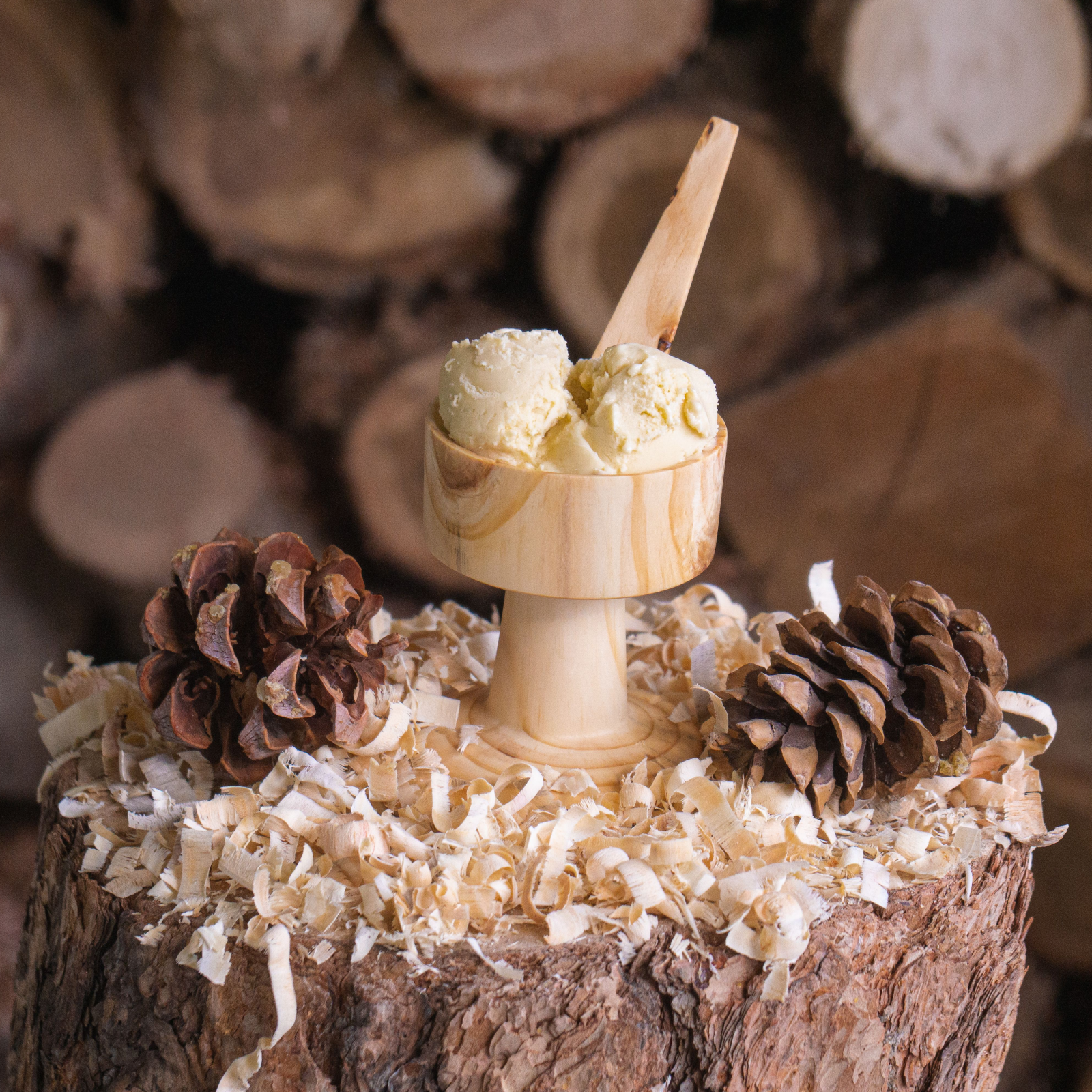
When Justin Davies cuts into a piece of wood, he wonders what it tastes like. Today, he shares his adventures in crafting desserts out of trees, from the bark infusion that made his tongue go numb to the ice cream concocted from an infamously smelly tree. Plus, Lidia Bastianich returns to answer your questions on pasta and pesto; we eat through the backroads of Vietnam with chef Anaïs Ca Dao van Manen; and writer Jenny Linford meditates on cooking’s most elusive ingredient.
Questions in this episode:
"I've been making a lot of fresh pasta recently and have extra egg white left over. I'd love to know a few recipes and good uses for egg whites."
"How do I get a strong basil taste in my dishes?"
"What is the secret to making light, fluffy gnocchi?"
Christopher Kimball: This is Milk Street Radio from PRX, and I'm your host, Christopher Kimball, today we're wandering into the woods in search of dessert. Justin Davies has made a name for himself as a forager who can turn cedar into ice cream and oak into cookies. Plus, later in the show, Lydia Bastianich makes her return to the phone lines. She's ready to answer all of your Italian cooking questions. She'll even share her philosophical take on pesto.
Lydia Bastianich: You know, use your senses. Use your olfactory when you're buying basil, put it to your nose. You know, you have a great machine there that will tell you.
CK: But first, we're getting a taste of Vietnam chef Anais Ca Dao Manen joins me now for her upcoming cookbook. She traveled across the country to experience the full range of Vietnamese cooking. Anais, welcome to Milk Street.
Anais Ca Dao Manen: Thank you for having me.
CK: I’ve been to Vietnam briefly years ago, fell in love with everything about it, especially the food. The difference is, you talk a lot about the North versus the South, so let's start with the North. (Yeah) What's distinctive about the cooking of the North?
AM: Well, I think you know it starts with the climate. The North has clearly four seasons, so obviously your ingredients will be different, and it's also the way I see it, it's the cradle of Vietnamese culture, while the South has gone through a lot more transformation, and it only has two seasons. Monsoon are really hot and dry. So, I think a lot of food starts with ingredients and the weather where they come from.
CK: So, let's talk about some of the recipes. Like, I love recipes where the techniques are different, because, you know, we're all bound by the rigid techniques we learned growing up. And mine were probably mostly French. There was one you cook a chicken leg, and you start by taking a knife and cutting slits in the skin, and then you let it sit in hot boiling water for five minutes, right? So, you want to just take us through that recipe a little bit.
AM: So, I think you're talking about ga roti. So ga roti is actually a play on roasted chicken in French, roti means roasted but, you know, for a very long time still now, Vietnamese people, we don't really have ovens in our kitchen. We don't use ovens. We use live fire and gas, you know, now, air fryer is the newest equipment. People would rather have an air fryer than oven. So, this is their way of roasting a chicken. In Vietnam, we always blanch the meat first, because that will remove the impurities. By either poaching quickly in hot water or pouring boiling water on top of the chicken, you remove the scum. So then whenever you're cooking it, you will have less scum. So, you'll make, for example, a clearer stock. And then when you slit the chicken, is so that it could absorb more the marinade. And then you want to have the shallot and the garlic to flavor your oil while you fry the chicken. But then you want to remove them, because you don't want them to burn (right) and then for me, one of my favorite ingredients in Vietnamese cuisine is coconut water. We have so much coconut water here, and so we use it in everything. So yeah. So, then you use that sweetness, the natural sugar from your coconut and your soy to reduce and glaze your chicken so that by the time your chicken is done, it melts in your mouth, and it has that sweet and salty texture, gooey caramelization on top of it. It's really good with rice, plain rice
CK: It really caught my attention. The other one, I really loved the sticky rice with fresh corn and coconut milk.
AM: Simple, but so good, right?
CK: Rice paper salad. I've never heard of this, so you want to explain this to me.
AM: So, one of the ingredients I think that makes really Vietnamese food Vietnamese is bánh tráng rice paper. We use it to wrap, we grill it so it becomes crispy, and when we use it to dip, and so for this particular dish, I think you're talking about banchan. So, this is like a classic snack. It's very simple. So rice paper dry is pretty dry, right? But then if you mix it with a nice sauce, which is in the book, and a bunch of different things, like mango for acidity, hot mint raw rum, or Vietnamese coriander for like that punch of freshness, peanuts and all this thing, the rice paper absorbed the sauce and suddenly becomes a little bit more chewy, and then, and then you go into this texture play in your mouth, and you have dried beef to go with it, spicy dried beef bakho, like beef jerky, Vietnamese beef jerky. And if you go to in front of a school at 4pm you'll see loads of ladies selling those. And the fun part of it is that you can actually ask them to put whatever you want inside it, and you put it in a plastic bag, and you just shake it, and then you eat it. And it's super easy to share with people or to eat it on the street, you know.
CK: So you've lived in lots of places, Paris, London, Bogota, Brussels, etc. So, what did you learn about cooking outside of Vietnam, you think was actually pretty valuable, even when cooking back in Vietnam.
AM: I think the best part of food is that it's always evolving. Right. When I came back here, I brought what I learned from French cooking, but then I applied to Vietnamese flavor, for example, I would do like a boeuf Bourguignon, but then I would infuse it with flavors that remind me of Vietnamese boca. And then I would serve, instead of serving this boeuf Bourguignon on its own, like this, I would then serve it with a really fresh herb salad on top of it, and with rice that's been flavored with like basil butter and not just plain butter. So, I think as we travel more and as we learn more about different culture, we realize that, yes, there are boundaries, but the fun part of food is to be able to combine things and to be playful, but as well as respectful of other people's culture.
CK: So, you visited the north of Vietnam, and, among other things, tasted some fried tree worms, which you actually liked. Could you just describe that?
AM: Yes. So, while I was in the north, I learned from the villages that back in the days, you know, if you're raising pig or a buffalo, you want to keep it for special occasion, because you didn't really have a place to store it. So, the main protein where smaller animals like chicken, are during autumn, it would be bamboo tree worms. So, you would knock onto the bamboo tree to figure out if would be hollow, and then cut down the tree, take those worm out, and then just fry it in oil and lime leaves.
CK: You knock on it, yeah, to see if it's hollow, yeah, cut the stalk down, and then it has worms in it.
AM: It has to be hollow, that's the thing, (right) Because if it's hollow, that means that the worm went inside and ate and ate it. And, you know, you make a sound. It's like, you know, if we have, like, a wall with nothing behind, makes a different sound, (right) And actually, it's really delicious, because it's crispy and it's a really good protein replacement, you know,
CK: Well, you know, my experience is you can fry anything.
AM: Yeah, I agree. It tastes good. If you don't know what to do with it, just fry it.
CK: There's a folk song, which I'd like you to translate for me. I mean, it's in English, but the chicken squawks and the lemon leaves, the pig grunts. Buy me some green onions, the dog cries sitting and standing, grandma, go to the market and buy me some galangal. What is that folk song?
AM: So, my middle name is Ca dao, and Ca dao, in Vietnamese, means folk song. And these folk songs were passed on from my great grandmother to my mom to teach her the way to cook and as well for the way you pair food. So, in this proverb, the chicken goes with lime leaves. We always pair chicken with lime leaves. And you have Ca dao for everything, for for the way you behave, and as well for the way to live life.
CK: Anais thank you. It's been, it's been a real pleasure. Love the book, and I can't wait to get cooking. Thank you.
AM: Thank you for having me, and I hope we get to meet and cook together one day
CK: Hopefully. Thank you so much.
AM: It's been great.
CK: That was Anais Ca Dao Manen. Her upcoming book is Vietnam the Cookbook. This is Milk Street Radio. I'm your host. Christopher Kimball, right now. Lydia Bastianich is back. She's returned as our guest co-host to take more of your Italian cooking calls Lydia, by the way, is a restaurateur, cookbook author, also host of Lydia's kitchen on public television. Hello, Lydia. Thanks so much for being with us again, here on Milk Street.
Lydia Bastianich: Oh, my pleasure being here.
CK: Before we get to the calls. I do have a question. Now, I was in Rome a while back, and I was in a. Restaurant, and we made rabbit cacciatore. Now, white wine, lots of vinegar. I mean, a whole bunch of it, rosemary, garlic. It was great. Now, a lot of cookbooks, when you look up chicken cacciatore, it's, you know, Hunter's chicken with tomato, et cetera. But I don't think it was originally tomato based, right?
LB: I love rabbits, so I'm glad you're asking me this. No, it doesn't have to be tomatoes. You know, tomatoes only came to Italy after the discovery of America. So, what did those Romans eat? What did you know? They ate Cornelia and Bianco in white vinegar. They used wine. They use absolutely but rabbit, my grandmother, when I was a young child, you know, after World War Two, she had all the foods around the courtyard. We had chickens, we had ducks, we had two pigs, and we had rabbits. And I would go out and forage for clover for the rabbits, because they loved clover. Then Sunday came and one would end up in the pot, and it was usually lots of rosemary, garlic, onions too, and vinegar. Absolutely, it was in a kind of white sauce that turned out a little bit brownish, although now the addition of tomato paste is common in my area. In the north area, not so much a lot of tomato but you know cacciatore. Cacciatore means a hunter. So, it just means any animal that the hunter caught made in his style, whatever the style, whatever they had around the house, whatever herbs they have, Rosemary, bay leaves, or whatever. I think that that's what really Cacciatore means.
CK: Yeah, I just thought the vinegar, rosemary, garlic white wine version was so much better, and goes really well with game, right? Because you want something, yes, you know, a little acidic to go with a darker meat, and much better than, like a restaurant, sometimes it's kind of almost a sweet sauce with sweet peppers and tomatoes, and I just don't think it's as good. But anyway, that was just my opinion,
LB: Right, right. I like it in its natural sauces with vinegar. You know. Now, rabbit meat is lean meat, and it's, (yes, it is), yeah, it's lean meat, and it absorbs in the acidity of the vinegar and whatever, so it gives it a lot of flavor so, we have to get rabbit on the menu more.
CK: Yeah, I rabbit hunt every winter, and we have a big game dinner, and I absolutely agree. So, let's take a few calls.
LB: Welcome to milk Street. Who's calling?
Caller: Hi, my name's Sam.
LB: Hi, Sam, where are you, Sam?
Caller: I'm calling from Spain. Although I am a British, Australian, American mongrel
LB: I hear a little accent there. I was wondering. Well, welcome, welcome. What is your question?
Caller: I've been making a lot of fresh pasta recently, and anytime you make fresh pasta, you end up using a lot of extra egg yolk. So, I have all of this extra egg white leftover because I'm using the egg yolk. I've tried a few dessert recipes and things here and there. And I'd love to know a few more recipes and good uses for this egg white. I know I can freeze it, but I guess I'm wondering if there's anything that maybe I haven't thought of outside the typical kind of meringue and, you know, almond Italian desserts. I can't remember the name of
LB: Oh, Sam, absolutely. There’re so many things you can do with egg whites. You know, if we go to Italians, you know, we make perone, we make bruti magoni cookies, those wonderful cookies that are very crunchy with whole hazelnuts in there. And they're so simple, just egg whites whipped a little bit of sugar, and you fold in the toasted hazelnuts, and it's delicious. Meringue cookies, pies, an almond pie down in Puglia, you know, you make like a regular crust, and then you make a meringue, and you put toasted almonds in there, just a little bit of flour to give it some body, and you have this meringue pie, which is delicious. So, meringue frittata, you know, all egg white frittata, by all means, with all the vegetables, you can also whip the egg whites and toss them in a stock, you know, like stracciatella. Stracciatella uses the whole egg. But, you know, some people are conscious about it, and they like the egg whites. Whipping the egg whites with some spinach, some cheese, grated cheese in a good stock, and you have yourself egg white stracciatella. But you know, in making dough, the region of Italy, that is really the epicenter of dough is Bologna, the city, so Emilia Romagna, and they make a dough, which is the supposedly supreme of pasta dough is egg yolks and flour as much as flour that egg yolks will take. And that's the whole answer. You don't need anything else in there, and it's very rich. But I prefer, I like whole eggs, the egg yolks dough It breaks. You know, you can't very well make a lot of stuffed vivioli, or you cannot roll it out as easy as you can. So, using the whole eggs in making pasta is what I would recommend, so you don't have that much of egg whites left. Chris, do you have any addition to that?
CK: I do. It's really obvious which is angel food cake, but with a twist, I was speaking to, I think, Stella Parks, and she said, when she made Angel food cake, she doesn't like the texture of regular angel food cake, so she greases the sides of the tube pan so the cake doesn't rise all the way, it kind of collapses on itself, and she feels that that's like a vastly superior cake. So, you might give that a shot, because it's a little more textured. There's more going on in your mouth. It's not quite as airy. So, if I had egg whites left over that's probably what I would do with them
Caller: Wow
LB: So, I have another idea for egg whites and dessert, you make piles of meringue, like little rounds of meringue on parchment paper, and you bake it, until its nice and crisp. And then, especially when the fruit is in season, I had it with apricots. So poached apricots and plain whipped cream, and you layer it. You layer the meringue, nice, some whipped cream, some poached apricots, some meringue on top, and the meringue acts like the layer cake in between, and it is delicious
CK: And marshmallows. I just thought I mentioned I've got a couple young kids running around, and that would be probably my eyes used for egg whites.
Caller: That's fantastic. Thank you so much for so many ideas. I absolutely love the podcast, and I really appreciate everything, and I'm very excited to try things out and let you guys know how it goes.
CK: Pleasure. Thanks for calling.
LB: Bye Sam
Caller: Thanks bye
CK: Lydia, I have this thing about egg whites, which is, unless it's savory, I always add some sugar to them, because you get a much creamier, more stable foam. Do you always do that?
LB: No, yeah, cream of tartar, it's what I usually use if I'm going to make a dessert or something, of course, sugar, but otherwise, I put a little tartar.
CK: I find if you beat egg whites without either lemon juice, cream of tartar or sugar, they're thin and foamy and they easily fall apart on you, right?
LB: Again, you know those cell the incorporate the air in it, and they under heat, they sort of pop open and it falls down. That's what happens to a cake that falls down. So, if you add either the sugar or the little bit of lemon or the cream of tartar, keeps that kind of bubble of air stronger. You know, sometimes you know that, Chris, when you do things, cooking is a lot about common sense and the feel at the moment. So, you know, you feel okay the egg whites are at the right moment. I like them like this. I'm going to add them, and you just do it. So, yeah, that works.
CK: Just do it. There you go. I totally agree you're listening to Milk Street Radio. Special thanks to Lydia for joining me on the phone lines. She'll be back later in the show coming up next how to eat a forest. Hey, Milk Street radio listeners for this year's Thanksgiving episode, Dominique Ansel is joining me to solve your biggest Thanksgiving baking questions. If you need new recipes, new inspiration, or maybe a pie making tutorial, email us at questions at Milk Street radio.com. Again, please send your Thanksgiving baking questions to questions at Milk Street Radio.com, and we'll be in touch. Thank You. This is Milk Street Radio. I'm your host, Christopher Kimball, right now it's my conversation with Justin Davies. Justin is a woodworker and a forager who has grown quite a following for turning trees into dessert.
Justin Davies: Today, I'm tossing some chunks of ponderosa pine bark into a pot with some cream, because these trees famously smell a lot like butterscotch vanilla or baked goods. And of course, I had to find out, does it taste as good as it smells? No.
CK: On social media, you'll find Justin showing off recipes he makes with trees as well as the bowls and spoons he carves out of the wood.
JD: This is a pretty piece of ponderosa pine. We got all this nice gray spotting in here.
CK: Justin, welcome to Milk Street.
JD: Hey, Chris, thanks so much for having me
CK: Here's a little quote from you “not knowing the names of these plants that are native to our own backyard causes this deep sense of loneliness and sadness”. I was really struck by that. I I spent a lot of time in the woods, and have had a sugaring operation for years, and I always walked through the woods going like, you know, I don't really know these trees too well. But why loneliness and sadness?
JD: You know, this is, it's interesting. This is a term that I borrowed from the great Robin Wall Kimmerer, you know, she writes about this at length in her book Braiding Sweet Grass and some of her other works. It was one of those mind-blowing experiences for me where I was like, oh yes, that is exactly what I was feeling. I was feeling a deep sense of loneliness. For me, it kind of stemmed in this one particular experience I had where, you know, I'm from Utah, I spent a lot of time in the mountains. And just, you know, probably about seven, eight years ago, I was doing a lot of trail running, and I had this experience where I was out on a training run one day, and I was pushing really hard up this pretty steep climb, and came around to switch back and and saw this tree that I'd probably seen this specific tree dozens of times, and this species of tree countless times. And I walked up to it and paid attention to it in a way that I hadn't before, you know, I plucked some of its leaves. I kind of patted its trunk and felt the density and heaviness and strength of its of its wood, and I just couldn't shake that feeling of sadness that I didn't know what this was called. And as Robin Wall Kimmerer writes, we're meant to know the names. We're meant to have an intimate familiarity and relationship with the plants that grow in the places we call home.
CK: Well, in my opinion, humble opinion, even if you're an outdoor enthusiast, you go through nature, right? (Yes) you don't actually stay in nature. And so, I you know, sometimes a red maple and a sugar maple, it's not quite so clear. So do you find you can actually identify trees pretty accurately. Or do you come across trees where you're not quite sure?
JD: Oh, I'm still learning, definitely. I mean, this first experience started a curiosity for trees that began this very long and winding road that led me here. But there are tons of times where I come across something new, and I say I have no idea what this is, and I find that to be really exciting, because, again, that's just another step toward curing that, that feeling of loneliness, right?
CK: Okay, so you get the idea about eating trees, Yeah, but why? There are so many things you could taste in nature, right? There’re spices or things that grow on the ground. They're flowers, their plants. Why the notion of the flavor of trees, which is at the heart of your project?
JD: Yeah, I think it just captured my imagination. As I was reading about these different species of trees, I was constantly surprised that some of these trees were actually edible. You don't tend to think of trees as a source of flavor or food. For example, reading about spruce trees and spruce tips specifically, and seeing those bright green neon tips that grow out every summer, and had never once thought, hey, are those edible? What do those taste like? And I pluck one off and pop it in my mouth, and I'm really blown away by the flavor of it. I didn't expect a spruce tree to have a bright, lemony sour flavor. That was not what I would have expected to come out of that.
CK: Okay, so you decide to make ice cream, and then the bowls to eat it in and the spoons out of the wood. One of the ones you did was Magnolia ice cream, which was one of the more interesting ones. So, tell me how you make Magnolia ice cream. There were just three parts to what you did.
JD: You know, I generally will pick a tree for that episode and say, okay, I know Magnolia flowers are in bloom right now. So, first step, cream base, let's take some Magnolia petals, just steep it in some cream, and that's pretty straightforward. The trick then becomes, what do I do next? And I like to find ways to incorporate that tree in additional and perhaps unusual ways, like when I did white oak ice cream. I steeped the wood in the cream, and then I gathered some acorns and processed the acorns to make them more palatable and then candy the acorns and put them in there with the Magnolia it's a little less apparent they don't grow an edible fruit or nut. So, what I did then was try to think of, well, what might mix into this ice cream really nicely, what might match that kind of gingery botanical flavor of Magnolia petals. And fortunately for me, there's a very thriving and prosperous community of foragers online. Alexis Nicole Nelson, the black forager on the internet. She's wonderful. She has a recipe where she makes Magnolia ginger snap cookies. So, I thought, okay, that sounds really nice. A cookie crumble, add the reserve petals from making Magnolia syrup, and, you know, I think it's going to taste nice, but that's the fun part for me, is tasting it on camera for the first time and seeing what, what, what I developed.
CK: Okay, so the worst one you made was this Bradford pear ice cream. You described it as it smelled like fish and trash. So, it's such a surprising pivot. So, what is a Bradford pear? I've never heard of it.
JD: If you've never heard of a Bradford pear, you Bradford pear, you've certainly seen one. These are the preeminent suburban tree in the United States. So, they do bloom in these spectacular white blossom, showy white blossoms, but they have an unmistakable odor, and that's what people really associate them with. They they smell like different things to different people, I smell kind of a fishy, garbagy smell, a lot of other people, for lack of a better term, smell, a boy's dorm room, I guess you could say, but yeah, they have a very unmistakable odor, and they become kind of the pariah of the tree world.
CK: So, since they smelled terribly, you thought you should make ice cream out of it as the ultimate challenge, or what?
JD: Yeah, yeah. I mean, this is to be quite honest. I was very confident that that was going to taste at best, like nothing, and at worst, pretty bad. But I knew that, because people have such strong opinions about this tree, I knew I had a hit video on my hands, and so for lack of a better expression. I was doing it for the views.
CK: You know, we talk about steeping magnolia leaves and ice cream or pine needles, but you said you steeped wood chips. So, does wood actually transmit flavor to cream?
JD: Oh, absolutely. Think of adding like oak chips to a batch of wine or mead. Why not try ice cream? I'm working on a spruce tip ice cream right now, and the mix in I'm making for it, I'm trying to make spruce bark flavored graham crackers to kind of make a key lime pie inspired ice cream with spruce tips. And I've been making spruce bark syrup, so spruce bark water overheat. And just yesterday, I tasted it, and it made my mouth go numb, which was kind of a surprise. And I looked it up, and apparently there are all these volatile compounds that can become extracted, nothing toxic, but can make your mouth kind of go numb. So now I've got some spruce bark in room temperature water going for a cold infusion. So that's the type of stuff that's been really fun to to learn more about. I'm not, I'm not trying to develop these recipes for mass market appeal or to find the next great thing necessarily. I just personally love sharing the journey of you know, I'm cutting into this piece of wood. It smells really interesting. I wonder what this might taste like as ice cream.
CK: Well, I think that the bowl you made for the Magnolia wood was, you know, forget about the ice cream for a moment. That was extraordinary looking. It just had that wonderful it's sort of like some some maple you get that. Is it spalted? Is that what it is?
JD: Yeah, spalted wood is wood that has some sort of fungal infestation in the wood, and those different types of fungus will react to different species of woods in different ways. So, a maple is a classic example of this. This Magnolia piece did a similar thing, where you can get what are called zone lines, where the fungus creates these black lines in the wood. So, it's just really fascinating thing. This is kind of what drew me into woodworking to begin with, very similar to recipe crafting. I think these are two sides of the same coin for me, where I'll grab a piece of wood and I just can't wait to cut it open and see what's inside of there. You know, nature being the ultimate artist.
CK: Are you, are you religious, or is nature your religion, or both?
JD: Yeah, this is a great question. I was raised quite religious. You know, I'm from Utah. I was raised Mormon, and then left the Mormon faith probably 12 13, years ago now, and I definitely think that I felt a deeper connection to nature than I ever did to the religion I was raised in, and that became a real part of my new my new connection with the universe and my place in it. I found a deep sense of understanding and connection through the inner connectedness of all things in nature.
CK: You walk through the woods now, do you feel like you have a quote, unquote relationship with the trees, or more of a familiarity with it? Is there something spiritual about this experience for you? I'm not. I'm not making a joke it’s a serious question.
JD: No, no, that I listen you're you're asking my kind of question there. I think absolutely for me, I do feel a deep connection with trees and with nature, and I think the more I've learned, it's just continued to deepen that relationship. And I've had very powerful experiences with specific forests and with specific trees.
CK: What do you mean by those experiences? What powerful experiences?
JD: Yeah, you know, I had one in particular that is just coming to mind right now, where I quit my job in 2021 it was, you know, pandemic times. I was one of those people where I had been working in this career for a while and never felt really fulfilled by it. Never really understood what I was doing there. And in a fit of burnout, I quit my job with no real backup plan. I didn't quit my job to make videos on the internet about trees and make tree ice cream that came much later by accident, but I just knew I needed to do something different, something that felt more aligned within myself. And I took a trip down after quitting my job, I took a camping trip, I loaded my dog in my truck, and I drove down into the middle of the desert in central Utah, this area called the San Rafael swell and pitched a tent underneath this giant old juniper tree. And I think that ancient old juniper trees there's a power and magic to these, these plants. You know, you're sitting there in this extremely desolate place, and you don't see water for miles, and it feels lifeless, and you look around and here are these giant trees, and I felt this real connection with this one particular old juniper tree that I was just kind of climbing up in and hanging out with that, it was telling me, like, look at me. I'm out here in the middle of this desert, and do I not look like a perfect work of art myself? Like, if you were to pluck me out of the desert and put me in a gallery, would I not be a perfect work of art? But I'm not sitting here concerning myself with whether or not people think I am or am not, I just am. And anyway, this was an experience I had that felt very powerful in that moment, and kind of gave me the courage to keep going down this path.
CK: Justin. It's been a great pleasure. I will walk through the woods a different man. Thank you so much.
JD: Thank you so much for having me.
CK: That was Justin Davies. His TikTok account is Just in the Trees. To see photos of Justin's bowls, spoons and tree flavored ice creams, please head to Milk Street Radio.com. You're listening to milk Street Radio coming up How to bend time In the kitchen. Hi, I'm Christopher Kimball, and you're listening to Milk Street Radio. Lydia Bastianich is back on the phone lines, and it's time for us to answer a few more of your cooking questions.
LB: Welcome to Milk Street. Who's calling?
Caller: This is Carrick. I'm calling from Gilbert, Arizona.
LB: How can we help you?
Caller: So, for many years, I have been trying to get a good, strong sense of basil in my dishes. I've gone to many restaurants and had a great taste of basil in sauces and other dishes. For whatever reason, when I make a sauce at home, I've tried putting at the beginning, putting it at the end, and I just can't seem to have a very strong taste basil in my sauce.
CK: Lots of thoughts. First of all, I have the same problem the basil I buy. When I open the package, I get a faint whiff of basil, you know. Oh, I mean, you should get this powerful blast. And my guess is that if you're in Calabria or some other part of Italy, the basil just has a lot more flavor. Secondly, when I was in Calabria a year ago, they just add a couple of two or three leaves at the very end. And it's not really adding a tremendous amount of flavor to the, let's say the sauce, but it's there. It just says a little bit of aroma when you serve it. The other thing I've noticed is basil really needs to be bruised to bring out the flavor. So, if you see someone making a pesto in Italy, and Lydia can confirm this, probably, you know, it's a mortar and pestle usually, right? Because they're bruising the leaves. And if you throw them in a food processor, it's not really the same. So, rolling the leaves, bruising them with your hands to help develop flavor before you cook with them, I think helps. But the big problem is, the basil you're getting a supermarket is just, you know, grossly inferior to the real thing. I mean, Lydia, what do you think?
LB: Yeah, absolutely, it's choosing the right basil. Now, you know, there's so many different varietals from the small, tiny leaves that's version of leaves that's very much used for the pesto, and it's not found readily here. But you know, use your senses. Use your olfactory when you're buying basil, put it to your nose. You know, you have a great machine there that will tell you. And then, of course, keeping it fresh in the house, just like flowers, putting it in water the refrigerator doesn't do justice to basil. It gets it black. And secondly is that, you know, the essence the flavoring, is captured in oils, and once you introduce it to a hot medium, the oils expand, the aromas flow out. That's why the kitchen smells so good when you're cooking, but a lot of the aromas are floating in the kitchen. So how do you keep that in your food? Use all of the basil. What I do is, when I'm ready to cook, I pluck off the leaves and leave them. But I use the stem. I throw it in the sauce, the whole stem. Don't cut it up, so you can pluck it out. Also, keep in mind, you know that the stronger the flavors in the sauce, Puttanesca has olives, has anchovies, they'll mask more the basil. So, if you feature the basil more, you will get more out of it. I think what Chris said, don't trap it, because trapping it you lose a lot of the oils right on the cutting boards. So, at the end, when you're ready, rip it right in your sauce. Give it a mixture. Put the pasta in. Save some for the end, for the topping, mix it quickly. Put the cheese, plate it and whatever. When you're plating it, use the rest of the leaves and just break them on top of it. That's when it really happens, because you have it three folds in there.
Caller: I really appreciate that tip. I will tear and use the stems.
CK: But the first thing is, don't buy lousy basil. Kind of hard to resuscitate basil that never had flavor to start with so
LB: Exactly Carrick thank you very much for your questions.
Caller: Thank you so much, and I'm looking forward to trying these in my next sauce
LB: All right, have a good time.
CK: Take care.
Caller: You too. Bye.
CK: This is Milk Street Radio. If you need a hand in the kitchen, we're always here. Give us a call. 855-426-9843, that's 855-426-9843, or just email us at questions at Milk Street Radio.com. Welcome to Milk Street who's calling?
Caller: Hi Chris. My name is Joan. I live in Greenwich, Connecticut.
CK: How can we help you?
Caller: I've always been interested in making gnocchi. I hope I'm saying correctly, even though I'm Italian, I wanted to know how to make light, fluffy ones versus the heavy lead sinkers that make you feel like you can't move after you've eaten them. I know that the prepackaged ones are made with potato flakes, where the homemade ones are made with fresh potatoes. I would like to know what the secret is to making great gnocchi, which potatoes are the best ones to use, and how involved the process actually is.
CK: I've made it three different ways with potato from scratch. It's not hard to do you cook like a russet, not a waxy potato, and you just add flour, and you mix it up, etc. The other way was with potato flakes, which is sort of a cheaters gnocchi. We've done that at Milk Street. I don't think it's as good as the real deal, but in a pinch, you could do that. But the one that really intrigued me was in Calabria, where they made a hot water gnocchi, which is flour and hot water (oh wow) and yeah, it's not going to be as light and fluffy as the others, but that was just another technique I never heard of. But let me turn this over to Lydia, who probably has a better answer.
LB: I was waiting for Chris's responses.
CK: Yeah, I'm sure you were.
LB: You were pretty close, Chris. (Thank you) Gnocchi, I use whole potatoes flakes and whatever else you guys want to use. It's okay, but. I use potatoes, russet, starchy potatoes, absolutely I boil it in their skin plenty of water. I test it with a fork. When it goes through. You can do it in the microwave if you want, but I like the skin on. And then I let it cool a little bit, and I peel it, I let it cool again, and that's when I rice it. But I rice it still warm, and I rise it right on the granite tap, or the marble or whatever. Wooden is fine too, but I find that the granite cools off the potatoes quicker. So, I spread them out. I take a fork, I don't sort of press it down. I want it to remain fluffy, and I spread them out a little bit of salt, still warm, so it takes in the salt, and I let it cool completely. The secret is, right there, you let it cool, because a lot of the water evaporates. If you don't let it all evaporate. If you don't let it cool, it will require more flour. The more flour you add, the more you need, the tougher the gnocchi come. So as little flour as you can to bring it all together, you know, I put an egg, I whisk an egg, and you can put some grated cheese, and you can put whatever, you know, little spices in their nutmeg, if you like. But simple gnocchi, straightforward, you whisk two eggs. When it's cool, I sort of drizzle the eggs all over, and then I take the flour and I sprinkle the flour and begin with a dough scraper to sort of pull it off and mix it the least kneading that you do, and the least flour to hold together as a dough, and it will stick a little bit in your hands, and that's okay. You kind of put some more flour, and you rub it off. As you go along, you will incorporate more flour,
Caller: Probably better less than more, because you can always add
LB: Exactly. It is also important that you have abundant water, more than regular pasta, because it is very floury and because the water temperature will go down, and then the gnocchi will settle low on the bottom, become mush. You want the boiling of the water to continue as you're cooking the gnocchi. So even cook it in two batches, you know, you fish it out with a spider, and then you put a little sauce, and then you continue the next. The secret in good gnocchi is not too much flour. Don't knead it too much. And you make sure that the water, when you're putting to cook, there's enough water so it retains its boiling point, or at least comes back very quickly to its boiling point.
CK: It sounds like Joan you just got a complete cooking class in gnocchi. I just want to say
Caller: I rather go to Lydia's house and eat it.
CK: Good point
LB: So, you feel confident now you're going to get in there and make good gnocchi’s (no) No, no, no,
Caller: I’ll give it a try. I think it's a cultivated art.
LB: You have to try it. You know, it's okay if it doesn't happen the first time. But just think about Lydia being behind you and telling you these things. And you do it, you do it once, you do it twice, you'll get it. I know you will
Caller: Okay. I'll let you know how it goes.
LB: Okay Joan.
Caller: Thank you.
CK: This is Milk Street Radio special. Thanks to Lydia Bastianich. You can learn more about her TV shows, cookbooks and line of pasta sauces at Lydia's italy.com. Now it's time for my conversation with author Jenny Linford on the importance of time in cooking. Jenny, welcome to Milk Street.
Jenny Linford: Thank you so much. I'm thrilled to be here.
CK: You say you're talking about the role of time in food and flavor. You say time's relationship with food is multifaceted and complex, extending far beyond the right cooking times for dishes. So just in a nutshell, what does that cover?
JL: A lot. I mean, I think you think about, yes, it's a big subject. So, if you think about time as the universal, invisible ingredient in the food that we grow, make and cook. It just gives you a sense of actually, how huge time is. When I first started thinking about time, I did start thinking about it from the point of view of cooking times. But the more time I spent thinking about time, I would say it just goes way beyond that, because you have the time that's gone into, let's say the growing of a crop. You have the time it takes, you know, a fruit, to ripen. You have the time it takes to rear livestock, but we say fight the effects of time, because time destroys food. You know, as human beings, we preserve foods in order to make it last against the deteriorating effects of time. So, it just, it's very multifaceted. I would say.
CK: Well, it's almost seems like our cultures have two opposing views, old and slow, young and fast, right? And so, you have the world of social media, which is infinitely fast. And then you have the. World of Iberica hams and slow food and other things but sometimes grilling which is quick is just as good as barbecuing which is slow. So, I guess my question is, is fast always a problem, or is it a case-by-case situation
JL: Yeah. I mean, in a way, what I was trying to say to people was, it's like, the right amount of time, (yeah, that's a good point.) You know, it's something to think about when you're with food. So, I looked at that question of, you know, the cachet that time has that we automatically think, oh, you know, an older Parmesan is getting better than a younger one. But the parmesan importer I spoke to he was like, Look, you know, no, I don't want it to be too old, because I want that milky sweetness, you know, from when it's a bit younger. And equally, the whiskey guy's an amazing, very dynamic whiskey man. And he was just like, it's up to people what they like. You might really enjoy drinking a younger one, you know. So, so it's quite interesting. There was a real flexibility, actually. And I think that's what I think that's what I just wanted people to, perhaps, to think about time.
CK: So, let's think about hanging meat. You know, you read the old books, and there, you know, they go on a pheasant hunt or something, and they hang it for three or four days, until it falls off the string, or whatever, and then it gets moldy, and you have to trim off the mold. But as you point out that that actually has a lot of massive benefits for flavor
JL: And texture. Yeah, yeah. I mean, it's interesting, because hanging meats is a big part historically in Britain. I mean, it's particularly for beef, and it really and it is, you taste the difference. You know, if you eat a piece of supermarket steak that sort of bright red and bloody. It's got that really metallic taste of blood, actually. And then, if you eat, you know, piece of beef from carcass that's been hung, it won't have that really immediate irony flavor. It'll have much more complex savoriness to it and a nicer texture, and just be a more rewarding experience, I mean, yes, and a more expensive experience with that, you know, because time is money, and so the hanging of meat takes time. The carcass shrinks, you know, because it's done in quite a cool, dry atmosphere. And they will, there'll be a loss, because they'll have to trim off the bits around the edge, you know, where it's got too moldy, whatever. But the meat will be tender and filled with flavor. And that is quite exciting.
CK: So obviously, starting late 19th century, you know, women were spending nine hours a day in the kitchen, just cleaning a coal stove every morning was a horrific job. And going back to the 1880s there was large movements or communal kitchens or anything to get out of the drudgery of of all those hours. And that's why convenience food, starting in 1900 were immediately accepted. But obviously there's been a reaction to that with slow food and other things. Do you think that there is a real anti fast movement, a real slow movement in the way people actually make decisions about how they want to live, or is that pretty much all talk?
JL: I think it’s; it's a mixture. I find. I meet young people who enjoy the making of food. There's a sense of pleasure in this idea of making something for real and putting the time. So, I think there is a sort of a sense that people crave that connection. That's all reality. Which food, of course, you know, is very real and we eat, it becomes part of us. There's sort of this serality, I suppose to food. But I think, you know, the overall trends are against slow because we live in a world, as you said, such a speeded-up world, you know, the takeaway culture of having food delivered to your door. So, my son and his girlfriend, they love having takeaways delivered. That for me, was never something that I would have particularly wanted to do if I would have wanted to go out for a meal, if anything.
CK: And by the way, takeaway food, I just have to say it, it just it never tastes good (I agree) I've never had good takeout.
JL: I concur with you. I'm it’s like why, and, you know, you're right. You know, making food was a lot of work, and often it was women's work. So, I do understand that the joys of having food that's accessible and quick, but there is also a joy, I think, to be had if you enjoy cooking. There is something really lovely about taking the time to make food, you know, I love having friends over, and I love thinking, what should I make for them? And you know, putting some time and thought and care into it, into making a meal, I think they'll enjoy making that. I find, you know, I enjoy that process, and I enjoy watching the pleasure that it gives them, and that sort of connective power of food, you know, which is very different from if I just got everyone over and ordered a ordered a takeaway. You know, there's sort of a pleasure from the reality of cooking.
CK: I just think time is interesting, because it just kind of depends. Sometimes, on the weekends, I cook a lot on a Sunday, especially, and I go out of my way to be slow. You. Like, I'll go get one spice out, and then I'll dither around. I'll get another thing out. I'll chop a couple onions. I just revel in the total inefficiency of the process. No, it's true. I just like, if it takes me four hours to make a one-hour recipe, that's fine, because I can drink quite a lot of wine in the four hours. So yeah, I think we focus too much on fast
JL: Quite because time is so complex. I just try to, in a way, to try and say to people, there are lots of different times. And you can, you know, it's like, you know, think how quickly the Italians cook pasta al dente, you know, beautifully. And it's so quick, you know, and you can have a wonderful meal in minutes, spaghetti with garlic and olive oil and dried chili. You know, gorgeous. You know, industrialization sucked the time out. It made people actually very efficient. And then, you know, what I have seen in my own career as a food writer is the rise of an artisan food movement in Britain, and people, you know, into enormous trouble to make something they're really proud of by putting time and care and with the right amount of time, and not saying it's not just like you know, time for no reason, time for a meaningful reason, to make something that tastes good and that's quite exciting to see.
CK: Jenny, thank you so much. It's been a real pleasure having you here on Milk Street. Thank you.
JL: Oh, thank you, Chris. A great pleasure for me too. Thank you so much.
CK: That was Jenny Linford. She's author of The Missing Ingredient, the Curious Role of Time in Food and its Flavor. That's it for today. Don't forget, you can find more than 300 episodes of Milk Street Radio at Milkstreetradio.com, or wherever you get your podcasts. By the way, we put together a collection of our all-time favorite recipes from Milk Street. You can find that collection at Milk Street Radio.com also find us on Facebook at Christopher Kimball's Milk Street. On Instagram at 177 Milk Street. We'll be back next week with more food stories and kitchen questions and thanks, as always, for listening.
Christopher Kimball's Milk Street Radio is produced by Milk Street in association with GBH co-founder, Melissa Baldino, executive producer Annie Sinsabaugh, Senior Editor, Melissa Allison, Senior Producer, Sarah Clapp, producer, Caroline Davis, Assistant Producer Mari Orozco, additional editing by Sydney Lewis, audio mixing by Jay Allison at Atlantic Public Media in Woods Hole, Massachusetts. Theme music by Toubab Krewe. Additional music by George Brendel, Egloff, Christopher Kimball's Milk Street Radio is distributed by PRX.
ADVERTISEMENT

Simple, Bold Recipes

Digital Access
12 weeks for$1
- EVERY MILK STREET RECIPE
- STREAMING OF TV AND RADIO SHOWS
- ACCESS TO COMPLETE VIDEO ARCHIVES

Insider Membership
12 weeks for$1
- EVERYTHING INCLUDED IN PRINT & DIGITAL ACCESS, PLUS:
- FREE STANDARD SHIPPING, MILK STREET STORE,
to contiguous US addresses - ADVANCE NOTIFICATION OF SPECIAL STORE SALES
- RECEIVE ACCESS TO ALL LIVE STREAM COOKING CLASSES (EXCLUDING WORKSHOPS & INTENSIVES)
- GET YOUR QUESTIONS ANSWERED BY MILK STREET STAFF
- PLUS, MUCH MORE

Print & Digital Access
12 weeks for$1
- EVERYTHING INCLUDED IN DIGITAL ACCESS, PLUS:
- PRINT MAGAZINE SUBSCRIPTION
- 6 ISSUES PER YEAR

