





Your email address is required to begin the subscription process. We will use it for customer service and other communications from Milk Street. You can unsubscribe from receiving our emails at any time.
Episode 912
May 29, 2025
May 29, 2025
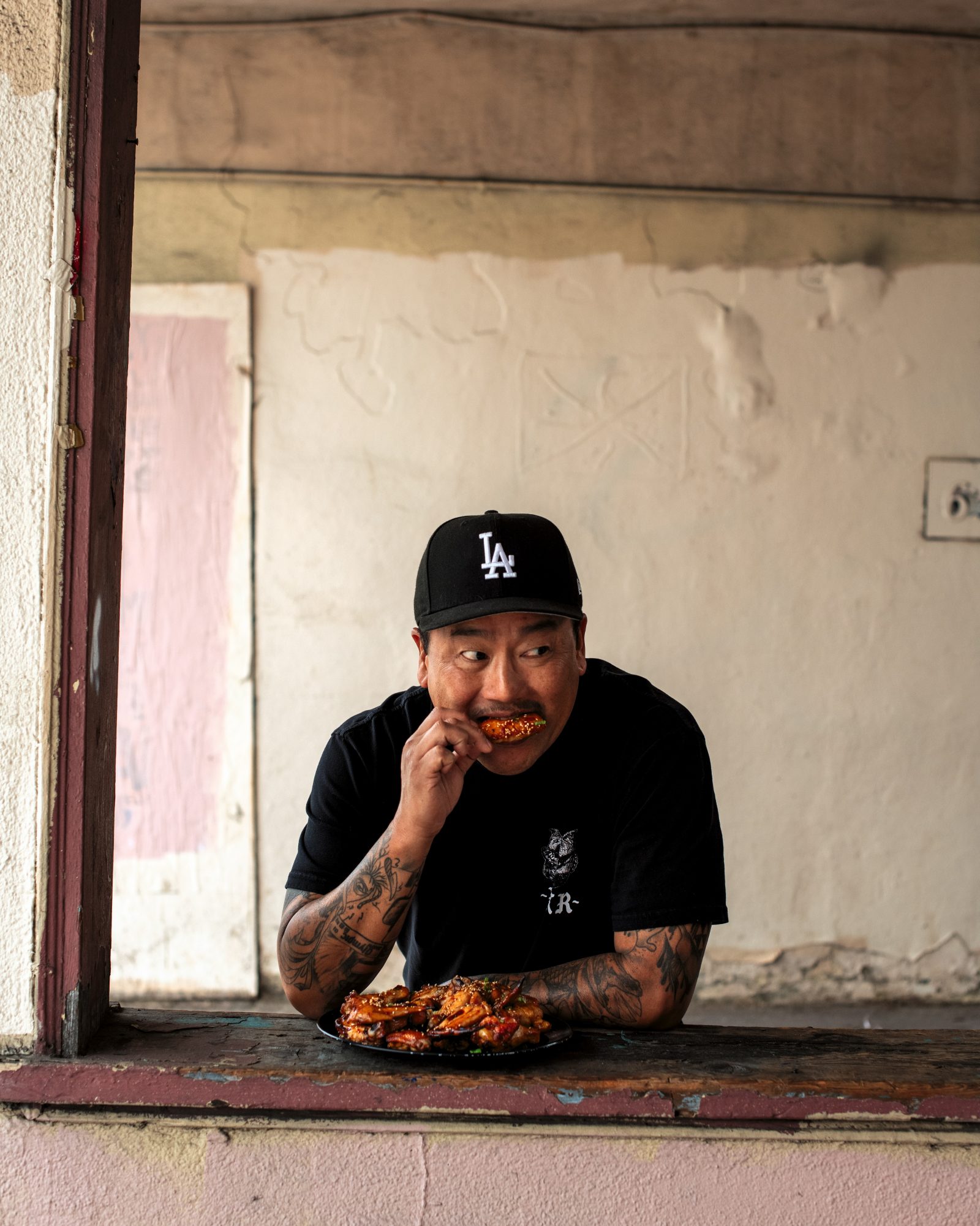
LA's Food Truck King: Up Close and Personal with Roy Choi
In 2008, Roy Choi was fired from his big restaurant job and ready to give up—then he started his food truck, Kogi. He joins us today to discuss the making of his now-legendary food truck, how he taught Jon Favreau to look like a cook for his 2014 film “Chef,” and why there's poetry in lowriding around LA. Plus, we hunt for clams, eels and anchovies with sea forager Kirk Lombard, and Chris and Sara Moulton take your calls—what constitutes the middle rack of the oven, how to make the perfect toum, and much more.
Questions in this episode
"What constitutes the middle rack of the oven?"
"I'm calling back with an update about my lemon meringue."
"How do I get rid of sandy broccoli?"
"I use gelatin sheets but most recipes call for gelatin packets. Do you have any tips on how to convert between the two or should I get rid of the sheets?"
"How do I avoid separation when making toum?"
Christopher Kimball: This is Milk Street Radio from PRX, and I'm your host. Christopher Kimball, our guest today, Roy Choi has done it all. He's worked in michelin star kitchens, launched world famous food trucks and hosted TV. But Roy says he sometimes misses simpler times
Roy Choi: All I woke up to do man was like, crease my jeans, crease my T shirt, polish my rims, figure out what tapes were in rotation that day. Have a milkshake and a carne asada taco and just cruise till the sun went down. That's it man.
CK: Cruising LA with Roy Choi that's coming up later in the show, but first, it's time to answer your cooking questions with my co-host, Sara Moulton. Sara is, of course, the star of Sara's weeknight meals on public television, also author of Home Cooking 101.
Sara Moulton: Chris, before we take a call, I've a question for you, how often do you add wine or beer to a recipe?
CK: I never cook with beer, and the only time I'd add wine is I would, in a sub simmer, take a bottle of wine, reduce it way down, and then I would use that near the end to fortify a sauce. But I would never in a million years, pour a bottle of wine into a pot and cook. we've tested this at Milk Street the meat ends up drying out. It gets really nasty, and the wine turns into this kind of vinegary, really unappealing liquid. I mean, the best thing to do is to reduce wine down, freeze it in an ice cube tray, whatever, pop them out, and then you can use them at the end, and then it's great. But I just don't understand these recipes. When you throw a bottle of wine, like for covid or something, I've never seen it turn out well.
SM: Well, what I was really thinking of, because you know how I'm so French in my training, is when you're making a pan sauce, and sure, you know. So, I tend to use wine a lot.
CK: I do that if I want to make a quick sauce, like roast chicken a lot. So, yeah, I'll get a little wine, a little butter, a little herbs, (maybe some shallots) some shallots, and, yeah, that's a good use of, you know, and it adds a nice cup of wine or quarter cup of wine, yes. But the whole thing about a bottle of wine in braising, I must be missing something, because it never works well, in my experience,
SM: No, I reduce it the way you said so too. I mean, I make braised short ribs, which calls for a bottle of wine, but I reduce it down to one cup.
CK: The only thing I can say that's good is, it's a Sunday afternoon. It's three o'clock, you're not going to drink till five, that's my rule. But if you're cooking with wine, the bottle's open and you can taste a little wine. So, it's a way of cheating. It's sort of the way Jacques Pepin cooks, yes, so that I'm all for. But okay, anyway, all right, let's take a call.
SM: Welcome to Milk Street. Who's calling?
Caller: Hi. This is Dale from Johnsonville, New York.
SM: Hi, Dale, how can we help you today?
Caller: I think this could either qualify as a cooking advice or marriage counseling.
CK: Oh, this is my favorite type of call.
SM We love this.
Caller: My wife and I have an unending I call it an argument. She calls it a debate about what constitutes the middle rack of the oven. Is it the location of the rack being in the middle, or is it the location of the item being cooked being closest to the middle?
CK: Well, wait, you have to tell us which side you're on first before I answer
Caller: I’d say it's the item closest to the middle of the oven. For instance, we cook a loaf of sourdough bread in a Dutch oven. If you put the rack in the middle, then the Dutch oven fits too high and gets more browns than I feel it should.
CK: Okay. Well, I have an answer, but I'll let Sara go first.
SM: Well, that's interesting about the Dutch oven, because I've usually heard them say to put it in the lower third, because it would be too high, using
Caller: Right and I’m using the middle as an example. But it could be any if it's a lower third, then how low do you go? Do you go so that the item is in the lower third
SM: No, I'd say the rack is in the lower third, and then the item goes on top of it, so it's, you know, lower third, passing the half. (Okay) that's what I say.
CK: Now we're going to get very mathematical, by the way, is your wife there? Or is it just you? (She is) Could you get her on the phone too please? We got to do this together. It's marriage counseling.
Caller: Yep, she's right here.
CK: I'm going to have to agree with you, because the point is that the food should be in about the middle of the oven. The only time they would say lower or higher would be if you want more heat on the bottom, like, for example, cooking a pie in a pyrex glass dish, right? You want a lot of heat on the bottom to cook the bottom crust. So, you're right. It's not the position of the rack so much is it (where the food is) where the food is. So generally speaking, if you have a choice between middle or slightly lower, and it says middle of the oven, I would put it on a slightly lower rack.
SM: The point of all of it is, if you want to brown the bottom, you put it lower down. If you want to brown the top, you put it higher up. If you want it to basically cook evenly, you put it in the middle
CK: Right, but here's the real question. Question, though, this is so interesting because, of course, I never argue with my wife, (never) But one of you referred to it as an argument. I think you did, and your wife referred to it as a debate, (right) I thought that was interesting.
Caller: Well, I am. I'm not going to gloat.
CK: Do not gloat no, if you gloat, your toast. Yeah.
SM: Yeah. No, no, it's like, I It's very easy with my husband, we never argue about cooking, because he does the dishes and I do the cooking. It's very simple. So that's one way to solve the problem
Caller: And for us, it's mostly the other way around
CK: Guys, this is not a big deal. That's our best advice.
Caller: Thank you so much
CK: Alright, okay, enjoy the rest of your long and happy marriage.
SM: Yes
Caller: Thank you.
CK: Take care. Bye,
SM: Bye.
CK: Welcome to Milk Street. Who's calling?
Caller: This is John Mine in California, from Silicon Valley.
CK: Oh yeah, you're the lemon meringue pie guy, right?
Caller: I am.
CK: This was about the topping. Was that the problem
Caller: It is, it is, my problem was the recipe called for three eggs, three yolks for the filling, and three whites for the meringue. But I found that that wasn't enough egg whites, and so I doubled that volume using dehydrated egg whites and additional sugar, and it was deflating on me. But I figured out the problem. It had nothing to do with the dehydrated egg whites. And one of your suggestions was, and what you asked me, Did I beat it long enough? And that was my problem. I did not whip it long enough. It needs to be whipped at least four or five minutes. I found
CK: How much sugar did you add to the egg whites?
Caller: I think I used about six tablespoons. Yeah, okay,
CK: Yeah, okay, what point did you whip them to? It held a soft peak. It was a stiff peak, what?
Caller: What they were a stiff peak. They were not foamy, right at all.
CK: I usually do very soft peaks. I under beat them, but in that application, I think a stiffer peak is necessary to hold its shape. Is the answer. It worked.
Caller: It worked well
CK Okay, yay.
Caller: There was still a little shrinkage. When I took it out of the oven, the meringue was probably four or five inches high, and it would only shrink maybe an inch, inch and a half after a couple of hours, and then it would stop shrinking.
CK: Well, in my house, there would be no pie left, but that's okay, right? Sara, any thoughts?
SM: Yeah, no the only thing I was going to say is, in terms of beating and how far you beat it, I agree with Chris that egg whites, I'd take them to soft peaks if I'm folding them into something else. But in this case, you want it to be very stiff, because you want to be all swirly and gorgeous. And that makes complete sense.
CK: There was one other thing we mentioned, I think I well, because I always mention this, did you add any lemon juice or cream of tartar?
Caller: Yeah, I did a bit of cream of tartar. Actually, a teaspoon of vanilla also, (that's fine) I found it made no difference whether it was six egg whites or three egg whites and three eggs worth of dehydrated egg whites. They both worked the same.
CK: Last thing, did you have the whipped meringue? Make sure it touched the pastry crust around the edge before you baked it?
Caller: Yes, that does help keep it from pulling in.
CK: This is amazing, Sara. Somebody actually listened,
SM: I know, and it worked. Yeah. Oh geez, John, you made us proud.
CK: Yeah, John, this is, this is a winner
SM: Thank you.
Caller: You're welcome. I baked about 12 meringue pies there my neighbors all love them, so the experiment was a success.
SM: Well, yay.
CK: John, thank you.
SM: Yes, take care.
Caller: You're welcome. Thank you for your advice. Love your show. Goodbye. This
CK: This is Milk Street Radio. If you need a little bit of inspiration, give us a call. 855-426-9843. 855-426-9843, or just email us at questions at Milk Street Radio.com
SM: Welcome to Milk Street. Who's calling?
Caller: This is Phyllis Howard from Attleboro, Massachusetts.
SM: How can we help you today?
Caller: Well, just first of all, so delighted to be able to speak with you all. I listen frequently to the show and frequently get the magazines and the books from the library. I'm quite a fan. But the reason I had an interest in speaking with you all was because one of the things that's really frustrating is broccoli. Oftentimes when I get broccoli, it's loaded with sand. We've tried rinsing it, soaking it, it's hard to predict when it's going to be sandy, and you really can't even see it when you're purchasing it. To determine if it's going to be a sandy bunch or not, I had googled it to see what solutions might be out there, and everything from just simply soaking it for 15 minutes or soaking with water and vinegar, and yet, I still seem to get sand in my broccoli. It doesn't seem to eradicate all of it. Two years ago, I never had this problem, and I don't know why, all of a sudden, seems to be happening.
SM: Let me ask you a question, how do you cook your broccoli?
Caller: Steam it
Caller: whole, not whole. I chop it up and put it in a steamer.
SM: Chop it up. How much?
Caller: like a floret florets
SM: Okay. And when you try to rinse it, how do you rinse it?
Caller: I chop it up first, and then I rinse each piece, and then I put it in a big bowl of water, you know, I rinse it, and then when I soak it, so it was about five minutes minimum, and then as I take it out of the water it was soaking in, I rinse it again and put it in the steamer.
SM: Okay, because that's where I was going. For example, when I cook with leeks, I always cut them up first and then float them in water. And the sand goes to the bottom, the leaks go to the top. So, I was going to recommend you cut it up first and then float it in water. It sounds like you're doing that. (Yeah) I haven't encountered this. Let me just say, one of the problems with broccoli is that it repels water naturally, so it's sort of hard to get it clean. Chris, do you have any ideas?
CK: Yeah, boil it. I did some research a long time ago that showed that boiling and everyone steams because it's quote unquote healthier. Blah, blah, blah. You do lose vitamin C and some other vitamins, but the bulk of the nutrient loss is the time between harvest and cooking. So, every day that goes by that the broccoli’s sitting around you're losing vitamins, so it has much less to do with cooking method than it does with transportation, etc. The other thing is, there are some compounds that actually do better with boiling than steaming. It's easier for the body to digest. The last thing is, broccoli is hydrophobic, which means it repels water, but if you put it in hot water, it gets rid of some of that waxy outside. There is a little science there that suggests boiling and water is a better way of getting rid of anything on the outside steaming. You're not going to end up with worse nutrition. Although I know a lot of people go, how could you boil your vegetables?
SM: I don't have any problem with that, as long as the …
CK: Jose. I just want you to Jose Andre boils vegetables. If it's okay, for Jose, it's good enough for us
SM: Of course.
CK: Does that sound like some of you might try, or is that just anathema in your household?
Caller: I would never have thought to do that, but I will try this.
CK: Yeah, give that a shot and let us know.
Caller: I certainly will. Thank you.
CK: Thank you. Take care.
Caller: Bye, bye.
CK: Welcome to Milk Street. Who's calling?
Caller: Hi, it's Marie Griffin
CK: How can we help you?
Caller: Well, my question is, and I do quite a lot of baking, but the one thing that always messes me up is using gelatin in like a frosting or a pudding or something. I have some sheets of gelatin, which, you know, most of the recipes call for the envelopes of gelatin. And I was wondering, it never quite turns out correctly when I use the sheets. And I didn't know if you had some tips how to either convert between the two, or should I just get rid of the sheets and use the other?
CK: I used to know the conversion. There is a conversion between sheets and granular gelatin, but I would just buy a box of KNOX gelatin, which has eight or 10 packets in it, and each packet is about two and a half teaspoons, almost a tablespoon of gelatin. In a former life, I actually weighed all the packets in a bunch of boxes, and they're not actually all the same. That is, each pack is slightly different. (Okay) you obviously put it on top of a liquid milk or water whatever, and let it soften. If you don't do that, it'll clump up when you add it to whatever you're making. But sheets is just an older version of granular gelatin. Sara?
SM: Yeah, I seem to remember, and maybe I'm just pulling this out of nowhere, that one package of gelatin will gel up to three cups of liquid. Does it sound right, Chris?
CK: Well, it's sort of like instant tapioca. Like what they say on the back of the box is overkill,
SM: yeah, so err on the side of less.
CK: So say you'll end up with something you could probably play, you know, stick ball with shaped it into
SM: Yeah, but I agree with Chris, you have to soak it to soften it in some of the liquid, and then you have to warm it up to dissolve it, and then you add it to the rest of the liquid. But I'm not as familiar with sheets. I've never really worked with them. I only ever worked with the granular stuff.
CK: I think they use sheets in European baking, a lot baking books, you'll see sheets of gelatin.
Caller: We lived oversea in Europe for a little bit, and I they probably are past their due date, and I probably should just trash them and go buy the KNOX.
CK: Yes. Well, as Sara points out, I'm past my due date too, but that's I would just get a bunch of those packets. I think they last virtually forever.
Caller: Oh, wonderful, wonderful. Well, thank you so much. I appreciate your help. Very much.
CK: Thanks for calling. It was pleasure.
SM: Yes, thank you.
Caller: Bye, bye.
CK: Welcome to Milk Street. Who's calling?
Caller: Hi. This is Courtney. I'm in Williamstown, Vermont.
CK: Oh, yeah, okay, all right. How can we help you?
Caller: I have made the Lebanese garlic paste toum several times, my husband and several times we've been successful, but there have been a time or two when we were not successful and it separated and it it's so much work and it's so delicious that It's so disappointing when it separates. So, I didn't know if you had any advice for us.
CK: I first had it years ago, four or five years ago, I was in Beirut. I had no idea what it was, but, you know, it's this. It's not as thick as a mayonnaise. It's foamier. And it's, obviously, it's garlic that is mashed up beyond belief with olive oil. And you make an emulsion that way, lemon juice, salt. One thing someone told me was you could try, like fixing a mayonnaise, you could take an egg white with a little bit of the broken emulsion, like maybe a quarter cup, and processing in a food processor, and then slowly add in the rest of the broken emulsion. It'll probably be a little fluffier and lighter than an actual toum, but it is hard because you're using the garlic instead of an egg yolk, essentially to provide the emulsification. And that's it's not as good as emulsifier as an egg yolk. But (right) you might give that a shot.
Caller: Okay
SM: You know what I I learned from the great Jacque Pepin that if a mayonnaise splits, or a Hollandaise splits they used to say, well, start with another egg or a part of another egg. And he said, no, start with a little bit of water. (Water). Yeah, so I wonder (that's a good idea), if it might be as easy as that. And I could be wrong, you might need more muscle, like an egg white, but you know, if it ever happens to you again, try a little bit of water
CK: That's a good suggestion.
Caller: I like that I could divide it and try egg white and water and see what works.
SM: I would do the water in a bowl and add the split to it, very, very gradually, like it's oil droplets, or, you know, somewhat gradually. Don't do it in a machine, because you don't want to over you know, you might separate it all over again. All right? And let us know how it goes. We love it. You'd be our test kitchen there and figure it out.
CK: It's a toum test.
SM: Yeah, the toum test. You'll do the toum test.
Caller: I like it. I'm inspired. I will definitely make it again soon, but hopefully it won't split. But if I do have that issue, I will definitely let you know what happens and what works?
SM: Okay
CK: Courtney, thank you.
Caller: Thank you.
CK: You're listening to Milk Street Radio coming up. It's the food truck king Roy Choi. Hey, listeners, I'm going to be taking calls with special guest host Jet Tila soon, and we need your questions. We want to hear your biggest cooking problems, toughest culinary mysteries and whatever you're curious about. So please send an email to questions at milkstreetradio.com and we'll be in touch again. That's questions at Milkstreetradio.com thank you. You Hey, this is Milk Street Radio. I'm your host, Christopher Kimball, right now I'm joined by Roy Choi in 2008 he helped the food truck scene take off with his truck, Kogi barbecue in LA since then, he's hosted TV, co-produced the 2014 film, Chef and open new restaurants and trucks. His latest cookbook is The Choi of Cooking. Roy, welcome to Milk Street.
Roy Choi: Hey, Christopher pleasure, to be here.
CK: So, I was reading your bio, and I was kind of interesting. You said you worked in friends hamburger shops. You made dumplings in a Korean restaurant, cleaning peeled vegetables, busboy, dishwasher, grill cleaner or salad bar assembler, breakdown guy. And then later on, it turns out you worked at Le Bernadin in Beverly Hills Hilton. So, tell me about the transition between hamburger shop and Le Bernadin. Obviously quite different. Were there any things in common?
RC: You know, I've seen every single part of this industry, and when you break it all down, it's all the same. It just, you know, the people are the same. The difference is the attention to detail and maybe your tenacity and your dexterity. But really, at the end of the day, food and beverage, I think it's a lot like martial arts in many ways, and that you could start learning karate, but then as you grow and evolve and end up in, let's say, Brazilian Jiu Jitsu, all those building blocks kind of lead to one another, and you're meeting kind of the same people along the way in each dojo, and it's the same thing with kitchens.
CK: I like the analogy, which, of course, for me, means absolutely nothing, because I've never been in martial arts. I assume you have been in martial arts.
RC: Yeah, I quit very early, like junior high school. But more than that, I'm a fan, and I watch it. And really the comparison is that wherever you enter, like you could enter a kung fu or Karate or Taekwondo or whatever, but wherever you enter, you're going to grow as a person, and your skill set is going to grow, and that's what happened to me in food. You're coming. Let's say you come in green to each form, whether it's martial arts or a kitchen, you could come right off the street be a knucklehead. And in many cases, both forums accept knuckleheads. And I think that's a big distinction that ties them together as well, but, but both of these arenas accept people without judgment, and as soon as you enter and break through, you start to completely change your ways into this way.
CK: Could you just drill down on that a little bit? So, what is it that you're learning?
RC: You're learning form, you're learning discipline, balance and appreciation for the culture and the art form of cooking or martial arts. You know, there is something to be said about the back door of a kitchen, even in this modern day and age, it's still very relevant to me. The back door of the kitchen is the first entry point for who could be the next teaching chef on Milk Street in in 10 years,
CK: I once spent a little time with a cover band and and they told me what their life was like, which was not great, yeah, a few hundred bucks a gig, and you're driving around the middle of winter, but they were all enormously talented people, yeah, and then another band is up there, filling Madison Square Garden or whatever, but there's a really tiny arc of difference between success and failure. And the same thing I I get to speak to the successful food people a lot, and you always wonder, like, you know what made made it work for you? But there are 10,000 other cooks and chefs out there who are grinding away, who will never get to the top. D is this Well, I mean, what do you think? How is it possible that certain people do get to that final flash, as you call it, and most people don't?
RC: Well, I just want to put into context that getting to the top sometimes is a shifting quicksand itself, you know, like you're never there forever, you know, and you're and even for me, like, what got me here on this podcast with you is starting a food truck at my lowest point of failure, you know. And not even thinking about like this is going to parlay into the next thing or the next thing. I was completely in the moment, and that's the thing that was able to move my needle. Was that I never thought about what's next after Kogi. What I thought about in that time where I was at my lowest, where my bank account was at its lowest, where my my life was at its lowest was, how can I just be right here, right now, because I had nothing else to lose, you know? And I think that's where the chance comes, you know. Well, it's
CK: Well, it's an excellent time to take a chance when you have nothing to lose, right? (Yeah, yeah) I mean, so what this is back in 2008, I guess. So, what was going on in your life? How did you end up at that point when you had nothing to lose?
RC: I had gotten fired from my job, and I had built a career as a chef up until then, and I was running big hotels, and then the 2008 economic crisis happened with the real estate market. And then also at that time, I had just got onto a new job to open these really big restaurants. And I did well in the R & D phase. But as the restaurant opened, I had never really experienced that type of volume. The restaurant was doing like 1500 covers a night, and I just got overwhelmed. But at that moment, I had something that I can only term as like a work amnesia. You know, I had been cooking 15 years professionally up until that point, but once the restaurant opened, I lost all sense of how to lead the team, and I was sinking, and I got fired, you know, and then, so once I got fired, I got fired right at the time that the economy crashed. It was like literally in sync. So, then I had reached a point in my career where, you know, I was an executive and going back out there mid 2008 where nobody had that type of budget anymore to hire me. I was overqualified for a lot of these positions, so I couldn't get a job. And then it was about four or five, almost six months of that, and I was down to literally, like four or 500 bucks in my all of my financial savings of anything. And it's one thing to lose your job when you're young, but it's another thing when you have a family and you're older. It was a really scary place for me to be, and I didn't know what was going to come next. I was really at a position where I was ready to go back down the ladder and start from scratch again, even leave the industry. That was at a juncture of 2.1 I was going to leave the industry and start over. I had always wanted to drive tour busses. That was a dream of mine when I was a teenager. I really wanted to drive one of those vans where they cut the top off and you wear the Janet Jackson mic. So, I was going to do that, or I was going to go back down and start from scratch, become a line cook again, you know, because I knew I had the tenacity and the ability to maybe start over and work my way back up.
CK: So, let's go back to your food truck. So, explain what it was, what it is. Why was it different, and why was it so successful?
RC: Well, I think our food truck was emerging of two worlds. One is that we come from the world of long Chheda's and taco trucks that existed before us. I always like to say that we are the children of those trucks. So, the thing about where we are, we're from Los Angeles. We're specifically from the central region of Los Angeles, the city Koreatown, East Hollywood, Pico Union, mid-city. That's where Kogi comes from. That area also represents, like the whole city. But the thing about our city is that because LA is so diverse and so vast, we never really had a bite of food that you could pinpoint you're based in the Boston area. Is that correct? (Yeah, that's right yeah). So, you could say clam chowder, right? Like you could say lobster roll. Those things instantaneously can signify that city in LA, you couldn't really say this bite represents the whole city. And I think for us with Kogi, you could bite into it and feel the whole city. You know? You could feel the east side. You could feel the Mexican influence, the Latino influence. You could feel the Koreans and the Asians coming through. You could feel the quirky, nerdy side of the city. You could feel the streets, the gangster side, and you could feel the Hollywood side as well. And that's what Kogi tasted like. Specifically, it tasted like sesame oil, soy sauce, kimchi, lime juice, dried chilies with caramelized meats and corn tortillas and a crisp salad filled with ginger, garlic, green onions. And so it was like all these things, these vibrant things that just shot out from the bite and and it just came at the right time. You know, the city was really hurting. You know, people were losing their jobs. Everyone was really scared. And then this truck that looked very familiar but tasted extremely brand new just tied a lot of things together for people.
CK: How is it as just as a business, compared to these big restaurants with 1500 covers a night and you go to a food truck? Is it? Is it possible to make a food truck? Well, obviously it is financially successful. I mean, what, what are the dynamics of that as a business?
RC: Yeah, I mean, a lot of people think that you just show up, right? And there are no costs involved. That's not the case. You know, there are still costs, things like licenses and propane and maintenance. You have to fix a flat tire, you have to fix a broken axle, a spark plug, all those things, and then you have to also bear the elements, you know, rain, traffic, cold, heat, like people don't come out in those elements sometimes, you could lose your whole window of service if you're stuck. You know. In gridlock traffic.
CK: So okay, that those are all the downsides. Give me the upside.
RC: Oh, those aren't downsides. Those are, those are, those are just facts. Those are facts and also fun. It's part of the Rubik's cube of running a place. The fun sides are being in front of people, having no barrier between you and what you're serving going to different neighborhoods. You know, that thing I talked about about being a tour guide, that's what was so essential in Kogi starting. I knew the streets, I knew the back alleys and the corners, and I knew how to get around. I knew the shortcuts, because I used to spend all day just driving, so that's so fun, and then handing the food directly to the person right outside the window. That is the most exhilarating feeling of running a food truck, looking into someone's eyes, handing them a taco, seeing them bite into the taco, and their eyes go in the back of their head, and they smile, and they just want to kiss you. And then you combine that feeling with freedom, the pressures of the world all go away, and you're on this kind of ship on your own ocean, and nobody can touch you. Nobody knows where you're at. You know, there are no emails to answer. There's no boss.
CK: Well, that's the critical for you and me, probably, (yeah) that's the critical piece of data. No, but (no boss) No boss. I'm totally unemployable from that point of view, yeah, absolutely,
RC: Yeah. And that's you could run a food truck. If this ever doesn't work out,
CK: I'm going to head for that truck.
RC: Yeah, I could never be employable ever again.
CK: It's been clear to me from an early age. So, so what is Korean barbecue? To explain what it is.
RC: What is Korean barbecue? It's very different than American barbecue. American barbecue is low and slow. Korean barbecue is quick and fast. It's marinated, usually in a soy sauce base with garlic and green onions, and then it diversifies from there, but it's usually thin cuts of meat. It could also be vegetables, but it's thin cuts and is sitting in this shallow marinade for a couple hours, up to a couple days, and it's grilled, usually over your table, and it's a meal that is eaten in its most essential form of a la carte. And what I mean by that is everything is separate. Nothing is a composed dish, from the punch on the little side dishes to the lettuce to the meats itself to the dipping sauces. Every bite is customizable, and that's the beauty of Korean barbecue, you know. And it's communal and it's interactive, you know. And so that's why so many young people love Korean barbecue, because it's the newer version, in a way of, like the old pizza parlor, where you can just come in, like a little league team could come in and just like, be loud and be themselves and completely, like, not adhere to any form of of teachable eating habits, and just like, be stupid and be themselves, you know? And that's, that's what Korean barbecue evokes in people
CK; Drunken kimchi, tofu, seafood, you you sort of, there's a lot to learn through this dish, right about Korean cooking, you want to just explain why you love this.
RC: Oh, that recipe that's from our new book, The Joy of Cooking that that recipe is a version of a drinking food. So, there are two very popular Korean foods right now. One is Korean barbecue, and the other is Korean drinking food, shots of soju and little things called Anju. So it's it's Korean tapas, and you don't go to eat a full meal, because there are things called icha Icha, samcha Sacha, which is 123456789, stops. So, you go in a progression throughout your evening. So, you start with Anju or drinking food, and maybe fried chicken might be number two, and then Korean barbecue might be number three. So, the Korean tofu is the most quintessential drinking food because it's sliced pork belly, caramelized kimchi and warm, soft tofu. And those three things together on a plate with soju, and you pick it with chopsticks, and you just eat a little bit at a time because it's so pungent. And you eat a little bit of time, and you take a shot of soju and you just talk and have fun. Usually there's some maybe dried seaweed and nuts, and then maybe some sauteed chicken gizzards, and that's the quintessential bar food.
CK: So, you were contacted by actor and director Jon Favreau to consult on the. Movie Chef. How do you train someone to look like a professional chef on camera when obviously they're not? Isn't that really hard to do?
RC: It's multifaceted. On one level, you have to look at the actual mechanics, right? So, you have to look at where you would hold your elbow, how you would hold the knife, the movements you would do as you're prepping, because when you're working in a kitchen, all your senses are on. So, it's like, don't just put your head down and look at the zucchini. Look around, because you're looking at the clock, you're looking at the pot, you're looking at the other cooks, you're looking at your watch, because the purveyors late, you know, and all these things, right? So, it's, it's that it's also minuscule things of like, how you tie your apron, how high the apron should be. We even got down to, like the tattoo placements and what tattoos are on there. So, all of those little, little easter eggs and hidden notes are really important. But it's really the movements. It's, it's in the body movements,
CK: Which means an economy of movement
RC: Economy of movement, but a really, really high-speed twitching that is contained (great description) you know, a manic, a manic expression that is like trying to burst its way outside of the body but is being contained. You know.
CK: That’s a great way of describing I never thought of that. (Yeah0. So, let's go back in time you moved to Orange County in seventh grade. You said you got into cruising and low riding in part as a way to be in the city. What is low riding, and how do you do it well?
RC: Well low riding is a culture. It's a culture that comes from the Mexican American community here in Los Angeles. It is spread throughout the world. You could find it in Tokyo now, but it's a culture that really harnessed the life of the LA weather and the immigrant culture and trying to express yourself, because what happens a lot is people think of us as minorities or the streets as just something that you have to avoid, or that is that it's something violent. But that's not all it is. The streets are poetry, if I can distill it all the way down low riding is poetry, and the poetry then expresses itself in tangible forms, in the paint and in the upholstery and the rims and the speakers, you know, and then pulling up to the parking lot, and then getting the food out, and then the families and your friends, and that's just one day. Then there are the car shows. Then it leads into competition. And so when you're 16 17, 20, and you're out there and you're out there and you're trying to make a name for yourself. You're putting all of your energy into your car so that someone can see it, and you're proud of it you know
CK: What was your car like?
RC: I had a Chevy Blazer. I had an ‘87 blazer that was dropped to the bone all the way to the floor with deep dish inky. So deep dish are where the rims are really, really deep. You could, pretty much like, stick from the tip of your fingers to about maybe the mid forearm. That's like a deep-dish rim. And then you roll on 50 series tires. And then I had 15-inch subwoofers in the back, and then I had mids all throughout, yeah, my was banging.
CK: How is it painted?
RC: I had white with a beige on the bottom. And then I had old English, like airbrush all throughout, yeah, man, you know, and the windows down back window open and you just cruise
CK; You're getting very nostalgic right now. I can tell.
RC: Oh man, I know I miss simpler times. You know, all I woke up to do, man was like, crease my jeans, crease my T shirt, polish my rims, figure out what tapes were in rotation that day, and just cruise till the sun went down. Have a milkshake and a carne asada taco, and that's it man.
CK: I'm, I'm in that car with you. Yeah, riding around right now, because sounds pretty good. Well, unfortunately, we have to leave it there. But, oh, that's a good place to stop. Man, that was, that was a great five minutes, low riding. I enjoyed every beat of that one. Roy, it's been, man, it's been, really been a pleasure. Thanks so much.
RC: Hey, likewise, Christopher, I'm a huge fan. I've been watching you since the beginning, and I just want to give you your flowers for a second, like I love the teachings that you give the world, you know, and is really really beneficial to us viewers. So, thank you.
CK: Hey, we like doing it. (Yeah, man) that's why you do what you do. (yes it ist) Right. Thanks so much.
RC: I really enjoyed it. Thank you. It's been an honor.
CK: That was Roy Choi. His new cookbook is the Choi of Cooking. You're listening to Milk Street Radio after the break, how A sea forager digs for dinner at the beach. Hi, I'm Christopher Kimball, and you're listening to Milk Street Radio now it's my conversation with sea forager Kirk Lombard. Kirk hunts for the seafood. Everyone else overlooks gaper clams, monkey face deals, and he's usually singing while he does it. Kirk, welcome to Milk Street.
Kirk Lombard: Thanks, Chris, great to be here.
CK: So, let's start at the beginning here, which is your fundamental premise is eat lower down on the food chain of the oceans, eating smaller fish. And one reason you give for this is that the meat is cleaner with fewer toxins. You want to explain why that's true.
KL: Well, that's not the case in all species, but in a lot of the fish, the smaller schooling, you know, mid water fish, they have a very short life cycle, so they don't have time to bio accumulate the toxins that like a swordfish or a tuna or other species like that might have. You know, I enjoy a big slab of halibut, like everybody. But personally, when I go out fishing, I tend to target the little guys. I eat a lot of smelt. And when the anchovies are running, I run down, I get my I have a special anchovy net, and I throw it and I nail my anchovies. I also, I still do clamming, and I catch hella monkey face, prickle backs. It's not going to be for everybody, you know, eating mackerel and sardines, but I do my best to try to convince them that there are huge benefits to eating those types of fish.
CK: So, let's talk about where to fish, because you're in California and you, you once talked about Creek, that's right, which is a place to fish. It was a dumping ground for animal waste products. Now it has a large sewer main there. This is sort of a, you know, a post apocalyptical, you know, industrial landscape, but you feel that what you find there is still quite edible.
KL: You know, a lot of times you have fish that come in and out of San Francisco Bay, and they don't spend their entire life in the bay, right, right? So they're migrating in and out, and it's probably a good idea to know which species those are. And I don't eat shellfish out of San Francisco Bay, that's for sure, because they're not moving around a lot. But my feeling is that the sardines are probably moving in and out of the bay. And yeah, I did eat those. But I'll tell you, that's not something I'm going to do every day.
CK: So, I saw you clamming on one of your videos. You had your hand, your arm, deep down there. So, what were you clamming for and why was the clam so far down?
KL: You know, it's funny. I was just watching that. There's a new BBC show All Things Great and Small or so. It's about a veterinarian. (Oh yeah) there's a scene where the guy has his arm all the way up the hole of a cow. Okay, that's kind of what it's like. I, you know, I've never done that, but that's kind of what it's like getting these clams, you know, sometimes, because you're shoving your arm way down in the mud, and then the deeper you go in the mud, and the clams, like really, really tightly packed. That type of clam, by the way, is called a horse neck, also known as a gaper Clam. But, yeah, that. Clam digs a hole that's about three feet deep, and so in order to to get it, and they're, they're easy to find. You know, you go out in the mud flats, and you, you look for the holes, and then you, you stomp your foot next to the hole, and if you get a spout, then you've confirmed that that's where the clam is. And then you commence digging. And it can take you 20 minutes to get one, (really). And, yeah, yeah, but they're big, so
CK: The names of some of these things, let's just talk about names. The monkey faced eel. Yeah, right, you say can be divided into three rough classes, gummers, peckers and Slammers. (So, you read my book) Yeah, I did. There's some, there's some weird stuff out there, fat innkeeper worms, oh yeah, referred to as the penis fish in Korea, yeah. I mean the long job, mud suckers, oh yeah, yeah. Night smelts or fries with eyes.
KL: You'd be surprised how many people are just completely thrilled to see a fat innkeeper worm Yeah, or a horse neck clamp, yeah? These are all like, my favorite things, yeah, these are a few of my favorite things.
CK: I thought you were doing sort of sea shanties. I didn't know.
KL: No, no, I was going to do musical comedy. I come from a musical comedy family. My dad was a Broadway singer (really) Yeah? My mom, too,
CK: Wow. So, wait. So, okay, what does a monkey face prickle back look like?
KL: Yeah. So, it has sort of the head, uh, picture howler monkey, and just kind of take the nose away.
CK: So, is this, like, three feet long? How long is this?
KL: Yeah, so the, I think the record currently stands at nine pounds. I had the record, by the way, until one of the guys that took my tour went and broke my record. So, I think I should get an asterisk on that.
CK Yes, absolutely. So how do you catch them?
KL: Yeah. So the way to catch a monkey face eel, we can say monkey face eel, even though it's truly a prickle back is you get a stick, and then you get a wire hanger from your closet, and just make a big enough loop that you can tie a piece of 50 pound test monofilament line to the end of it, and then you put a hook on the end of that. Then you bait it with a glob of squid. You go out at low tide, and wherever you see cracks and holes between the rocks, anywhere between, I don't know, Alaska and Point Conception in central California, there may be a large prickle back underneath that rock that you're looking at. So, you you gently probe the bait into the hole, and then the eel grabs the bait, and then the struggle begins, and you rest it from the hole, and you net it, and you have yourself a monkey face prickle back.
CK: So okay, so if I was to walk into a fish store, a fishmonger’s place, are there smaller fish I should think about buying and what am I going to do with them?
KL: So, you got two problems if you're trying to walk into a store and get smaller fish. Number one is they may not be in those stores because there may not be a great demand for them. Number two, they might be an absolutely awful quality because a lot of those small fish, they don't last well. They don't have a good shelf life, but when they do appear in the market, those fish are high in omega threes. They're low in the things that we want to avoid, like mercury. And generally speaking, this isn't the case in all of these small fishes but generally speaking, of smaller fish, like an anchovy or a sardine. Those fish are designed by nature to withstand huge amounts of predation, so they live fast and they die young, and so that if there's anything that you're going to harvest on an industrial level, you know, generally speaking, those fish can withstand massive predation much better than other species, but it's a tough sell. You know, it's an it's a tough sell, especially like I know this because I'm running a seafood company, and, you know, people get a bag full of smelt, and, you know, they've signed up for $30 it's hard to explain to them the value of that, right? It's hard to explain the value of two pounds of anchovies.
CK: So, what do you do with two pounds of anchovies, or five pounds of smelt, or whatever?
KL: Well, what you do with a night smelt is the easiest, right? You take a night smelt and you fry it, okay? And they're absolutely amazing. My wife has a thing where she stuffs them and then she broils them, and they come out like golden brown with this pistachio stuffing. And then, because they're so small and you're broiling them, or you're frying them hard, you don't have to clean them. This is a fish that it's not eating. It's spawning. And when it's spawning, its stomach is is clean. So. So you can just take the fish, you don't have to process it. They have no scales, or they have deeply embedded scales that don't need to be scaled, and you just broil them and pop them in your mouth. I mean, it's that easy.
CK: So, on top of your foraging tours and your seafood company, you also sing in a band called the fish wives. Yeah, think you could take us out with a little bit of a sea shanty.
KL: Alive, alive. Oh, alive, alive. Oh, crying cockles and muscles, alive, alive. Oh, we actually have cockles
in California, which was a huge benefit to living here, as far as I'm concerned. Anyway, in Dublin, fair city, where the girls are so pretty, I first set my eyes on sweet Molly Malone as she pushed her wheelbarrow through streets broad and narrow, crying cockles and muscles, alive, alive, oh and alive, alive, oh, alive, alive, alive, oh, this is where you have to say, don't call us. We'll call you kids, and you bring out the hook singing, cockles and muzzles alive oh.
CK: That was Kirk Lombard singing Molly Malone, which he performs with his band The Fishwives. Lombard is the author of The Sea Foragers Guide to Northern California. That's it for today. To hear all of our episodes, please go to Milkstreetradio.com or wherever you get your podcasts, we put together a collection of our all-time favorite recipes, from hot milk sponge cake to Thai cashew chicken. You can find that collection at Milkstreetradio.com you can also follow us on Facebook at Christopher Kimball's milk street, on Instagram at 177 milk Street. We'll be back next week, and thanks, as always, for listening.
Christopher Kimball's Milk Street Radio is produced by Milk Street in association with GBH co-founder, Melissa Baldino, executive producer Annie Sinsabaugh, Senior Editor, Melissa Allison, Senior Producer, Sarah Clapp, producer, Caroline Davis, Assistant Producer Mari Orozco, additional editing by Sydney Lewis, audio mixing by Jay Allison at Atlantic Public Media in Woods Hole, Massachusetts. Theme music by Toubab Krewe. Additional music by George Brendel, Egloff, Christopher Kimball's Milk Street Radio is distributed by PRX.
ADVERTISEMENT

Simple, Bold Recipes

Digital Access
12 weeks for$1
- EVERY MILK STREET RECIPE
- STREAMING OF TV AND RADIO SHOWS
- ACCESS TO COMPLETE VIDEO ARCHIVES

Insider Membership
12 weeks for$1
- EVERYTHING INCLUDED IN PRINT & DIGITAL ACCESS, PLUS:
- FREE STANDARD SHIPPING, MILK STREET STORE,
to contiguous US addresses - ADVANCE NOTIFICATION OF SPECIAL STORE SALES
- RECEIVE ACCESS TO ALL LIVE STREAM COOKING CLASSES (EXCLUDING WORKSHOPS & INTENSIVES)
- GET YOUR QUESTIONS ANSWERED BY MILK STREET STAFF
- PLUS, MUCH MORE

Print & Digital Access
12 weeks for$1
- EVERYTHING INCLUDED IN DIGITAL ACCESS, PLUS:
- PRINT MAGAZINE SUBSCRIPTION
- 6 ISSUES PER YEAR

