





Your email address is required to begin the subscription process. We will use it for customer service and other communications from Milk Street. You can unsubscribe from receiving our emails at any time.
Episode 815
July 11, 2024
July 11, 2024
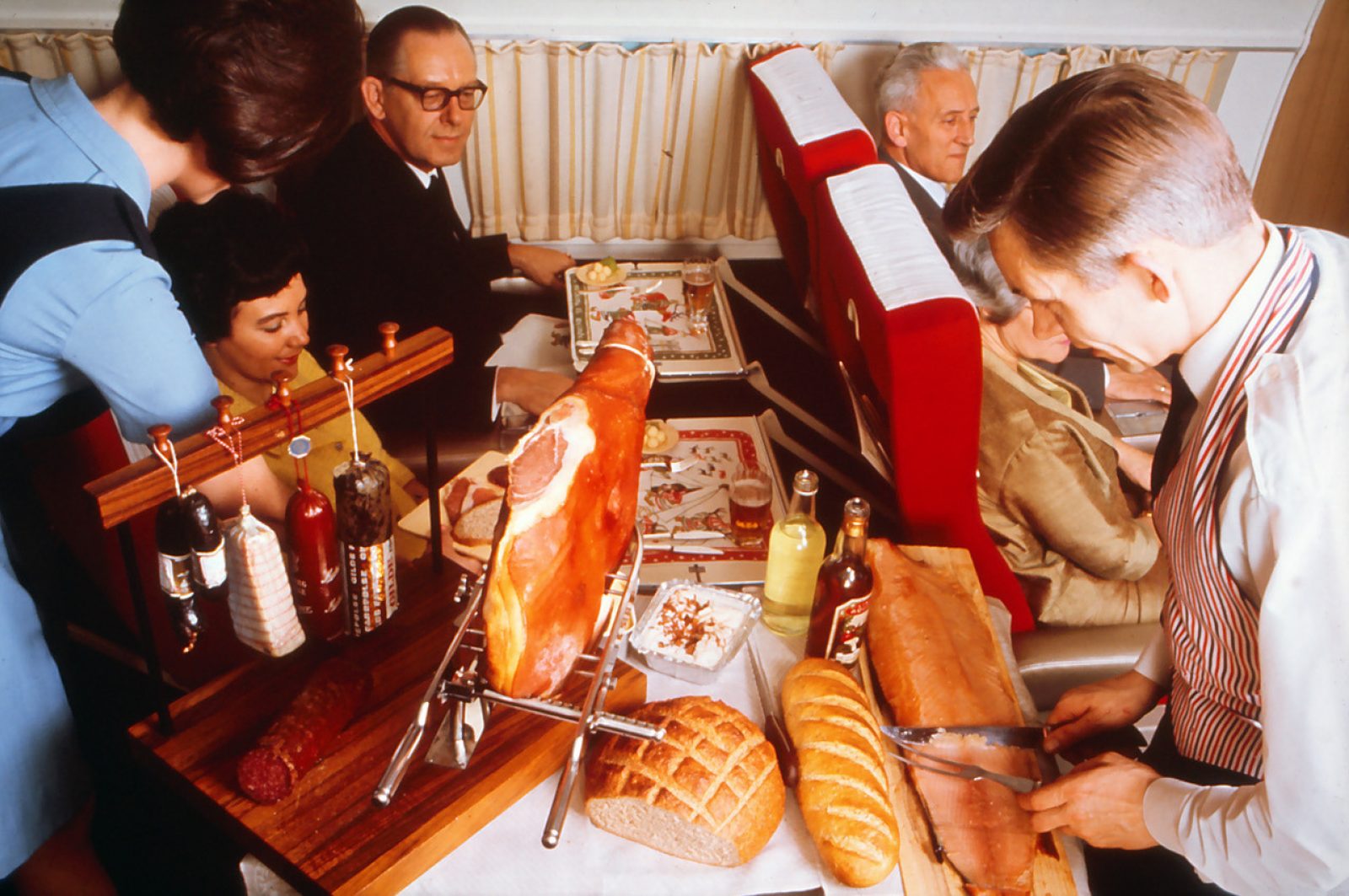
The Glory Days of In-Flight Dining: From Smorgasbord to Baked Alaska
Is airplane food bad on purpose? Historian Richard Foss takes us through the turbulent history of food in flight, from extravagant meals aboard zeppelins, to the flaming Baked Alaskas once served en route to Singapore, to the truth about mediocre food service on planes today. Plus, Rebecca Rupp tells us how carrots won the Trojan War, Amanda Herbert shares a recipe for the world’s first macaroni and cheese, and we head to Bogotá for a lesson on great barbecue.
Questions In This Episode:
How do I make a better cinnamon crumble topping for my cakes?
I’m from Michigan and I want to hear how Sara made my favorite burger at my favorite Ann Arbor restaurant back in the day.
When should I be putting a lid on my pots and pans during cooking and when is it better to leave it off?
Christopher Kimball: This is Milk Street Radio from PRX. I'm your host Christopher Kimball. Airplane food has a terrible reputation.
Voice: Of all the things that the airlines do to you the food is the worst. What do you think this is? Cool. Well, about seven hours ago that was lasagna.
CK: But in the early days of aviation, it was more like fine dining.
Voice: A lot of people think that we started out with something that would be like an economy class and then diverged to create first class. No, it went the other way.
CK: Flight Attendants used to slice charcuterie to order. Caviar was served in coach. So where did things go wrong?
Voice: What's the deal with airplane food?
CK: That's coming up later in the show. But first is my interview with Rebecca Rupp, whose book details the strange histories of common vegetables It's called How Carrots Won the Trojan War. Rebecca, welcome to Milk Street.
Rebecca Rupp: Well, thank you very much. I'm delighted to be here.
CK: So how did carrots win the Trojan War to start. I had to read the book carefully to to figure that out.
RR: Well, supposedly, as the Greeks were moving in on Troy, and were walled up in the Trojan horse, they ate carrots, and the quote was to bind their bowels, because obviously, the horse was a terrible place for a bathroom break.
CK: And they didn't know how long they were going to be in there either, I guess, right?
RR: Hopefully, just overnight, but it's not clear that carrots do any such thing. In fact, the Greeks and Romans used to serve dishes of boiled carrots as aphrodisiacs.
CK: Cabbage seems to have a pretty long story behind it. It was to prevent drunkenness. Good for hangovers. In the Roman times, it was the vegetable of choice. I'm just quoting from you for curing colic paralysis and the plague. That's pretty good. It was also good for a palliative for gout, hiccups, my favorite shrew mouse bites. And claims that a child washed in the urine of a cabbage eater will never be weak or puny. I'm just fascinated by how well of course I guess 20 years from now we'll look back and say the same thing about the 21st century. But all of this mostly nonsense, I would say, grows up around a food item.
RR: A lot of this comes out of Pliny's Natural History, which was written in the first century CE 37 books. He was accumulating all of the world's knowledge and not vetting any of it. So basically, anything he heard, he wrote down in his encyclopedia, and this is where we get a lot of this stuff like asparagus will cure scorpion stings and elephantiasis. And if you are rubbed all over with mashed asparagus in olive oil, you will never be stung by bees.
CK: Henry Ford, he was really into vegetarian cooking and carrots. So, he had a 12 course all carrot dinner in which he was the guest of honor. It sounds just awful. Carrot soup. carrot mousse carrot salad pickled carrots, carrots au gratin, carrot loaf, carrot ice cream all accompanied by glass after glass of carrot juice.
RR: Carrot Cake might have been all right.
CK: Well, yeah, there you go. Little fat in it and sugar. The other thing you talk about, which is really interesting is that when people are growing carrots, for example, in the 19th century, they were growing really big carrots, right? Not what we have today.
RR: Yeah, some of the early cookbooks are fascinating. You'll see carrot recipes where it says boil your carrots for two to three hours, which you would think would reduce your carrots do absolute slop.
CK: Maybe they liked really overcooked 80-pound carrots or something. I don't know. But you said the 19th century growers boasted of two-foot-long carrots that were a foot or more in circumference, and they weighed up to four pounds. So, I would think they were probably pretty gnarly to eat right if they were that big.
RR: I would think they would have been woody and dreadful.
CK: Yeah. Chapter Six in your book is called How Celery Contributes to Casanovas Conquests. This seems to come up a few times in your book so is celery a real aphrodisiac?
RR: Well, celery seems to contain androstenone which is a steroid that supposedly acts as a pheromone. It's found in male sweat. It's found in boar saliva. And the guess is that if you munch down a lot of celery, particularly the leaves and slurp up a lot of androstenone before heading out on a date, you may be exuding pheromones that will attract females, or maybe not, but celery was nicknamed the vegetable Viagra for a while.
CK: Well, you're right the Egyptians use celery stalks to treat impotence. The Romans used them to treat constipation that seems like half of everything was used for that. Middle Ages treatment for gallstones, a palliative for wild animal bites. There you go like shrew bites, if that seems to be a theme here. So, corn, corn is you know, the success story of all agriculture, I guess. It's now you have this long list. It's used in pancake mix shoe polish, instant tea, mayonnaise, surgical dressings, cat litter, golf tees, and soap. You say chapter seven, corn creates vampires. So how does it do that?
RR: Well, that was kind of a hoot of his story, actually. Corn is not a complete food. So, it lacks specific amino acids. So, if you're living on a diet, that's almost exclusively corn and corn products, you're going to develop a dietary deficiency disease called pellagra. And people who suffered from pellagra, were sometimes called the butterfly people, because the first sign would be the development of a sort of butterfly shaped rash across their face. But if this went on long enough, this could kill you. And many of the symptoms, such as sensitivity to the sun lethargy, people believed that this could have been the source of some of the vampire stories. Because once corn was introduced to Europe, nobody really knew how to prepare corn. And a lot of people developed pellagra. And it's kind of interesting to think that maybe all Dracula needed was a few more vitamins in his diet, not blood.
CK: So, cucumbers, this is one I really like food historian Waverly Root describes cucumbers as quote, as close to neutrality as a vegetable can get without ceasing to exist. That's a pretty good definition. So of course, today, cucumbers have almost no flavor, at least here in the States. Was there a time in history where cucumbers actually had flavor?
RR: I don't think so. There are 96% water, and the other 4% is nothing much. They were supposed to be great thirst quenchers, I came across an ancient Egyptian recipe for cucumber water that sounded absolutely awful, in which you cut the end off the cucumber, then mix up the insides to make it slushy. Then plug the end back up again and bury the cucumber for several days. And then when you dig it up, you've got an interesting drink.
CK: So, when you go back in time to do this research, were there some things on the positive side, that you thought well, hey, you know, maybe we should do that today? Or maybe maybe there was a point of this, with some good ideas from Roman times or Egyptian times or Sumerian times.
RR: There were some odd ideas. You know, you're not going to get red beets by watering your beets with red wine. But you have to give credit to certainly a lot of the Neolithic farmers, you know, practically everything we have in gardens today had been domesticated and developed by about 3000 BCE. So, anything that could be made edible and delicious these people did it. And we don't know who any of them are, of course, but that's I think that's a wonderful story.
CK: Rebecca, it's been, it's been a pleasure. Thank you so much.
RR: This was delightful. Chris, thank you so much.
CK: That was Rebecca Rupp, author of How Carrots Won the Trojan War. Curious but true stories of common vegetables. Now I'm joined by my co-host Sara Moulton to answer a few of your cooking questions. Sara is of course the star of Sara's Weeknight Meals on public television. Her latest book is Home Cooking 101. Sara so I've actually a couple times had good food on an airplane. I say a couple times out of like 300 times. Have you ever I actually had a good meal on a flight.
Sara Moulton: Let me tell you a funny story. Years ago, when I used to work for Good Morning America, and I was the food editor. We did a whole segment on who had the best airplane food. So, it was me and a camera guy, and we pretended that we were newlyweds. And we flew around the country on all the major airlines at the time.
CK: Wait, wait, wait this was a job?
SM: Yes. (nice work if you can get it) And back then they served you whole meals, you know, real meals are not the same as first class. And so, we flew on every airline I mean, well, every I think five, the top five, just around the country, sometimes a couple flights a day, he would shoot me eating like, oh, isn't this fun? We're on this, you know, honeymoon, and I can't remember who won. I think it was Trans Air. Was that one of them TWA. I think wow. (How is the food?) Not great. No, but call me silly. I always loved airplane food because I just love getting on a plane. You know, it's like TV dinners. You know, it's many little different tastes and everything.
CK: I hate it. But once many years ago, we were in London and there was a hurricane coming. So, we had to get out of town because they're going to close the airport. So, the only thing I get was Lufthansa ticket first class. (Oh, shucks) well, I had (first class is a whole different ballgame) I had points. I didn't have to pay for it. So that was (first class is great) waiters with white jackets. They had they had all the wonderful, cured meats. You know, when it first I always say no, I don't want to eat anything. And then I looked at the food when women say she looks better than that horrible sandwich I bought somewhere in the airport you know. That was amazing.
SM: Yeah. Well, in first class, anything is possible.
CK: No, no. If you get upgraded to first class, the food's not great. The other place that's good is Japan Airlines. I mean, going to Japan. They'll give you like Udaan in a broth. (Oh, nice). Very simple. That actually is pretty good. But that's about it. So, you've never had a great meal?
SM: No, I've never had a great meal. But I always enjoy it. As I said, because I love it sort of reminds me being a kid with TV dinners and all the little compartments.
CK: And some adult is serving. Yeah.
SM: Yeah.
CK: All right, let's take a call.
SM: Welcome to milk Street. Who's calling?
Caller: This is Carrie from Cincinnati, Ohio.
SM: Hi, Carrie, how can we help you today?
Caller: I have been attempting for a couple of years now to try and make a good like cinnamon crumble topping for like a cake or a muffin. And I've tried different, you know, variations on like brown sugar, white sugar, you know how much flour. Sometimes they say, you know to use melted butter, or like melted but not too hot. I've just tried everything I feel like I can think of, and I never make anything beyond sort of a crust of topping. I don't get those good, like, crumbles. And I was just wondering if you had any good advice for that.
SM: Well, first of all, are you following anybody's recipe in particular?
Caller: I've tried a couple of different recipes. The last one I tried was actually like, Betty Crocker or something like some really well known, as opposed to like random recipes you find on the internet, (right) And that didn't work for me either.
SM: And when you say it doesn't have the crumble that you want, what do you mean like big chunks of crumble?
Caller: Any chunks. Big or small. I just sort of
SM: smooth, flat crust?
Caller: Yes.
SM: Okay. And what are you putting in it besides flour and sugar and butter, anything?
Caller: Well, I did actually try some ground almonds one time, and that did give it sort of a better texture. But I still got the same issue. It kind of feels like when you have the wrong temperature butter for your cookies, and they get too flat or too crispy. You know, I've tried refrigerating it before I bake it and that didn't help either.
SM: Okay, well, here's what I would recommend. Are you using white sugar or brown sugar?
Caller: I typically use white sugar.
SM: Well, I would try using brown sugar. I think that will give you more depth of flavor. It has little more moisture. I would use cold butter. And what ratio of flour butter sugar are you using? Do you know?
Caller: Oh man, so more flour than sugar.
SM: Right. That's correct. You can either do 3 2 1 or 2 1 1 So let's say you do
CK: or you can do 911 that always works
Caller: You are my 911
SM: You could do two parts flour, to one part sugar and one part butter. I would go with cold flour. I wouldn't mix it too much. Because you said you want those clumps if I was going to add nuts, I'd add Chuck nuts you know leave them a little course because you want some texture. might throw in some oatmeal for a little more texture. Don't over mix it.
Caller: Oh, that's a great idea.
SM: Yeah. Chris, what do you think?
CK: Definitely cold butter. I agree you do it by hand and a bolt on put in a food processor, the Betty Crocker recipe you had just go through that recipe for me. Do you remember the proportions and how you did it?
Caller: I don't exactly remember the proportions. But the thing that was kind of different was it said to melt your butter and then let it start cooling off a little bit. But have it still be runny rather than you know, chunky like a cold butter
SM: I think that's the problem too
CK: Cold butter is much better.
SM: Yeah.
Caller: Well, I appreciate your help.
SM: Yeah, I think we absolutely agree on this
CK: and you know, we all like Betty.
Caller: Yeah, I mean, I've tried lots of different recipes. And this time I thought I'll go for like, your old school classic. Like Shirley Mills __. And, you know, 100 people could make a recipe and it can come on different. (That is so true). No disrespect to Betty at all.
CK: Well, give that a shot.
SM: Yes, Carrie. Thank you.
Caller: Well, thank you all very much for your help. I love your show. Thanks so much.
CK: Thanks for calling take care
SM: Bye bye.
CK: This is Milk Street radio. If you're stumped in the kitchen, please give us a ring anytime the number is 855-426-9843 one more time. 855-426-9843 or please email us at questions at Milk Street Radio.com.
SM: Welcome to Milk Street who's calling?
Caller: This is Michael Durst in Philadelphia, Pennsylvania.
SM: How can we help you?
Caller: Sara, how did you make the det burger when you worked at the Del Rio in Ann Arbor, Michigan. Oh, I was a loyal customer and classmate.
SM: Oh, my goodness, did we go to school together?
Caller: I didn't know you. But when I looked up what happened to the Del Rio a few years ago, I learned that you would work there as a waitress and a chef. Correct. And I was a frequent customer there when I was a student a university student
CK: Wait, wait wait. Did you guys go out together or something? Is this one of these like lonely hearts you know surprise.
SM: Mike, I don’t know. How was it for you?
Caller: Unfortunately,
CK: So, wait, wait, what was the Del Rio?
SM: So, the Del Rio was a bar in downtown Ann Arbor, Michigan, that was a jazz bar. So, they had jazz a couple days a week Sundays, I think always. And it was you know, hippie dippy run like a commune. I remember going to the opening meeting, where they all said we all share. And of course nobody drinks on the job. And you know, we're all very serious. And then the very first time I'm on the job, we do shots, you know, it's just part of it. So, it was like one big family. It was a really wonderful job. But the food was actually very good, even though it was sort of fast food. But any rate, one of the things that it was known for was this one dish. It was called the det burger, named after a bartender Bob Detweiler, who one night was bored. And so, he invented a burger and named it after himself. And the original was so good. But the ingredients you're going to be horrified, had a quarter pounder that was cooked on a flat grill, right? You had a flat top, and then the det mix was put on top of it. And the det mix was canned mushrooms can slice California olives that had no taste, freeze dried green peppers. I didn't even know they existed. (it sounds awful) Oh, yeah, it was really awful. So that was the det mix. So, you would cook the burger, and then you would put the det mix on top. So was that was olives, green peppers, canned mushrooms. And then the American cheese. Okay, but this is really exciting part. And this was brilliant. So, it's a flat top right. So, then you take some beer, you pour it on top of the whole mess. You put a lid on it. It was steamed in beer. It was fantastic. Oh, with a grilled onion. So, we did grill a slice of onion. And those det burgers were amazing, right Michael? Off the charts right?
Caller: They were great I was a regular with my buddies. We'd go there a lot, especially Sunday nights to hear the music
SM: The jazz, right. So, did you want to know the original or my updated version?
Caller: Either one.
SM: That was the original. So, my version was I took ground chuck you know, high fat burger, thick, eight ounces, not four I used sauteed cremini mushrooms. Either the chopped can chilies or roasted poblanos that you peel and chop up. And kalamata olives. So that's my det mix. And then my cheese is cheddar, sharp, sharp, extra sharp. I still do the grilled onions and beer. And the improved versions pretty good too. I mean, they're both good. I really don't want to beat up on the original because it was wonderful. But I I couldn't see freeze dried green peppers and canned mushrooms in my cookbooks. So. But Michael, that was a wonderful time. And that was a wonderful place. And I was very happy there
CK: You guys should get together. I mean, we should, we should film this reunion. The way det burgers. Yeah, we'll call it the det reunion.
SM: Anyway, Michael, that was fun to share with you. That was a very special place.
Caller: Yeah, it was a great time.
SM: Sure was. Okay.
CK: All right guys
SM: Well, thanks for bringing up that memory and take care.
Caller: Thank you. And I appreciate it.
SM: Bye, bye
CK: The Way We Were is the right song for that. He seemed to be particularly fond of that point in his life. Like there was a little emotion there.
SM: Well, I felt the same way I would have stay be there forever except my mother forced me to go to cooking school
CK: Damn
SM: I know
CK: You're listening to Milk Street Radio after the break fine dining on hot air balloons and the Hindenburg. This is Milk Street radio I'm your host, Christopher Kimball
Alan King: Of all the things that the airlines do to you, the food is the worst. I mean, there's no way to describe it. First of all, I don't need melted pineapple on my chicken, you know. But if you see the ad, do you have to see the ads, full page ads seven chefs slicing the beef Wellington. Then when you get on a plane to give you a disease piece of chicken.
CK: That was comedian Alan King performing on The Carol Burnett Show. He was one of the first comedians to make airplane food a punch line. My next guest argues that today airlines serve bad food but on purpose. But there used to be a time when in flight dining was luxurious and innovative. Richard Foss is the author of Food in the Air and Space, a Surprising History of Food in the Skies. He joins me now. Richard, welcome to milk Street.
Richard Foss: Thank you very much. Happy to be here.
CK: In thinking about food in the air and space. The thing that struck me is what you wrote about the fact that food was used for all sorts of reasons. Not just to please the passengers, for example, at one time, they made the experiencing coach so terrible, so that people would ante up and buy a first-class seat. (absolutely) So absolutely. I was going into this book, I go like, okay, everyone was trying to do the best possible job they could all the way along. But it turns out, that's not necessarily true.
RF: Well, let me let me point out one thing in reaction to what you just said, which is that that is not peculiar to the history of food in flight, because throughout human history, people have used food to indicate things about the status of the people they were serving it to the degree to which they wanted to please them. If you go back to the English term, giving someone the cold shoulder that goes back to the medieval era when you served someone the least desirable cuts of beef after a couple of days because you were ready to get rid of them. So, a lot of people think that we started out with something that would be like an economy class and then diverged to create first class. No, it went the other way. The average experience in the late 1940s, early 1950s would be what we would think of as first class.
CK: It's hard to shock me, but I was very surprised that you got intentionally bad food. Somebody in a marketing meeting came up with that. And everyone said, well, that sounds like a good idea. But anyway, let's go back to the beginning. So, because you're talking about flight, it's not just airplanes. So we have hot air balloons and then zeppelins so let's talk about hot air balloons. You point out in the early days you didn't know where you were going to land, when you were going to land. And as you also point out, you might land in a place where there was no food. So, part of provisioning, it was provisioning for an adventure, at least some of the early flights.
RF: All early aviators were daredevils when it comes down to it. They were scientists or daredevils. As was the case in a lot in the 18th and 19th century, sometimes both. You
CK: You say early on, like 1836 there was a balloon flight, where they use calcium oxide heating technology. So, what were some of those techniques for warming food in the early days?
RF: Prior to this, anywhere you were fire was your friend, even on a wooden ship at sea, they would brick in part of it so that you could have a fire at sea to cook. And all of a sudden when you are hanging under a bag of flammable gas, you can't have fire. And so, what they did was they used a technique first recorded among Arabic magicians and medieval pilgrims. And both Arabic magicians and medieval pilgrims would take some calcium oxide and water and heat food with it. The magicians did it obviously as a trick. But medieval pilgrims who were traveling in wagon caravans would take the calcium oxide, so that even when you were in a moving wagon, you could heat some food. So, the idea was around, but it required chemical knowledge. It was impractical, and it doesn't get things really hot, it gets them warm.
CK: So, the Zeppelins were interesting, because at one time, according to whatever, and people thought that the Zeppelin or dirigible would be the way people would travel in the future. So the meal served in the luxury in which because it was only for the rich, was just amazing, including, I think you mentioned aluminum piano, because it was lightweight in one of them. So, what was the what was the food like there?
RF: Well, the waiters were dressed in tuxedos, they had a fantastic selection of wines, mostly German. They had a set of cocktails served aboard that were named after the places that they went. And they did some fantastic cooking in a kitchen that was actually about the size of the average family dinner table. But they would make it a long leisurely dinner because other than that, what are the passengers doing all day other than looking out the window reading or sitting in their state room.
The crew are busy on their appointed tasks, some on the lookout, other's preparing the tables for a meal. We have five meals a day, so nobody looks like starving. The sea takes on new and beautiful aspects as dusk approaches. And we have our dinner to the accompaniment of music, all on gramophone.
CK: After World War Two, I never thought about this but makes sense. You say Alitalia, among other airlines was quote, stuck with a bunch of converted bombers for their passenger aircraft. So, they made the food outstanding, because, quote, “Nobody would want to fly them otherwise”. My favorite example was the 1960 Mohawk airlines, they were flying prewar DC 3’s
RF: Yes. And they were flying with aircraft that were so old that one of the airline executives as a joke once mused that the experience was almost like being aboard an old train. So, they decided to decorate the aircraft to look like a very old Pullman car. They had all of the stewardesses because it wasn't exclusively female workforce in the cabin back then, dress like Dancehall girls, and they passed out beer, cigars and pretzels. And people started wanting to fly these flights because that kind of Carnival costume party atmosphere. So, this airline took having very old aircraft and made it into a virtue and they made enough money off of those flights to buy new aircraft.
And of course, we discussed our whole new jet fleet, a $60 million purchase. The fleet is composed of brand spanking new BAC 111’s and Fairchild Hiller 227, we aim to keep them that way. brand spanking new.
CK: So, let's get to the cooking. So describe to me today, how food is prepared, both before it gets on the plane then on the plane. And then how, for example would have been prepared back in the earlier days of aviation, let's say in the 50s or 60s
RF: Actually, when it comes to how it would be prepared from the 50s or 60s or today, the answer is essentially it would be reheated aboard the aircraft using the exact same technology because of the fact that toward the end of World War Two, an inventor by the name of Maxon created the world's first functional convection oven. And if you've ever wondered why it is that every time you get aboard an airplane and they serve you a meal, it's the exact same little shape of dish. It's because that is what is designed to fit in a Maxim convection oven and that is what went into service in 1945 in the military and 1947 afterward. So, this technology is the exact same. And the only refinements we have in meals since then, is that we know all kinds of things about how to prepare frozen food.
CK: So, the food they serve today comes into the airplane frozen?
RF: Yes. So frozen food comes about after World War Two, and it starts out being maybe mediocre by modern standards, but compared to what it replaced, which was a picnic lunch and hot coffee or tea, it was great. It wasn't mom's cooking, unless your mom wasn't very good at cooking, but it was a bad version of mom’s cooking, and that was better than a bad picnic.
The catering staff bring in the stores, the precooked meals, the milk, coffee, sugar and biscuits. And each item is carefully checked and put away in the restricted space of the galley.
CK: You say in Cathay Pacific, they once served flaming Baked Alaska
RF: Yes, and that that was remarkable to me that they did something like that aboard a flight, they would have been something where they poured a little bit of liquor on top of it, lit it just long enough for people to see the fire and then served it, it was a stunt. Cathay Pacific is one of the examples of an airline that by any reasonable standard should not exist. Cathay Pacific is based in Singapore. And for Singapore to become a business hub for the world they had to be available by a nonstop flight from the places where businesses happened. And that meant that businesses would schedule their conventions and their meetings and other things in Singapore. And in order to get people to fly them, they had to have fantastic food, same thing that SAS did in the 1950s. Because they knew that nobody in their right mind really desperately wanted to visit Denmark in February. But if you made it so that the flights going through Denmark had fantastic Danish smorgasbord service, people would love it, they would have fine quality meats that they were slicing, they would have all of the little skin that avian style finger sandwiches,
The next time you're going to Copenhagen, Singapore, or any of the 102 places we fly, fly the world at a slightly higher level.
RF: Now, this is an element that points to both the rise in quality in airline service. And its decline. Because as long as the economic incentive was for excellent food and service service kept getting better. But with the dawn of frequent flyer programs, and the deregulation of the airline industry, the incentive flipped. The era of frequent flyer points, suddenly created brand loyalty that had never existed before and made it so passengers were willing to inconvenience themselves in terms of time, and so that they would put up with worst quality food and service.
CK: It's funny, the airlines are still a place where a class exists, right?
RF: Oh, yes, it still is. And I wish that there were some situation I could imagine that could reverse that incentive again, so that there was once again, competition for providing a good experience, it would take the equivalent of some billionaire deciding to start a new airline and make the bet that people would be interested in paying not the exorbitant difference to get first class, but to have an all business class airline and to do it well. But absent that, I don't see how we're ever going to have really good food because we have an incentive against it.
CK: So, if you could go back in time, and pick a couple of flights or situations, which you would love to have experienced in terms of onboard service. Obviously, maybe, you know, an airship a dirigible would be good. But could you give me a couple examples of times and places you would have loved to experienced?
RF: I really would have liked to experience the service on what are the airlines that you mentioned, Cathay Pacific, and I would have liked to have done that in the early days when they were serving Chinese food in flight. Because this was something that was so important to the psychology of the newly independent colonies. Air India was the first one to serve Indian food in flight. And it was such a point of pride. So, I think I would have loved to have tried the Chinese and Indian food in the early days, partly just to be among those passengers who were full of pride and those airline employees who were full of pride at serving their own culture.
CK: Richard, it's been a real pleasure. Thank you very much.
RF: Thank you.
CK: That was Richard Foss. His book is food in the air and space the surprising history of food and drink in the skies. 17 century sailors lived on salted beef ship biscuits, peas and beer. And please don't even think about what brined beef tastes like and smells like after a few months at sea. But steamships revolutionized seagoing dining at least for the wealthy. The menu for the SS Kaiser Vilhelm from May 1900. Included consummate, duck, capon, roast beef, and chocolate souffle for dessert. Today, cruise ships offer wagyu carpaccio, braised pork cheek and ricotta Bundlettes. By contrast, United Airlines offers a snack box with popcorn, mustard onion pretzels, Oreos, gummy bears and fun size m&ms. So next time maybe I'll just travel by sea. Not only is the food better, but so is the leg room. You're listening to milk Street Radio coming up medieval mac and cheese and more recipes from England's oldest cookbook. That's after the break. I'm Christopher Kimball and this is Milk Street Radio. I'm joined now by JM Hirsh to talk about this week's recipe. Colombian style Asado pork chops. JM, how are you?
JM Hirsch: I'm doing great.
CK: You know, I've said before you and I travel for Milk Street, you do more than I do. But you seem to get involved with more interesting, more fun trips. So, you go to Bogota. And you end up at some bar, whatever it is having great food, but you also obviously loved the experience. Right?
JMH: Yeah, and you know, I think we're using the term bar loosely. Imagine, if you will, a bowling alley. But at either end of the alley, there are explosives. (What?) Yeah, the explosives are hidden in these lumps of clay. And you take these metal pucks and you huck them down the alley at the mounds of clay. And sometimes you hit explosives and they explode. And I never quite figured out whether you're supposed to hit the explosives or if you're not supposed to hit it in order to earn points, because I was distracted by the meat, which was the real reason I was there. So I had gone to this bar to play Taeho is the game but also to eat asado which is a very broad term for essentially Colombian barbecue. But it applies to all sorts of meats. And what's interesting is the meats all our sauce to the same way. But the difference of course comes in how long they're cooked. And the meats themselves because there's sausage, there’s steak, there’s chicken, there’s pork, it's just a mash of all different meats. Well, sauce, really well grilled. And this part of the whole experience where you go and you play this weird exploding game, and you eat a ton of really amazingly flavored meats.
CK: Is this an indoor outdoor? Is it barbecue, what's going on? It's
JMH: It's a little bit of everything, honestly, you know. And there are all different types of places where you can get Asado and I was in a Taiho hall when I first had it, but there are a lot of Asado shops where it kind of just, it looks like a restaurant, but there's no front of the restaurant. And so, the cooking kind of spills out onto the street in front of the restaurant. And the way it's cooked is really amazing if you can imagine just like a massive metal pyre with all these hooks on it. And we're talking about the size of a small car, and they just hook the meat on these hooks. They spin it over a wood fire and they kind of adjust the cooking by spinning it more or less, and by moving the meat up and down on hooks closer or further from the word fire, it's really a fascinating process and it will come to you with just tons of plantains and salt roasted potatoes underneath which are now sopping up all the juices from the meat. And then you've got this really well sauced really well grilled meat just heaped on top of it. And it's very much a family experience. And everybody gathers around, and you just grab the meat and you just dig in it is really just an amazing, delicious experience.
CK: So, there's a paste here of some kind is that sort of a marinade paste, or you just put it on bright before you cook it or what.
JMH: So, it goes on both before and after the cooking. It acts as a marinade, but it also acts as a finishing sauce. And it's really well seasoned, really bright. It's got cumin in it, it's got alspice time, they leave Apple wine, which it's not really a wine, it tastes more like a dry hard cider. And then there's onion and garlic and sugar and just it's just an amazing array of flavors, and they slop it on to the meat before it goes on the grill. And then they put it back on some more when it comes to off the grill. And you just kind of dig right in and it's so delicious. It's really, really wonderful.
CK: So besides you don't have one of these hauls and hooks and everything. It sounds like one of those recipes, you could never do at home. So, you're starting with like loin chops and this marinade, how do you do it at home?
JMH: You know, the nice part is that you make the sauce all in a blender, you know, you throw in some scallions, some bay and all the other ingredients. You just throw it into a blender, you whip it up, and then we used bone in pork loin chops, and you slop it on, we found that you can leave it for an hour is fine. And then you throw it on the grill, but you can also boil it to make it a little bit easier at home. And boy does it come out. So tender, so juicy and just so rich with flavor. It's like it's sweet and savory and herbal at the same time. It's really nice
CK: Colombian style Asato pork chops without the exploding little pots, whatever, there for, thank you so much. It sounds like a great barbecue recipe. Thanks, Jim.
JMH: Thank you. You can get the recipe for Colombian style Asako pork chops and milk street radio.com.
CK: I'm Christopher Kimball and you're listening to Milk Street Radio right now. My co-host Sara Moulton and I will answer a few more of your cooking questions.
SM: Welcome to Milk Street, who's calling?
Caller: Hi, this is Mike from the Twin Cities in Minnesota.
SM: Hi, Mike, how can we help you today?
Caller: Well, I have a question on lids for pots and pans. People like me who are trying to learn to cook a little more intuitively, you know, without a recipe, I feel like I still don't know when I need to use a lid. Other than when I'm boiling rice, or just getting a pot of water to boil a little more quickly. I've had recipes where it says put a lid on it when I you know wouldn't intuitively do it. And then I get beautifully brown veggies or meat, whatever I'm cooking. And then sometimes there's recipes where it says put a lid on it when I would think oh, I would want some liquid to evaporate from this. So, for people who are learning to be a little more intuitive in the kitchen, how would you guide them to use lids more effectively?
SM: Well sounds like you already know, I'm wondering who was told you to put a lid on when you're browning vegetables because that doesn't make any sense at all.
Caller: I've had like asparagus, I know I've recipes with like asparagus or broccoli, you're putting kind of trying to sauté them and get a little browning in the skillet, they put a lid on it for a while I've had recipes do that.
SM: In general, I mean, the point being that if you want to keep the moisture in there, you keep the lid on. If you want to lose the moisture, take the lid off. It's that simple. So all the things you just said, bring it to a boil faster, put the lid on, when you're steaming, put the lid on, when you're braising, you need the slow, moist heat to break down all the connective tissue and collagen. Keep the lid on until you know this is a new method that Chris and everybody's been using, you know, take it off towards the end so you can brown the top part of it rather than having to sear it first. And sometimes you're right, there is a combo. Sometimes you want it on for part of the time and off for part of the time but basically you want to keep the moisture in keep the lid on, Chris?
Caller: Okay
CK: Well, I mean, if you're cooking somebody for 10 15 20 minutes, it doesn't matter at all unless you're steaming for a piece of fish or something. But for long cooking where you don't want to reduce the liquid. You put the top on or mostly on but most of the time with a stew or braise or anything else you probably do want to concentrate the liquids so you probably would have the top off or some portion of the time. The only time I keep a top on is a quick steam or something else like that. But if it's going to be long, slow cooking. I leave the top off because I want those liquids to reduce. The other thing is if you start with very little liquid like I do stews with a cup of liquid sometimes, then you probably do want to keep the top on, let's say in the oven for the first couple hours, because all that liquids going to evaporate, you're going to burn the food. So, it depends how much liquid it depends how fast you're cooking. But Sara is basically right, you keep the top on to stop the liquid from concentrating and boiling off or simmering off. So, at the end of the day, by the way, it doesn't matter that much. I mean, you can just play around with it yourself. I mean, the great thing about not having the tarp on as you can see what's going on, which I love, and that's why I like doing things on top of stuff. But anyway,
SM: Was that helpful, Mike?
Caller: Yeah, it sounds like my gut was leading me the right way. Yeah. And, you know, if a recipe says to do it, I'll do it. But if I'm just kind of wing it, I'll probably just, you know, ignore it in the drawer.
CK: Taste the liquid as you go along. I mean, you decide how much concentrated liquid you want. It's up to you So, right. Anyway, Mike, thanks so much for calling.
SM: Yes. Thanks, Mike. Take care. Bye.
Caller: Thank you so much. It's really nice to talk to you
SM: yye
CK: This is Milk Street Radio. Now let's hear from culinary historian Amanda Herbert. About England's oldest cookbook. Amanda, how are you?
Amanda Herbert: I'm very well, Chris. Thanks for having me on today.
AH: So, what's on your mind this week? I'm going to take you back in time to medieval Europe, a time of soaring cathedrals and imposing castles, knights performing in tournaments, and infamously the black death. And I'm going to ask if you are going to imagine herself at a medieval feast in this time, what would you picture what kinds of drinks and dishes would you expect to see on the table?
CK: Well, you always think about what you see in old movies right? From the 40s or something. massive amount of food, huge banquet halls, sides of beef and other meat, all sorts of strange things being offered lots of spices, overindulgence, throwing bones to the hounds. Those are probably incorrect, but archetypal, you know ideas of what we think of as medieval dining.
AH: Well, you're not wrong. But one history recipe book in particular, helps us to think about medieval cooking in a whole new way. It's the Form of Curry, which was written in 1390 and compiled by the Chief Master cooks of England's Richard the second. Its name is a little bit misleading. It's not about curry as we think of it today. They borrowed the word curry from the old French meaning cookery or kitchen. But regardless of what it was named, this recipe book does contain some recipes for exactly the kinds of things you're describing cranes and herons carved with lard-ons of swine roasted and eaten with ginger, other exotic proteins like swan, porpoise and wild boar. But that's not the only thing that you see in this recipe book. There's also a salad which calls for parsley, sage borage, mint, fennel and watercress, dressed with raw olive oil, vinegar and salt, as well as herb fritters, muddled with flour and water, lemon zest and salt fried in oil and eaten with a kind of clear honey.
CK: Really, is this la 1986 or is this England 1382.
AH: It is, in fact England 1382 or1390s. But in fact, a lot of the dishes in the form of curry are vegetarian or pescatarian. Medieval cuisine was full of ingredients like almond milk, which features in many, many of the recipes. In fact, one of my favorites is for an almond milk caudle, which calls for blanched almonds, wine, ginger, sugar, and saffron and a caudle l if you haven't had one before, is a kind of warm, nourishing drink sort of like a really thick hot chocolate that's intended to make you feel cozy and healthy
CK: When someone says vegetarian, I don't think about 14th century Europe.
AH: Absolutely not. In fact, one of the dishes that's the most surprising in the form of curry is a really early form of macaroni and cheese. That's called macros in the recipe, the chef is supposed to make a thin foil of dough carve it into pieces, cast it in boiling water and season well and then take cheese and grade it and this is my favorite part have butter cast beneath and above the dish.
CK: You know there's still a modern recipe down south where you cook instead of like chicken and biscuits you cook dough and strips and add it so I wonder whether that was pasta or that was dough, but it seems to me there's some relation between the two it's kind of interesting.
AH: It is interesting to think about yeah, I've had that kind of chicken and dumplings before which is super delicious. And this one does say that it's supposed to be a thin foil of dough, so foil brings to mind like a really thin paper thin almost see through kind of dough, but it's true. I mean hardened or dried dough come in a little bit later in the 14th and 15th century and they kind of merge together with fresh pasta in Are many of the ways that they do today.
CK: So, what's your impression overall about how people ate and what their diet was like, in other words, were a lot of these recipes, special banquet dishes, or were there sort of everyday recipes as well,
AH: They were intended to be banquet dishes. So, the form of curry was written for the court of Richard the second. And it was so popular that it then got hand copied over and over again to other elite households. But I think just because it was written for a royal court doesn't mean that average everyday people didn't eat some of these foods. And The Form of Curry acknowledges that in the beginning of the book, so it says, this book will teach with demand for to make common pottages and common meats for all manner of states, both high and low. Now it's probable that they were thinking of the lower status people who worked inside of elite households. But nonetheless, I think it does suggest to us that the people who wrote this book had the diets of lots of different people in mind. That's
CK: That's interesting, because it's a very different picture of what people were eating in the 14th century. And maybe their food was better than we thought. Thank you.
AH: You're very welcome. Thanks for having me.
CK: That was culinary historian Amanda Herbert. She's an associate professor at Durham University, and part of the research team for Eat Medieval. That's it for this week's show. But don't forget, you can find more than 275 episodes and Milk Street Radio, at Milk Street Radio.com or wherever you get your podcasts. You can find out more about us at 177 Milk Street.com. There you can become a member and get 1000s of recipes, access our online cooking classes and get free shipping on all orders from the Milk Street store. can also learn about our latest book, which is Milk Street 365 the All-Purpose Cookbook for Every Day of the Year. Please check us out on Facebook at Christopher Kimball's Milk Street on Instagram at 177 Milk Street. We'll be back next week and thanks as always for listening.
Christopher Kimball's Milk Street Radio is produced by Milk Street in association with GBH co-founder Melissa Baldino, executive producer Annie Sensabaugh, senior editor Melissa Allison, producer Sarah Clapp, Assistant Producer Caroline Davis with production help from Debby Paddock. Additional editing by Sidney Lewis, audio mixing by Jay Allison and Atlantic Public Media in Woods Hole Massachusetts. Theme music by Toubab Krewe, additional music by George Brandl Egloff, Christopher Kimball’s Milk Street Radio is distributed by PRX.
In this episode
ADVERTISEMENT
ADVERTISEMENT

Simple, Bold Recipes

Digital Access
12 weeks for$1
- EVERY MILK STREET RECIPE
- STREAMING OF TV AND RADIO SHOWS
- ACCESS TO COMPLETE VIDEO ARCHIVES

Insider Membership
12 weeks for$1
- EVERYTHING INCLUDED IN PRINT & DIGITAL ACCESS, PLUS:
- FREE STANDARD SHIPPING, MILK STREET STORE,
to contiguous US addresses - ADVANCE NOTIFICATION OF SPECIAL STORE SALES
- RECEIVE ACCESS TO ALL LIVE STREAM COOKING CLASSES (EXCLUDING WORKSHOPS & INTENSIVES)
- GET YOUR QUESTIONS ANSWERED BY MILK STREET STAFF
- PLUS, MUCH MORE

Print & Digital Access
12 weeks for$1
- EVERYTHING INCLUDED IN DIGITAL ACCESS, PLUS:
- PRINT MAGAZINE SUBSCRIPTION
- 6 ISSUES PER YEAR

