





Your email address is required to begin the subscription process. We will use it for customer service and other communications from Milk Street. You can unsubscribe from receiving our emails at any time.
Episode 919
August 22, 2025
August 22, 2025
Saffron Coffee, Black Limes and Tahini Dates: Inside the Gulf Kitchen
This week we’re joined by Noor Murad—longtime recipe developer at the Ottolenghi Test Kitchen. She’s here to share cooking inspired by her home country, Bahrain. We talk about the magic of tahini dates, lamb with fenugreek, and spiced rice. Plus, Meathead is back to take more of your barbecue and grilling calls, from the rules of ribs to whether bones actually make your meat taste better; we learn how to eat like a Greek with Athens chef Carolina Doriti; Adam Gopnik considers the tart cherry; and we make Cantonese Barbecued Pork.
Questions in this episode:
"Does bone-in make meat better? What's the best way to cook a standing rib roast? Is a tomahawk steak a viable piece of meat?
"Do you have any advice on cooking rabbit on a grill?
"Every time I make wood fired fish, it falls apart. Help!"
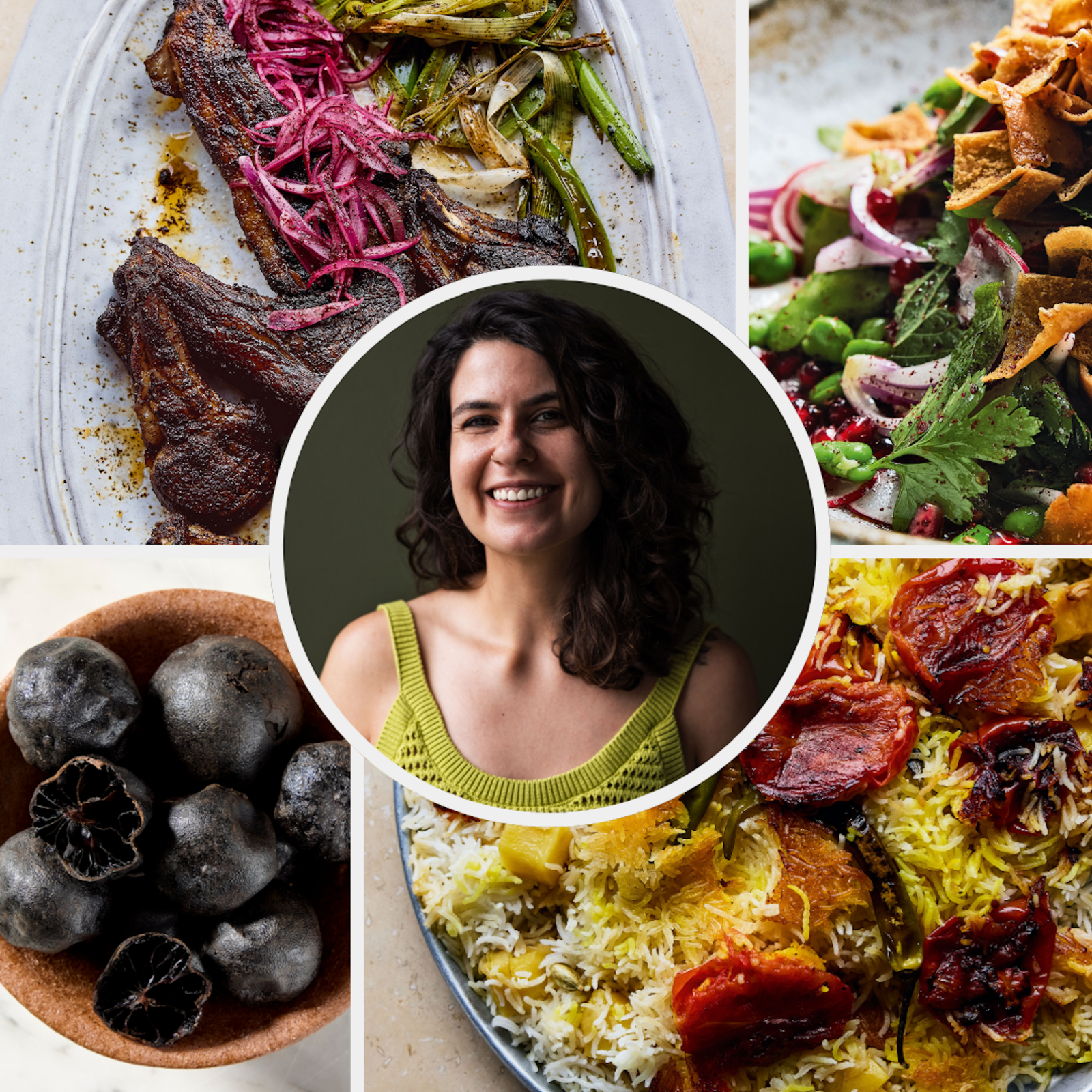
Christopher Kimball: This is Milk Street Radio from PRX. I'm your host. Christopher Kimball. Noor Murad grew up in Bahrain, an archipelago in the Persian Gulf known as
Noor Murad: the land of a million palm trees.
CK: Those palm trees grow dates that Noor likes the Dunkin tahini. She also loves stewed lamb and fenugreek seeds, and above all else, black limes.
NM: I've wanted, more than anything, to just kind of spread the black lime love around the world.
CK: We'll explore the flavors of gulf cooking with Noor. But first, we're heading to Athens for an insider's food tour of Greece. Carolina Doriti is a Greek chef and tour guide, and she joins me now Carolina welcome to Milk Street.
Carolina Doriti: Hello. Thank you for having me.
CK: So, the first question I have is, I take the red eye from Boston. I get into Athens at six or seven in the morning. What about breakfast?
CD: Well, if you ask the average Greek, he will tell you Greek breakfast is probably coffee and a cigarette, (right) But I think pies are very popular for breakfast here. And there are many, many different types of pies in Greece, like a warm, sweet bougatsa pie, for instance, which is filled with milk custard and topped with powdered sugar and cinnamon. And then we've got Greek yogurt, of course, which is typically served with honey and walnuts.
CK: Okay, I'm going to walk around Athens now, and one of the first questions I always have is, What about the street food? So, what are the options in Athens? And what do you recommend?
CD: Of course, there's souvlaki, which is the famous Greek street foods. Or then they've got gyros, which is like layered slices of pork, actually in Greece, and not lamb, seasoned very nicely, and then slow cooked on a vertical rotisserie until it's almost caramelized on the outside, and then it's nicely and thinly shaved when it's ready
CK: Authentically in Athens, if you have it wrapped in pita bread, what would they put with it as well, anything?
CD: Well, the old schools of like it places, which are my favorite, they will put some sliced tomato and some chopped parsley, onions, red onions, which in Greece are very sweet and crispy and either yogurt or some tzatziki, which is yogurt mixed with garlic and grated cucumber.
CK: So, I walk into a restaurant, how do I navigate the menu? Like, what are some of the things I should be aware of? What are some of the things I should watch out for et cetera?
CD: Well, first of all, usually, in Greece, most people speak English, so the best way, I think, is to talk to the waiter and get their advice, because there might be things that you would never understand them in the menu to order them.
CK: Give me an example of that
CD: Like green beans. It might say green beans, and you will have, I don't know, you will probably imagine boiled green beans, but this is a stew that is cooked in olive oil and tomato and carrots and potatoes. And it's fantastic when the beans are in season and they're fresh, or you may read in a menu, fava. And it will have nothing to do with fava bean. It will be a yellow, creamy paste which is made of, of a type of yellow split pea, which is very traditional in Greece.
CK: These are great. Okay, keep going. I like this list.
CD: Yeah. So, then you might also read fricassee, which is something you might be familiar with from the French cuisine, but Greek fricassee is completely different. It's it's a type of meat, usually lamb, goat, pork, chicken, cooked with seasonal greens, often foraged greens, or it can be greens like lettuce and chard, and then you finish it off with an egg and lemon sauce. Fantastic dish. And then we've got some recipes with intestines, such as Kokoreç, for instance. So, in Greece, Kokoreç is usually liver and other offal wrapped with intestines and then slow cooked, ideally over charcoal, while it rotates. And then this is thinly sliced. But when this is done properly, and most people prefer to use just liver inside the intestines, and they season it very well with oregano. So, it's quite aromatic. It's really, really good, I think.
CK: Let's talk about ouzo. So, is this a drink, like a pastis, or something you might have to develop your appetite before dinner? Is it something you drink after dinner, or is this something that's strictly had with food?
CD: You can have it before dinner, but most Greeks the moment they put the first drop of alcohol in their mouth they want something to eat along. So, ouzo is the classic drink we pair seafood in Greece, and there are restaurants called Ouzeria, and these restaurants most commonly focus on seafood.
CK: Why ouzo pairing with seafood?
CD: Because it cleanses your palette, and it pairs fishy flavors, like strong fishy flavors like even, you know, like mackerel and you know, anchovies and sardines, it pairs really well with them.
CK: So, what about the higher end restaurants in Greece? What are their takes on traditional recipes?
CD: There are many ways to see how you can modernize a recipe or take a different turn. I mean, some may want to deconstruct it. In my opinion, Greek cuisine is very fashionable in its traditional, old-school form, because it's a very sustainable cuisine, and it's a very seasonal cuisine. And I think that naturally, it really represents the, you know, the big trends of cooking at the moment.
CK: So, I get off the plane and you meet me, and you say to me, look whatever else you get out of this trip. Here are the three things you should never do when you're in Athens.
CD: Well, eat near the Acropolis or drink. Yeah, do not eat near the Acropolis. Do not ask your hotel where to eat, and do not ask a taxi driver where to eat
CK: Now the taxi driver is going to send you to his brother's place or something (his cousin) his cousin, yeah, of course, Carolina. Thank you so much. I now, I have my list. I need to go to Athens.
CD: I hope will you call me when you're here.
CK: I definitely am calling you.
CD: Great. Thank you.
CK: Thank you. That was Carolina Doriti. She's a chef, also bureau chief for Culinary Back Streets Athens. Her upcoming cookbook is The Greek Islands Cookbook. Now it's time to answer your barbecue and grilling questions with our special guest co-host Meathead Goldwyn. Meathead is the founder of Amazingribs.com also author of Meathead, the Science of Great Barbecue and Grilling. Hey, Meathead, what's going on?
Meathead Goldwyn: Hello, Christopher. It's good to be back with you.
CK: We talked about marinating many times, and you know that I have made a career about saying marinating doesn't work, but we did find, I don't know if you comment on this, that with chicken, sometimes pork, a yogurt marinade seemed to actually work. It can't be a super thick piece of meat, but there's something in a dairy product, a yogurt that seemed to actually penetrate into the let's say a chicken skewer, for example. Yeah, I noticed that other marinades just don't get inside. But why yogurt?
Meathead: I think it's primarily the acidity. Acid does work on protein, and it can soften it. In fact, if you marinate something in an acid too long, it will make the skin or the surface mushy. Now, of course, marinating in yogurt is an old Indian tradition. I mean all your tandooris, but I've been playing a lot with pickle brine, which is the same thing. It's a high acid. It does penetrate. Now, I've been with you for years. I've been preaching that marinades are a surface treatment. They don't penetrate; they don't get deep into the meat. They don't alter the center of the flavor, but the acidity is a distinct effect, and it works primarily on the surface. And it can actually, I think, aid the crisping of chicken skin.
CK: I just want to say publicly, this is an exception to the Kimball rule. I’ve got to look and just Okay, let's take some calls
Meathead: Welcome to Milk Street. Who's calling?
Caller: This is Bill from Scottsdale.
Meathead: So how can we help you today?
Caller: My question is kind of three parts, and they're all kind of interrelated. So, you know, a lot of times when you hear chefs on TV talking about cooking a piece of meat, they always say, hey, bone-in adds a lot more flavor. So, I really want to know the truth about that, if bone-in makes it better, and why? And then the second question is, a standing rib roast, what's the best way to cook it? And the third question is, is tomahawk steak? Is it really worth the box? Is it really a viable piece of meat? I'd love to hear your opinions on that. Thank you.
Meathead: These are good questions. First of all, the bone is coated with calcium, and calcium has no flavor. Now, the interior of the bone has lots of flavor. There's fat, and the stuff that makes blood is down in there. So, if you're going to make a stew, say, with short ribs, and throw them into a stew where there's wine and water and stuff, they will extract flavor from the interior of the bone. But if you're cooking on a grill or in a pan or in your oven, that's dry cooking, and there's nothing going to get the flavor out of the marrow. All you've got is the calcium. Now, the calcium is not going to affect the flavor of the meat directly, but it is going to alter the cooking dynamics. That is to say it's like a heat shield. It's like on the space shuttle. It's going to block heat from entering the meat. And if you've ever sat down with a bone-in rib eye, you know the meat closer to the bone is a little less cooked. It's more rare than it is on the other side. What's the old song? The closer to the bone, the sweeter than meat, that's it. It's going to alter the heating dynamics of the meat. And so, you'll have one side more cooked and one side less cooked. So, I take the bone off, and I save the bone, and I use it for making stock. And this way, I get the meat cooked evenly all around. And I do the same thing for a prime rib. Now, you asked about a standing rib roast. That right slab of ribs is going to block heat from coming in, and I want the meat to cook evenly on all sides. So, I cut that slab off, and that slab is a meal. I mean, that's a meal for two. It's marvelous. And I'll grill or smoke that, and then I'll cook the rib roast, just the meat, and I'll take a lot of the fat off of there too, and it's just fantastic. And that's called the eye of the ribeye. So, I get the bones out of the way. I think they alter the heating physics of the whole thing. And then your question on tomahawk steaks, tomahawk steak is just a bone in rib eye, but they've left the whole rib. Usually, it's just a portion of the rib from the back, but they've left the side of the and you're paying for that bone. It is cool. Let's face it, it is just very cool. It's impressive, but I don't think it has any impact on flavor,
CK: unless you marinate her for 30 days in bourbon.
Meathead: Now I got, I got that. It's really good. I’ve got to say, I do like, I do like chewing on the bones. So, if I do cook it with bone in I do get pleasure from chewing on the bone.
Caller: That's great. So you know, based on what you're telling me too, talking about the heat shield, especially with the tomahawk, that's why I think I've always been disappointed with those steaks, because I find them not as tender as a regular ribeye, and the cooking, again, to your point, is very uneven, and I think their explanation really helps me understand the whole thing. So that was excellent. Thank you
CK: Bill. Thanks so much for calling
Caller: Okay, and thanks so much for taking my call. And all the best to both of you.
Meathead: Good luck, goodbye.
CK: Take care. This is Milk Street Radio. Before your next barbecue, give us a ring. 855-426-9843 one more time 855-426-9843, or email us at questions at Milk Street Radio.com,
Meathead: Welcome to Milk Street. Who's calling
Caller: Hi, my name's Laura
Meathead: and how can we help you today?
Caller: I was wondering if you guys had any advice on cooking rabbit on the grill.
Meathead: Well, I'm not a hunter. I have cooked rabbit that people have brought me, but I think I'm going to defer to the infinite wisdom of Christopher Kimball, who is a hunter.
CK: I do hunt rabbit. Well, the back strap, the loin, has to be cooked totally differently than the legs, the back legs, so the back strap, just like you would with venison, is like a tenderloin, right? You cook tenderloin very quickly over high heat, and that's a few minutes, right? It's done. The legs, however, need to be low and slow, so you essentially barbecue them right or just put them in a low oven, or braise them over low temperature, because they're going to take time to break down. And they're much tougher because they obviously the muscles are well developed, so you just have to separate those two things.
Meathead: Christopher, do you brine, or do you use a special rub, or any kind of preparation in advance?
CK: I find that what I like to do with the legs is a little bit of liquid in the pot, you know, a cup or cup and a half a braise. Put it in a low oven and let it cook in like a 275 oven or something like that. I find that to be the best, but you can't cook it fast, you can't grill it. Just not going to be good.
Meathead: Can they be confit?
CK: Yes, absolutely. And that's why you do duck confit. I cook it in oil, you know, for two or three hours submerged. That's fabulous, absolutely delicious. Matter of fact, that's probably the best way to cook a rabbit like, (oh) Yeah, that's a good idea.
Meathead: So, you wouldn't spatchcock it and cook it like a chicken then
CK: Do you want to eat it when you're done? Or, or is this for display purposes? No, well,
let me ask
Caller: I will verify this is a bad idea.
CK: So, Laura, how have you cooked rabbit, and what's worked and what hasn't?
Caller: I tried to cook it a lot like chicken, and I have failed. It's not great that way. So, your suggestion of splitting up the rabbit has been what I've started to do when I process them. And so, putting my back straps all together and then the legs all together, I haven't figured out a good way to barbecue it.
CK: No. One thing I do when I get back from hunting is I will obviously field dress it, skin it, cut it into the pieces, and then I will put it in salted water overnight, and that cleans it up. But also, essentially is a brine. It's a very weak brine, and I find that does help too, but that's what I always do in a cool spot, if it's in November, in the barn or whatever is fine, or in the refrigerator, just let it sit overnight in salted water.
Caller: For one gallon of water, how much salt would you have in that when you make that weak brine?
CK: The usual formula for brine is one cup of regular table salt per gallon. Is that right? Meathead?
Meathead: Roughly, you want somewhere in the three to 6% range, which is you got to do the math,
CK: So, I would do half of that, probably for this, because it's going to sit there overnight, and it just is, it cleans up the meat. And then you also get some benefit, because it's going to hold on to water longer when you cook it
Caller: Okay I actually have one more question, if you guys are willing to take it, (sure) I cook every day, but sometimes I forget to take my meat out of the freezer. And so, I'm wondering about grilling from frozen
CK: We just did this at Milk Street. You can take a frozen steak I do reverse sear method. I put it in a 250 or a 300 oven for maybe 15 or 20 minutes, get the internal temperature up to like 90 95 and then finish it on the grill, on a skillet. And it turns out it cooked in the same amount of time as a refrigerated steak. So, I don't understand why that's true, but this is an inch and a half thick steak. It worked just fine. So, you can cook a frozen steak as long as you do the reverse sear.
Caller: And so, I just use the same principles that I use when I forget, and I want to cook it inside.
Meathead: (Yeah) are you familiar with the concept of reverse sear? (Yes) okay, yeah basically you warm it at a low temperature, and that cooks the interior evenly from edge to edge, and then you sear it afterwards. And up till now, or up till recently, almost all your cookbooks told you to sear it first and then pop it in the oven. And nowadays, conventional wisdom, and I've been teaching this for years, is to reverse sear, and the results are, you get a much more even interior temperature and gorgeous exterior crust. So great way to go.
Caller: Alright. Well, thank you very much for your time.
CK: Thanks for calling. Take care.
Caller: Really appreciate it. Thank you, guys.
CK: This is Milk Street Radio. If you're having a grill emergency. Give us a ring anytime, 855-426-9843, that's 855-426-9843, or send us an email at questions at Milk Street Radio.com Welcome to milk Street. Who's calling?
Caller: Hi, Chris. This is Jorge.
CK: Hey, how are you? Where are you calling from?
Caller: I'm calling from Los Angeles, California
CK: Good place. How can we help you?
Caller: One of my favorite dishes at restaurants is wood fired fish and every time I've tried to recreate the dish on my grill, it's really been a disaster. My fish filet or whole fish, inevitably becomes a mess, and I really need help. I love this dish
CK: Well, I can help you. I was in Mexico in Nayarit a year or two ago, and we went fishing in the morning, and then in the evening, went to bar Fernando, and they did a fish preparation which solved all my problems. Zeren diato, they take these big filets of red snapper, they would brush on azote some chilis, tomato paste, soy sauce or Worcestershire, and they would put them in baskets. And what they did was. Is interesting. They had these big wood grills, but they'd angle the baskets at about a 45-degree angle. So, the fish was cooked very low heat, and the fish was on there for like 20 minutes, half an hour a long time, and you end up with a super meaty flesh that wasn't dry. And so, we came back to Milk Street and figured out how to do that, and then you can brush it at the end with more butter, Worcestershire sauce, whatever, but you end up with a very meaty fish that is not dry and flaky. So, I think the secret in that case was very low heat, even at an angle off the grill, and that's what we do at home now. Is very low heat, at least. That's one way to do it. But Meathead, you probably have 26 better ideas.
Meathead: Well, you mentioned the baskets, that is absolutely the best solution, if you can imagine they look like two tennis rackets hinged at the top, and you put the fish on where the strings are, and so you're flipping the basket rather than the fish. The fish may stick to the basket a little, but you're not going to have it self-destruct all over the grill grates. But if you are cooking on the grill grates, the first thing you need to do is get those grates as clean as you can, because metal likes to stick to protein, and I would recommend you leave skin on and you choose a firm fish. Now, the ones that come to my mind first are swordfish or halibut or tuna. You got a few others that you'd recommend Christopher?
CK: Yeah, any firm white fish is fine, but I would cook those over very low heat. I mean, you could use cod or whatever, but halibut, of course, is super expensive, as is tuna, and they're great, but the more delicate fish are a little trickier, right?
Meathead: Yeah, and the more delicate I absolutely try these fish baskets. You can buy them online. And by the way, oiling the food is better than oiling the grate when you oil hot metal, the oil cracks, it changes its chemistry. But if you oil the food, the food's 38 degrees out of the fridge. It stays cool a little longer. Oil the fish, and eventually it will let go of the metal, so don't force it. And I did something interesting. I got one of my spatulas, and I took it down to my basement, where I've got a grinder, and I ground the edge really sharp, like razor sharp, so it can get deep under something, but you wouldn't want to really go scraping it off the surface, if you can avoid it. And another fun tip is while it's cooking, if you want got some old herbs, it's time to replace throw them on the fire, some sawdust, some wood chips. They put out a little smoke. Not a lot the fish is going to cook quickly, and that really amps it up a notch.
CK: I was nodding my head until you got to the herbs. In southern France, when they cook over vines, right? I mean, you have a massive amount of that, but a few herbs is really going to make a difference on coal
Meathead: It gives you smoke. It's not going to give you an herb flavor per se in fact, it makes it It smells like marijuana. Your neighbors are going to come over and ask you, what the hell your smoke? I'll also take a big bowl or pan and lay it on top of the fish, so that puff of smoke that comes from the dried herbs or the sawdust will get trapped in the gap above the fish. And that will also help the process a little. You want to take the fish to 125 to 135 at the most. You absolutely can't overcook fish
CK: I do about 120 but what I've found is, especially tuna, it just keeps cooking. You can take it off. It's rare, and by the time you eat it, it's like, well done.
Meathead: If you overcook tuna, you might as well eat it out of the can. It's just no good.
CK: I think we mostly agree. Does that answer your question at all
Caller: Yes, those are amazing tips, something to try, absolutely
CK: And look up Zerandeado, Z-A-R-A-N-D-E-A-D-O, because that, for me, is like my go to recipe now, especially for a thin filet. You know, thicker filets you can just grill, but the thinner filets are just murder. So, try that in a basket and very low heat. Jorge, thank you very much. Hope that's helpful.
Caller: Absolutely helpful. Thank you.
CK: You're listening to Milk Street Radio. A special thanks to Meathead for joining me on the phone line up next black limes and Bahraini street food with Noor Murad. Hey Milk Street listeners, as fall approaches, I've asked Stella Parks to help me answer your baking questions, from spice cakes to Halloween candies and beyond, we're opening the phone lines to tackle your autumn baking projects. Please email us at questions at Milk Street Radio.com. Again, please send your fall baking questions to questions at Milk Street Radio.com and we'll be in touch. And thanks. This is Milk Street Radio. I'm your host. Christopher Kimball, right now it's my conversation with Noor Murad. She was a recipe developer at the Ottolenghi Test Kitchen, and now she's out with a new cookbook called Lugma. The recipes are inspired by her home country, Bahrain and the rest of the Persian Gulf. Noor, welcome to Milk Street.
Noor Murad: Thank you. Thank you so much for having me.
CK: So how do you define gulf food versus middle eastern food? What's the difference?
NM: Well, gulf food is quite unique, I think. And I think not enough is really known about it, but it's a real mixture of different foods. I'll take Bahrain as an example, which is where I grew up. But Bahrain, being a small island, really pulls on different influences and different cultures. So, the three big flavors are, like, Arabic flavors, Indian flavors and Persian flavors kind of combined into one. And that's all due to, like, it being an important seaport throughout history and a center of trade seafood is really huge in Bahrain, but Gulf food is known for its like grand rice dishes, like big platters, slow cooked meats, lots of very heavy on bold flavors, loads of spices. But every region and every country is different to the other, which is why I say it's really hard to paint the whole of the Middle East with one brush when every single area has something different to offer.
CK: So, tell me about Bahrain. So, it's an archipelago of more than 30 islands. You say it's equal parts arid desert, high rise, city, salty sea, hot tarmac, stifling heat and calm waters. So, for those of us who've never been there, maybe you could just describe it for a minute.
NM: Yeah, Bahrain is a really interesting place. I feel like it's definitely changed a lot and modernized over the years, so that's why all the skyscrapers and modern roads come in. But Bahrain also has kind of held on to its old ways, in a way it's got, like, all the the souks and the little alleyways and the little markets that still kind of hold a huge place and are like the heart of Bahrain. And yeah, it is kind of like it's kind of stuck between old and modern in some ways.
CK: So, your dad went out fishing on Fridays to a disappearing Island, which sounds something out of a great adventure book from the 19th century. So, so what? What is a disappearing Island? And did he go out just to be alone? Did he go out because he loved fishing? This is his way to have some peace and quiet. Why did he go out every Friday?
NM: Yeah, I mean, I think everyone in my family had in Bahrain, they have an affinity with the sea, but my dad is a fisherman, much more as a hobby, you know, he'd go out and the weekends probably to get away. It was like his thing to go with his friends and have a beer and go do some fishing, you know. But the disappearing Island is actually just a very whimsical way of talking about a sand bank that exists, yeah, in the middle of the sea. So, during high tide it's not visible, and during low tide, it's just this stretch of sand and just surrounded by water, and it's just so magical. So, we would time it on the weekends, so that we'd arrive there during low tide, and we'd anchor the boat, and it'd be my sister and I, my mom and my dad, and, yeah, we'd spend the whole as many hours as we could before high tide came again. And it would be very just like something really magical like. So, I wanted to kind of bring it to life in the book. So, I wrote the story of the disappearing Island and mom’s sandwiches, and then the recipe that was inspired by that.
CK: So, the title of the book, Lugma: Abundant Dishes and Stories from My Middle East. It probably means more than that. So, to you, what does that mean?
NM: Yeah. So yeah. I mean, it definitely had like two meanings brought to life with this book. The first one was just because of my career working in food and then working as a recipe developer Ottolenghi was very much like my whole career at the time was about taking bites of food and analyzing it to make the perfect recipe or a dish, which made sense for the book, but it also made sense because in Bahrain it's still a culture that we eat with our hands, especially like the rice dishes, there's a real skill to eating with your hands. My grandfather was a master of it, and we're real feeders as well. We love to feed people and often off of our own plates. So, I always say that, like when someone goes to make you bite off of their plate and hand it to you from their hand. It's an, it's a gesture of love. So, for me, lugma is the ultimate form of love. If someone tries to feed you in that way, then they must really care about you. It's quite an intimate thing to do. I think.
CK: I loved your description of black lime so much I went out and bought some because I I've had them, but I never had them in my kitchen. You want to describe the two things. I want you to describe black limes in fenugreek, which is is one of the strangest, wildest tasting spices ever. So, could you just describe what they're like and how you like to use them?
NM: Yeah, so black limes are the backbone of cooking in Bahrain, and I'd say the Gulf, Iran and Iraq. But they're basically dried limes. So, you can find them in the lighter kind of like they look kind of like grayish greenish, or the black limes, and there's sun dried limes. The only difference between the lighter ones and the black ones are the black ones have been heat treated to get that really dramatic color. But basically, we use them in everything in Bahrain like you poke a few holes in them, they're rock hard, they're hollow, but as soon as you add them to a liquid, they kind of soften and slowly release their flavor. They've got, like, this kind of earthy, bitter flavor that you can't really substitute with fresh limes for your fresh limes are zingy and, like, really refreshing, whereas these ones are just type of deep, deep, deep flavor. You can also we add them to rice dishes as well. Grind them up. Use them as a marinade for all kinds of meats. Use them in desserts. Use them as a base for a tea, which I've been making a lot lately, and it has been a real hit. So yeah, they're just so, so versatile. And I've wanted, more than anything, to just kind of spread the black lime love around the world. And then fenugreek, the fresh fenugreek hilbah, is a bit harder to find, so I don't really include it much in the book, and then it comes also as a leaf that can be dried. And people call that METI, and that's used a lot, obviously, in Indian cooking. But what I like to use a lot, which people can be a bit afraid of, is the fenugreek seeds. So, the fenugreek seeds are so hard, they're kind of like little stones. They're even quite hard to grind. You need a lot of like arm power to grind it into a pestle and mortar, so the best thing is to use a spice grinder to blitz it up. They're also quite bitter, but when you pair them with different spices and a little bit of sugar, it just makes this wonderfully complex spice base that I use a lot in stews. There's a slow cooked lamb with fenugreek, and it's just so fragrant and so wonderful and such an underrated spice. I think that people should definitely use it a bit more.
CK: So, dates with tahini, chili and salt. Could you describe what this is? Is this, you say it's a typical snack?
NM: Yeah. So, we call it Tamar with herda, which is basically dates with tahini. So, dates are grown everywhere in Bahrain. There's a lot of date palms. I mean, way back before you know now we're talking about Bahrain in the 1950s it used to be called the Land of a million palm trees, because Bahrain was just desert and palm trees, date palms, but yeah, a lot of like families harvest their own dates, like mine included. Like, my dad's retirement project is his date harvest. It's just a huge part of the culture, and there's so many different varieties as well. But the common one is halal dates, which are kind of they're very, very sticky and sweet, whereas I feel like Majdal dates, which are more popularized in the West, they're like the Palestinian dates. They're a lot bigger and meatier, whereas Halal states are smaller and stickier, and you dip them into some tahini, so you get a little bit savory, something nutty and savory in the sweet date, and you have it with strong Bahraini gahua, which is Arabic coffee. And Bahraini coffee is infused with saffron and cardamom, and it's the green coffee beans. So, it doesn't look like coffee, because it's kind of looks a bit yellowy orange, but it's very, very strong. And you have it in like this final which is looks like a little shot glass. And because it's so strong, our desserts and our dates are very sweet, so it balances it out.
CK: Cardamom is a typical ingredient lots of places with coffee, but I've never heard of saffron with coffee
NM: Yeah, it's different. Not you know, it's like Marmite. Some people love it, some hate it, but I absolutely love it so much.
CK: Madruba beaten chicken and rice. This is not something I've had, so you want to explain that.
NM: Yeah, madruba is very close to my heart. I really, really love this dish. So madruba in Arabic means beaten. And it's basically a dish of, think of like a any kind of spiced rice dish, like a biryani or something, you know, it begins with like ginger, garlic, green chili, loads of spices, tomatoes in the base, and then you add the chicken bone in. You add the rice, and then instead of adding enough water to make it like a pilaf, you add a lot of water, too much water, and you let it simmer for like an hour and a half or so on a really low and gentle heat, so the rice kind of becomes overcooked, and the chicken becomes super, super tender, and then you shred the chicken, remove the bones, and you just beat the whole thing. And traditionally, this was done in a sort of cylindrical pot. So, the women would sit on the floor and put the pot between their feet to secure it, and then they'd take a long wooden paddle, and they would beat the rice and chicken against the sides of the paddle. So that kind of gave it that consistency of, like pulled rice and chicken. And the result is, like this, kind of like a savory porridge meets congi vibe, and it's so, so delicious. You top it with loads of fried onions and, like ghee on top and herbs and lemon. It's typically served during Ramadan, because after fasting for the whole month, it's super satiating and easy on the stomach. And there's something just really lovely about having those food traditions. And I was for the longest time, I think it was always about like, okay, I need to come up with a new, inventive recipe and a new thing. And definitely, when I started writing Lugma, I really went back to, like, what do I really want to eat? And since then, I feel like my cooking has really changed. It's really simplified, and it's really gone back to to what I grew up eating.
CK: So okay, so let's say I go to Bahrain. Give me the short list of what I should eat or what I should experience if I went there for a week.
NM: Okay, so Bahrain has a really great street food scene. If you wanted like the traditional like rice dishes and slow cooked stews, you would need to go to a Bahraini house, because that's where you're going to find it. But on the other hand, the Bahraini street food scene, you would have to go to the souks. And those are like the local markets. We have the two big ones, which is manama souk, which is Bahrain's capital, and then there's a Muharraq souk, so there in Manama souk, you would have to go to this place called Alu Bashir, and they only serve one thing. It's chickpeas in this like spicy, tangy, vinegary hot sauce, and they pour it over a fried samosa, it probably costs you, like, I don't know, a couple dollars, and it's so, so delicious, and then you'd have to go to Tikka Amin, which is this place, I mean, there's loads of places that have tikka, but people always think of Tikka like the Indian tikka masala and tandoori chicken and stuff. But Bahraini tikka is actually just skewered meat that's marinated in ground black lime. So, the black lime gives it this really earthy, acidic taste, but it also acts as a tenderizer for the meat. And it's put onto skewers. And in between every few pieces, they put some lamb fat as well, and they cook it on charcoal, and it is so, so delicious. It's served on a big piece of tandoor bread, which is like bread from the clay oven. It's all like bubbly. And they put this skewer with raw onion chili and rocket. And sometimes, like this little green yogurt sauce
CK: You're killing me. This sounds so good. You
NM: You eat it. You tear off the bread and you eat it. It's hot. Burns your hands. Obviously, you have to eat with your hands. We don't do forks here. And you have some of this, like melty lamb fat, and the meat is, like, so tender and acidic. And like, you just get the spice from the raw onion chili, and you make a ___, and you just eat it. And it is one of the most amazing street foods that I think exists.
CK: Noor, thank you so much. It's been it's just been really fun, and I learned a lot. Thank you so much.
NM: Oh, thank you so much for having me. I appreciate all your questions.
CK: That was Nora Murad, her book is Lugma: Abundant Dishes and Stories from My Middle East. Coming up Adam Gopnik considers the cherry. Hi, I'm Christopher Kimball, and this is Milk Street Radio. Now let's head into the kitchen with JM Hirsch to talk about this week's recipe, Cantonese, barbecued pork. JM, how are you?
JM Hirsch: I'm doing great.
CK: Char siu is the topic today. I just made it last night, and it was good and bad. The good was, I loved it. I had three helpings, but I tried to tell my kids it was just bacon, you know. Anyway, it's absolutely delicious. And I was really enamored with the fact it's not hard to do as well. So how do you make it
JMH: Well, next time, tell the kids that it's candied bacon. That will get them.
CK: I said sweet bacon, but candied
JMH: Well, the way to think about char siu is this, combine the flavors of the very best Chinese takeout with the tender, meaty succulents of the perfect southern barbecue that is char soup. It is sold all over Hong Kong. It's often a lunch staple at just stalls, and what really makes it so good is the lacquering glaze that the pork is finished with. It gets this sweet sauce sloshed on at the very end, and that just caramelizes over the heat, and it just gives it this perfect combination of sweet and savory, tender, fatty and lightly charred. So, you're getting this push and pull of all these different flavors and all these different textures. It's really just a fantastic way of cooking pork.
CK: So, the basic method, there's a marinade, like soy sauce, etc. Then it's grilled for 15 or 20 minutes. And this is pork shoulders, so it's got some fat in it, (right) And then it's glazed and finished off. So the whole cooking is, you know, unlike a real barbecue, which could be ours, this is like under half an hour, right?
JMH: It's really fast, and the only thing that takes any time is the marination, you know, based on what we tasted in Hong Kong, we season it with brown sugar, soy sauce, Chinese five spice, fresh ginger and some salt. I mean, there's a lot of flavor packed into that. Let it sit for at least four hours, but you can let it go for as much as much as 24 hours, if you want. Then, as you say, you grill it low and slow for about 20 minutes or so, and then, then the magic happens. That's when you hit it with this glaze at the very end, which is a combination of honey and Xiao zing wine and black pepper. And then give it another few minutes of the heat. And again, that glaze sets up, and it becomes this perfectly lacquered finish. It's wonderful, wonderful way of finishing the meat.
CK: In Hong Kong do they just eat it with rice? What do they do with it?
JMH: So, they'll eat it either warm or at room temperature, typically over white rice. But the leftovers. Now the leftovers, those are wonderful, because what you do is you cut those up into little bits and you use those to make fried rice. Little bit of eggs, some scallion. Oh, it's a wonderful combination, because, again, you're getting that sweet and savoriness out of the meat, and it's just perfect in a fried rice.
CK: JM, thank you. Char siu or Cantonese barbecue pork, less than half an hour on the grill. Great on rice, great in stir fried rice, and great as a sandwich. Thank you.
JMH: Thank you. You can get the recipe for Cantonese barbecued pork at Milk Street radio.com
CK: Coming up Adam Gopnik considers the cherry.
CK: Hey, Adam, how are you?
Adam Gopnik: I am well, Chris, today I wanted to share with you my own meditation on a very small subject, and that is the tart cherry. If I had to pick a single fruit from all around the world and the whole range of tastes, I would take the tart cherry. Its virtues and its joys are many, and like all true virtues and joys, I think you'll agree, allied to an undue amount of labor. That is that with tart cherries, you have to pit them, and you can only pit them one by one.
CK: Well, you get the $25 plastic Norco cherry pitter
AG: Yes, and of course, it creates major red squirt action on my linen shirt or apron, so that when I'm done prepping a tart cherry crisp, I look like Sweeney Todd in act two. Do you share my passion for tart cherries?
CK: It is one of my favorite fruits of the summer. Yeah, and I my favorite is actually a tart cherry pie.
AG: Yes, I spend the month of June and July making tart cherry crumble and tart cherry crostata and tart cherry Hungarian soup made with red wine and topped with sour cream. I don't know if you know that dish (I do) it is one of my favorite things. Now you are asking yourself, Christopher, why does he feel this passionately about the tart cherry?
CK: Or words to that effect, Adam
AG: I could sense it, and it's certainly true that my obsession with the tart cherry intertwines with my notorious francophilia for the tart cherry, though, obviously grown here in New York state and obviously a major agricultural industry in Michigan and Washington is in its origins. Did you know this? Chris, a French cherry. French tart cherries are called a Mont Morenci cherry. Mont Morenci is a little suburb of Paris, and that's where the tart cherry was born. It was even a Cherry Festival there for many years. And you use the expression in French, le temps des cerises, the time of the cherries, as the ultimate idiom for a great, good time, a time of ultimate pleasure. You say that year was our le temps des cerises, the year after our wedding, or perhaps the year after our divorce. But whenever you're trying to indicate a perfectly happy time, you call it the le temps des cerises. Now, here's where my obsession with tart cherries takes a very peculiar and historic turn. And stick with me here, because we have to go on a kind of it's going dark. (You're going dark now). I'm going dark exactly. The lights come down at this moment because it involves the man whom I think of as the greatest popular music performer of 20th Century French popular music, and that is the great Charles Trenet. Charles Trenet, and when I was a young man, I used to listen to his songs and dream of Paris. And one of the most famous of all of those songs is a song called le temps des cerises……, I will never forget the cherry time and the memories that I keep in my heart. Now, after I had moved to Paris a few years ago, I learned something that made me incredibly sad, because I was such a fan of Trenet and of his songs, and that is that he'd had a very, what the French call an ambiguous war during the occupation and collaboration of the 1940s he'd continued to perform for German officers for the Vichy government, exactly, and I learned something that caused me even more pain, Chris, which was that those songs that I had loved so much were recorded in the 1940s exactly as kind of ideological anthems for the Vichy government. And then, having felt very sad about that for years, when I was studying the history of the Montmorency cherry to talk to you about it today, I discovered something that blew my mind, and that is that the song le temps des cerises is not actually a Trenet original. It was the clandestine resistance song of the Communards. You know, they were. They were the people in 1871 who rebelled, the Parisians, who rebelled against the new royalist government in a great popular rebellion, they were brutally crushed. They were not allowed to express themselves. And that song, le temps des cerises, I will never forget, cherry season, was their subterranean, clandestine song of resistance. When they talked about the le temps des cerises, they meant the time of the commune, and they meant their memories that they kept dear. And then I realized that that's what Trenet was doing.
CK: Trenet, this is revisionist history. Yes, he was slipping
AG: Yes, he was slipping that song past the German and the Vichy sensors, because they would hear it simply as one more petunist hymn to the French countryside when it was actually a witty and clandestine gesture designed to wink his way past the guard dog at the gates. So, what could be better? My French musical hero is redeemed by his praise of the tart cherry. My heart was so full with this news about the political meaning of the Montmorency cherry that just before I left my kitchen to come to speak to you, I made what I think is the queen of all tart cherry desserts, and that is a cherry clafoutis. And you know what I love most about the cherry clafoutis? Chris?
CK: I'm about to find out
AG: You can't escape it. It is the one tart cherry recipe where you are compelled to leave the pits inside the cherries.
CK: What a lovely story. The hero becomes the traitor. And finally, at the end of the story, it turns out he was the hero all along, (exactly) Adam that's just what I needed. An heroic ending.
AG: I agree.
CK: Thank you.
AG: Thanks, Chris.
CK: That was Adam Gopnik, staff writer at The New Yorker. His latest book is The Mystery of Mastery.
That's it for today to hear all of our episodes, head to milkstreetradio.com or wherever you get your podcasts. We've put together a collection of our all-time favorite recipes from Milk Street you can find that collection at Milk Street radio.com you can also find us on Facebook, at Christopher Kimball's Milk Street, Instagram, at 177 Milk Street. We'll be back next week with more food stories and kitchen questions and thanks, as always, for listening.
Christopher Kimball's Milk Street Radio is produced by Milk Street in association with GBH co-founder, Melissa Baldino, executive producer Annie Sinsabaugh, Senior Editor, Melissa Allison, Senior Producer, Sarah Clapp, producer, Caroline Davis, Assistant Producer Mari Orozco, additional editing by Sydney Lewis, audio mixing by Jay Allison at Atlantic Public Media in Woods Hole, Massachusetts. Theme music by Toubab Krewe. Additional music by George Brendel, Egloff, Christopher Kimball's Milk Street Radio is distributed by PRX.
In this episode
ADVERTISEMENT
ADVERTISEMENT

Simple, Bold Recipes

Digital Access
12 weeks for$1
- EVERY MILK STREET RECIPE
- STREAMING OF TV AND RADIO SHOWS
- ACCESS TO COMPLETE VIDEO ARCHIVES

Insider Membership
12 weeks for$1
- EVERYTHING INCLUDED IN PRINT & DIGITAL ACCESS, PLUS:
- FREE STANDARD SHIPPING, MILK STREET STORE,
to contiguous US addresses - ADVANCE NOTIFICATION OF SPECIAL STORE SALES
- RECEIVE ACCESS TO ALL LIVE STREAM COOKING CLASSES (EXCLUDING WORKSHOPS & INTENSIVES)
- GET YOUR QUESTIONS ANSWERED BY MILK STREET STAFF
- PLUS, MUCH MORE

Print & Digital Access
12 weeks for$1
- EVERYTHING INCLUDED IN DIGITAL ACCESS, PLUS:
- PRINT MAGAZINE SUBSCRIPTION
- 6 ISSUES PER YEAR

