





Your email address is required to begin the subscription process. We will use it for customer service and other communications from Milk Street. You can unsubscribe from receiving our emails at any time.
Episode 829
December 19, 2024
December 19, 2024
Holiday Lollapalooza! Cronuts, Cocktails, Baking Q&A and the Best Books of 2024
It’s an all-out holiday hour of Milk Street Radio! We check in with French baker Dominique Ansel about how the invention of the cronut changed his life, his secret trick to a perfect fruit soufflé and why you shouldn’t buy cookies in France. Plus, author Julia Georgallis offers three tips for how to eat (and drink!) your Christmas tree; Adam Gopnik and Chris Kimball reflect on their top food books of the year; J.M. Hirsch provides a festive batched cocktail recipe; Cheryl Day answers your biggest baking questions: and we prepare your new favorite dessert: Paris Flan.
Questions in this episode:
"Every year I think there has to be a way to get more on top of my holiday cookie baking - so, which cookie doughs can I freeze ahead of time? Do I freeze the dough or the baked cookies?"
"Are light brown sugar and dark brown sugar interchangeable?"
"I’m trying to make my grandmother’s almond brittle, but I think her recipe card is missing an ingredient - can you help me figure out what’s missing?"
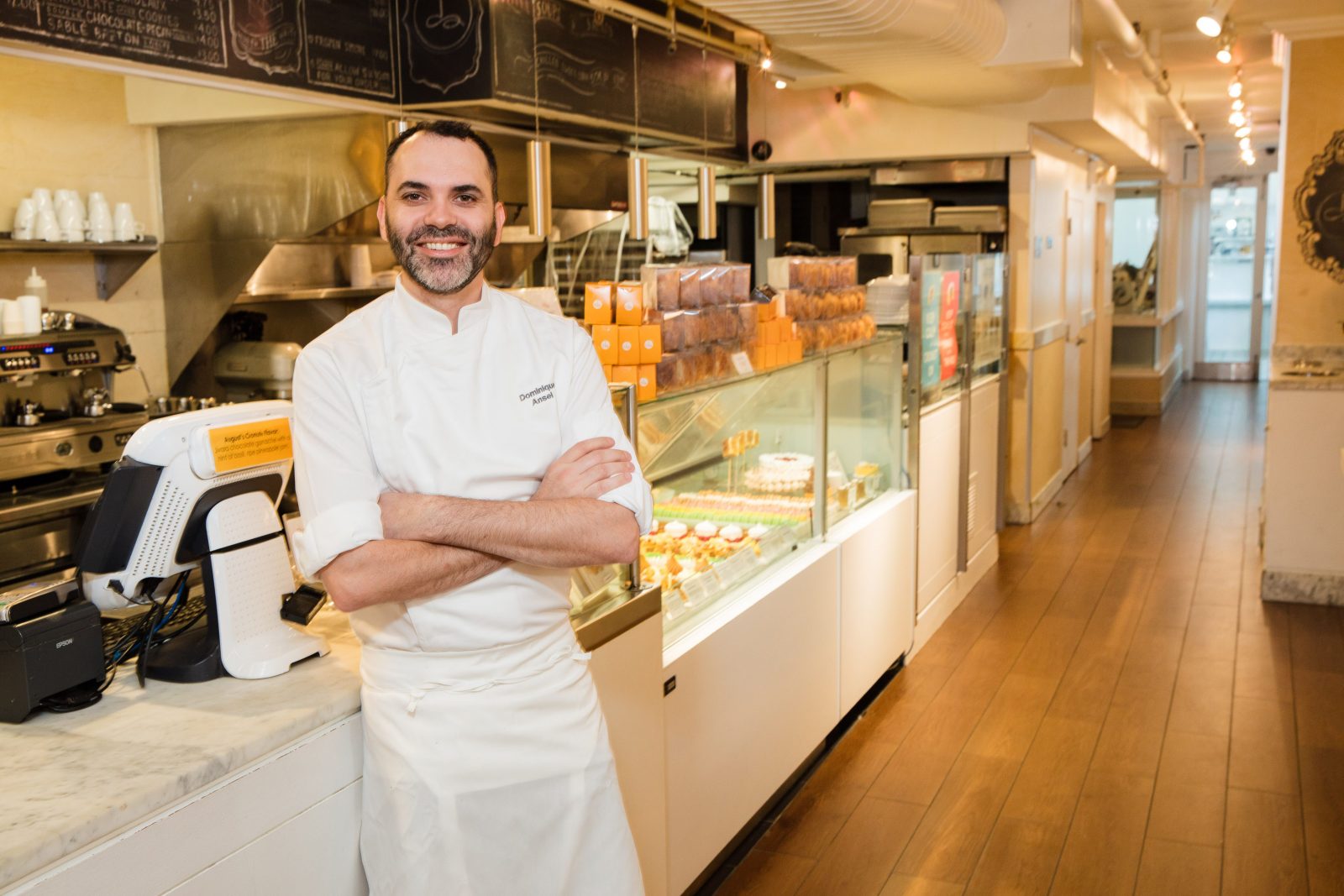
Christopher Kimball: This is Milk Street Radio from PRX, and I'm your host, Christopher Kimball, today we're embracing holiday baking with Dominique Ansel, a French baker who had to travel all the way to America just to taste a good cookie.
Dominique Ansel: I remember the cookies when I was a kid. They were just a few in the pastry case. They were dry, they were flat, they were not good at all. French people don't eat cookies.
CK: Later in the show, it's my conversation with Dominique Ansel, the creator of the Cronut. But first we're tackling your holiday questions with my special guest host, Cheryl Day. Cheryl is, of course, the author of Cheryl Day's Treasury of Southern Baking. So, Cheryl, it's the holiday cookie time. I know lots of people who spend most of December doing nothing but making cookies. It seems like the only time of year they make them. But, you know, I have my favorites, like Moravian you know, cookies? (Oh yeah) those are good because they're thin and they're spicy. Do you have a cookie that most people don't probably make or know about that I should put in my list?
Cheryl Day: Hmm, that you Christopher Kimball does not know about
CK: Well, I mean, just something that you really love that's not the typical sugar cookie.
CD: No, I'm really traditional. I love a great molasses cookie. I love my sugar cookie recipe. I just love the tradition of making old fashioned cookies, and I just kind of have the same ones. But I'll have to think of something new this year
CK: Wait I have something new (okay) something old. You know, in the old days in the 16th, 17th century, in London, they used to do gingerbreads, and for special occasions, they were like three feet high. (Oh, wow) They would frost them to be like a king or a queen or whatever. They were very elaborate. But I think the idea of a giant gingerbread (that would be amazing), like a one-foot-high gingerbread, or two foot high gingerbread, I think that would be really cool.
CD: And recently I saw, I'm trying to think where I saw this. It was almost like a brioche made into the shape of, like ginger people with different fillings inside. And I thought that'd be a fun thing, you know, to make too and tie it up to give. I love giving food gifts, period. I just think, you know, food gifts are just so thoughtful. And, you know, from the heart. So, I just try to think of, you know, ways to give in that way,
CK: Another excellent reason to be a friend of yours.
CD: You want one of those brioches?
CK: Oh, yeah, man. All right, let's take a call.
CD: Welcome to Milk Street. Who's calling?
Caller: Hi. My name is Ashley.
CD: Hi, Ashley. Where are you calling from?
Caller: I'm in Los Angeles.
CD: How can we help you today?
Caller: My question is, every year around the holidays, I start making cookies, as one does, yeah, every year I keep thinking, okay, there's got to be a way to get more on top of this. And my question is, what doughs can I freeze when? So, I know some does you can freeze, like, just the whole mass of dough, but should I, like, form the cookies and then freeze them and bake them off. Or should I bake them and freeze a baked cookie? And if I have the ones that you shape, like in the cookie gun, can I shape them and then freeze them in shape?
CD: Yes, you can do all of those things, but I'll tell you I am on team, bake then freeze. And I'll tell you why. I had a baker that used to bring me, and I owned a bakery for, gosh, over 22 years, but she one of our bakers, would bring me a holiday cookie box for Christmas, and it was the best thing ever. And I could never figure out with our schedule how she had time to do this, so I asked her, and what she did was she baked all of her cookies, and then she froze them, and then some cookies, you know, she would need to fill or decorate. So, she'd thaw those, and then she would fill them and decorate them as needed. And then they were great. But when she baked and froze them, she just put them in, you know, nice containers that you could put parchment in between the layers, and they tasted, I mean, I just could not believe it. So, I've been on Team bake than freeze ever since. But yes, you can also, you know, have your doughs, but why not just get it out of the way? You know, then they're done. You definitely can. If it starts with creaming butter and sugar. You can definitely bake them off later, but then you'd have to thaw them out some you can, you know, bake straight from freezing. And it gets complicated. The only cookies that I don't. Don't do that too. Is like a meringue cookie, but otherwise, yeah, it definitely saves you so much time in the long run.
Caller: Even like a chocolate chip cookie or a like gingerbread cookie, that is, you know, you want a little chew and a little crisp like, that's not going to be affected poorly
CD: Not at all, not at all. I mean, one of my favorites is like those shortbread type cookies that are like crescent shape that you dip in chocolate, the texture and everything is really great. So that's my answer. I'm sticking to it. What about you, Chris?
CK: Yeah, I would agree, if you've done more of that than I have, the exceptions would be like something you have in the freezer when someone comes over unexpectedly, right? And you want something to be fresh out of the oven, something like that, which you can freeze shaped and then just put them on a baking sheet and bake them. Then you have the smell coming out of the oven. They're warm. But for Christmas cookies, I agree, yeah, you could do it ahead of time.
CD: Well, it just saves you so much time, and it's not as daunting to have to bake them all at once.
Caller: Yes, and have five different doughs going right? Well, this is blowing my mind. I mean, this means I can start earlier and go slower, and this is amazing news for me
CD: And enjoy your holiday, right?
Caller: Yeah, absolutely
CD: Please report back.
Caller: I absolutely will. Cheryl,
CK: Cheryl, I think this was life changing.
CD: I mean, I always keep some cookie dough, like Chris said, in the freezer. You know, when you just have a hankering for cookie, but I just think baking that cookie box with all the variety you definitely need ahead, you know, a hands up, yeah, for sure.
CK: Yeah. One of my kids there was a cookie swap last Christmas, and I think she spent three- or four-days baking cookies. I think she needed to go into a rest home for a week.
CD: That's how you feel.
Caller: Yes.
CK: I mean, she was totally done in after that. I agree. You got to shift some of the work ahead of time.
CD: Well, thanks for your question.
CK: Thanks for calling.
Caller: That's amazing news. Thank you so much. Take
CK: Take care.
Caller: Bye.
CK: This is Milk Street Radio. Cheryl and I are here to better your baking. Call us anytime. Our number 855-426-9843 one more time. 855-426-9843, or email us at questions at Milkstreet radio.com
CD: Hi, welcome to milk Street is calling.
Caller: Hi, this is Jennifer Joe's calling from Peoria, Illinois. How are you?
CD: Great. How are you, Jennifer?
Caller: I am great. I'm so excited.
CD: I went to Bradley University.
Caller: I teach biology there.
CD: Wow, that's amazing.
Caller: I am actually teaching a class this semester where we talk about the science of baking in this class. So, what is baking soda? What is baking powder? Why do we brown our food.
CD: Oh, I love that. Well, how can we help you today?
Caller: So, one of my questions is about brown sugar. We have a lot of family in Maine, so we love that kind of dark molasses flavor in our foods, and so I prefer the flavor of dark brown sugar. Most baking recipes call for light brown sugar. Can I usually substitute them one for one.
CD: You really can. I mean, there is a slight difference. And since we're talking about the science of baking, there's more acid in dark brown sugar, which, when you add for a cookie, you're going to be adding baking soda, and that's going to activate that, but it's just going to make your cookies rise just a little bit more than the light brown sugar. And that's not a bad thing. But yeah, it's slight, and if you were weighing it, it would be exactly the same.
Caller: Fantastic.
CD: Chris, do you think?
CK: Yeah, I think light brown sugar is 3% molasses and dark brown 6% or whatever. But, yeah, I don't think it's going to make a big difference no.
CD: And if you prefer the flavor of dark brown sugar, I say go for it. Jennifer
CK: And you know, very often Cheryl's probably did this too, you reach for the dark brown sugar, all you have is light,
CD: Right. You're still making cookies.
CK: You're still making Yeah. So, you're still in business. So yeah,
Caller: I always have both in the cabinet, and I never really know if it actually matters or not.
CD: Well, it's funny, a lot of recipes don't even you know, say which? They just say brown sugar. Some recipes so
CK: How do you keep your sugar nice and soft and loose? Do you put a little sugar bear in it? Or do you keep in the fridge or what?
Caller: I do I have them in are they called, like, Cambro plastic sugars, like food prep, and then I do have the little clay sugar mine's shaped like a gingerbread man, but yes
CK: I find they work pretty well. And then I keep it in the fridge, and it actually works. You don't get that solid block of sugar.
Caller: I find that works really well. Tell us to just use it really quickly.
CK: Well, that's true. There you go. It's like, what do I do with all the bourbon in my house? Well just drink it that's the best thing. All right, thanks, Jennifer.
CD: Thanks for your question.
Caller: Thank you.
CK: Appreciate it.
Caller: Bye
CK: Welcome to Milk Street. Who's calling?
Caller: Hello, my name is Julie. I live in Ramsey, Minnesota.
CD: Hi Julie.
CK: How can we help you?
Caller: So, I have this recipe that was my grandma's, and I had it multiple times growing up. It was always my favorite, and I've made it multiple times with different things, and I can't get it to turn out. I don't know. I think maybe there's an ingredient missing from her recipe card.
CD: Probably
CK: Give us the basic recipe approach. What do you do?
Caller: So, it's almond brittle, and she's got one cup of white sugar, two thirds to one cup of whole blanched almonds, one half a cup butter or margarine, and one tablespoon of water. And then she used to make it in a cast iron pan. And she didn't pour it down and break it. She poured it into individual probably two and a half inch circles, and she poured them on wax paper to cool. And I've tried butter, margarine, I've tried white sugar, brown sugar, I've tried non skip. I've tried cast iron. I can't get it to work. It either hardens in the pan or it doesn't harden at all.
CD: Baking soda, no baking soda?
Caller: No. That is not on her recipe. Do you think maybe that's what it needs?
CD: I've never made a brittle without it. I'm a little perplexed about the individual portions also. And you said you used to make it with her.
Caller: Yeah. We made it every year. That was kind of our thing.
CD: Wow, that's awesome. And you drop it on the wax paper, you know, what it reminds me of is something we do in the south. Pralines, or pralines,
Caller: Oh, yes. And those are so delicious
CD: Which is made with dairy. But this was definitely a brittle though.
Caller: Well, that's what she calls it. Yep, it was hard. It was a little bit chewy though. It wasn't hard like peanut brittle. It was chewy than that, but not as chewy as a caramel.
CK: When you make it what's going wrong? The texture is wrong.
Caller: Yes, the texture is wrong. By the time I wait for it to get the golden color, it's gotten too hard. And if I don't wait for it to get the golden color, then it doesn't get hard. Have
CK: Have you tried adding a little corn syrup to the mixture when you're heating it?
Caller: I think I did once, because I looked at a peanut brittle recipe and it called for that, but that didn't work either.
CK: Do you use a candy thermometer right when you're doing this. Are you just looking at color?
Caller: I'm just looking at color.
CK: I would get an Insta-read thermometer, a good one, because you want to get that sugar syrup to what, 248 to 249 250 whatever it is. I think also, then you add other ingredients, and then I think you may have to take it up to a higher level on the second pass with this, I think what's happening, I think, is it's the wrong sugar temperature. Either it's (okay) too high or too low. If you don't have any chew, you just may be the sugar is being brought to too high temperature. That would be the thing, right? Cheryl,
CD: Yeah. But I'm really still perplexed about the texture, because I've never seen or heard of a brittle that's individually done, and it seems that it would be hard to do it quick enough, (right) You know? So that's what made me start thinking about a proline or praline, which has dairy. So, I do think there is a missing ingredient.
Caller: It's not foggy, like a praline, that's more clear, and it's not soft, like a praline, I know you can just kind of break it, it's not that soft.
CD: It's not soft, okay? It's a brittle, like she called it.
CK: I would add corn syrup, and I would definitely get as good Insta-read thermometer and nail the temperature. That's the problem with candy making. It's has to be pretty precise. Also, when you take the temperature, you push up the pan a little bit, right, so the liquid goes away from you in the pan. So, when you put the thermometer tip in the middle and you mix it around a little bit, you're getting an accurate reading, because that's also a problem
Caller: Okay. How much corn syrup do you think would be good? Two cups
CK: Two cups of sugar, four cups of sugar, what's the amount? One cup, two tablespoons of corn syrup is fine.
Caller: And then Cheryl, what are you thinking about the baking soda?
CD: For that amount, that's not very much, no, so maybe a half a teaspoon,
CK: Yeah,
Caller: Okay, I will try both of those things
CD: Because, I mean, I would think that that would help. But have you ever had trouble when you're scooping it out or portioning it out? Do you have any trouble getting it done fast enough before it sets up?
Caller: Well, I haven't gotten it to set properly, so I haven't come across that yet
CK: We need to have a new rule on this show, which is, if someone's making something delicious, they have to send us some right?
CD: I think so too.
CK: I mean, this is definitely put some in the mail, because we love to try it, right?
CD: Yeah, I mean, I just love the thought of it being on a little piece of wax paper. That's just so you know, old timey, yeah.
CK: I love it.
CD: I love it too, yeah.
CK: All right. Hope that works out.
CD: Okay, thanks for your question.
Caller: Thank you so much.
CK: Take care.
Caller: Bye. Bye.
CK: You're listening to Milk Street Radio right now. Author, Julia Georgallis is here with a tip for how to eat your Christmas tree.
Julia Georgallis: Hi, I'm Julia Georgallis, and here are three ways that I really like to use my Christmas tree in my cooking. The first is a recipe based on a traditional Italian cake called torta di pinol Chocolate. Pine nuts are something that people don't usually associate with Christmas trees, but they do actually come from pine trees, and so the way I like to use these is to toast the pine nuts in with the butter and incorporate them in a really chocolatey, gooey brownie. The second way is hands down, one of my favorite recipes, Christmas tree ice cream. I really love to use blue spruce as weirdly, spruce tastes quite a lot like vanilla. And so the way that you make this ice cream is you take a big bunch of Christmas tree needles, clean them really, really well, chop them up, and steep those needles in a custard, cream, milk, sugar, egg yolks, and then you end up with this beautiful Christmas tree flavored ice cream, which is really exciting and quite surprising, I think. And then the third way is really, really fun. You can make a Christmas tree booze so you can use your older dryer Christmas tree. You could also use the bark. And what you would do is you take two large handfuls of spruce, fir or pine, put them in a sterilized glass bottle full of good quality gin or vodka, and let the alcohol infuse for about four days, and after you've got yourself a really beautiful kind of alpine flavored alcohol, which you can gift or you can drink well into the new year, happy holidays.
CK: That was Julia Georgallis, author of How to Eat your Christmas Tree.You can get her recipe for Christmas tree ice [email protected]. Coming up after the Break, how a viral creation changed one Baker's life. This is Milk Street Radio. I'm your host Christopher Kimball
Cronuts news segment: it's no surprise people go nuts for cronuts, the $5 croissant donut confection that's gone viral. People lining up as early as 5am even overnight, sometimes just to snag a maximum of two of these elite treaties.
CK: That was a clip from an ABC news segment in 2013 when Baker Dominique Ansel went viral for his invention of the cronut. What happens after a viral baking moment? Well, 10 years after the invention of that pastry, Dominique Ansel. is here to tell us, Dominique, welcome to Milk Street.
Dominique Ansel: Thank you. Thank you for having me.
CK: I actually have used your recipes, and you actually have changed the way of bake. I've always loved to bake, but some of your ideas were I thought, really innovative, and you're high on my list of experts on baking.
DA: That's so nice to hear. Thank you.
CK: So, you're a serious guy, you're a serious baker, and then this phenomenon happens, which you know, I'm sure you don't regret, but I guess you never thought when you got started you'd at least briefly end up with a bouncer outside.
DA: Absolutely not, I don't think anyone can think of this. If you had told me that, like 20 years ago, I would have laughed at you. But I did. I did, and remember it was like 2013 I only had four employees at the bakery and were trying to do something special, and had made this pastry just for the weekend, and randomly, a friend of ours snapped a photo of it and put it on his blog. Still had blogs at the time, and he had to call me same day and explained to me that his article went viral. So of course, you know, putting things in perspective, I was just the beginning of social media, something going viral, like, like, have nobody was talking about, like, I'm happy for you. You have to go on viral. It's like, no, you don't understand. We had an increase of traffic of 300% and over 140,000 links to the same article in just couple hours. This, this thing is huge. Be ready. You're going to get busy this weekend. Like, oh, sure, yeah. You know, I made like, 35 today. I'm going to make 45 tomorrow. And little did I know, by day three, we had over 150 people line up before we even opened the shop. People will come as early as two o'clock in the morning lining up on the sidewalk. You know, the neighbors were calling the police because they were not so loud. It was like madness. It was like so overwhelming.
CK: So, what's so good about the cronut? I mean, first of all, explain to me how you make it and secondly, why did it become such an obsession with so many people do you think?
DA: Sure, so how we make it this similar process to croissant takes about three days to make why it went so so big and viral is still hard to pinpoint exactly. A lot of people ask me the same question. I think it was a time where people were looking for something exciting, something new, and we had this like, you know, cute. I will say cute idea to combine a croissant a donut shape and to finish it like was elegant. He was changing the flavor every month. And then, you know, things went viral because people relate to it. People like, understood what it was, and then picked it up from one news to another, from one country to another. And then, you know, before we knew it, it went across the world.
CK: Did you come up with a name? Or was the name? Did someone else come up with it later?
DA: Yeah, we came up with a name. It was very interesting, because at the time, we had a friend who also was a lawyer. She was like, oh, listen, you know this great idea, you should trademark the cronut. I was like, no, no, no. I don't want bother with that. She was like, no, no. You seriously, you should, you should do it. I was like, no, no, there's no need. It's just a pastry. I don't want to do that. She's like, listen, I'm going to do it for you. (Good for her) and we'll talk about it later. And she did it. And five days later, they were about 27 applications for the same, same name, and she explained to me that trolls will go after it. If it goes viral, they will try to trademark it before you, and they will prevent you from using your own name.
CK: Well, that's because very often the big difference between one thing and another is the name,
DA: Exactly, yeah, and the name sometimes is the mark that people recognize as a product.
CK: Are there different styles of being a pastry chef, you know, doing a perfect tar tatin or coconut layer cake, or just doing, you know, like in Japan, you do the same thing over and over again to get really good at it for years. Then there's, you know, for the eye, right? The pastry chef, where the plate is entertainment, lots of little dots of fruit puree, et cetera. So, there's a lot of presentation. Where do you stand on that, in terms of either just doing a great job with something familiar, on the other end of the spectrum, you know, making dessert an experience, or is there, is it always just a combination of those things?
DA: Yeah, that's actually a great question. I think you need a little bit of both. I would say, like, you only recognize a good pastry chef by a perfect croissant. And a croissant is very telling. It sounds simple, it sounds silly, but it's it's very hard technically to master.
CK: No hold on. Croissant does not sound simple. Croissant, to me, sounds like the hardest thing in the world you can possibly make. And I've tried
DA: But it's simply in the in the idea of it, you know, it's like, hundreds of years old. It was some similar shape to French classic. You can find it like all around the world. There's a lot of bad croissants, so many bad questions all over the world, but it's hard to find a good one.
CK: So you go to Paris, and you start dropping off resumes at various bakeries, and you say, after just a few days, I had eight job offers. So what year was this and why? How did you get eight job offers, just randomly dropping off resumes.
DA: So, I was living, living with my parents, coming back from my military service, and I just want one thing is to find a job in Paris. So, I had, like, $2,000 of savings. I had bought this small car that was falling apart, and will drive from my hometown to Paris in. Video, but an hour and a half drive, and I was completely lost, I will drive around with my huge map that will unfold in the car because no GPS, no cell phone at the time, and every time I would see a bakery, I was parked the car. Quickly drop off a resume and run back to my car. Eventually, you know, people will start calling, asking me, you know, questions and offering me jobs on the phone. It was 1998 was, you know, still in my 20s. Oh, no, that was barely 20s. I was 19 years old. It was, it was a fun time.
CK: So, let's, let's get into baking and recipes. You like souffles, you talk about a fruit souffle. So, a standard souffle usually some sort of a bechamel base. But the fruit souffle is that a cooked, thickened fruit base, as the base for it, or do you use, still use a bechamel? Or what's the base of a fruit souffle? So
DA: So, fruit souffle usually is a puree of fruits that you mash up and then strain, and then you make custard with, like pastry cream. My one of my trick actually, is that I add a little bit of corn starch. So, corn starch, kind of like stabilizes the egg whites and keep it good, right there. I remember my days at Daniel working for Daniel Boulud I had 10 desserts on the menu. And always, there's always someone that wanted a classic souffle in the middle of service on a Saturday night. And of course, you know, it throws like, everything off, and you have to stop everything, like make a pastry cream and whip the egg whites, and you have to time everything with server. It's very, very challenging. So, what I found out, but with the regular recipe, just special cream and egg whites always collapse. It will never, like, rise up the right way, or is cracked. There's always something wrong. So, what I found out, I added a little bit of corn starch, and with the egg whites and the corn starch, that made the perfect texture.
CK: So, you're you're whipping the whites, adding sugar to the whites, and also adding some corn starch to the whites. As you
DA: Actually not, I add the corn starch in the pastry cream (I see) and when you put in your dish, you can keep it in the fridge for a couple of hours and then just pop it in the oven and it rises up perfectly. It's just like the perfect recipe.
CK: But then you've also said, and I agree with this. You say it's important to leave room for mistakes, but being a pastry chef, they're very little room for mistakes because it's precision, it's weighing, it's science. So, when is it okay to leave room for mistakes?
DA: I think your whole life you have to leave room for mistakes the only way, like human people like learn. You know, we still make mistakes in our kitchen every day, but the learning experiences in life, and none of us is born like doing everything perfectly. I still do mistakes, and I still learn from it, and thankfully, if I knew everything, I'll be it would be a boring life.
CK: Well, I should get a medal of honor for mistakes. I think the key is not whether you make mistakes, it's just surviving them. Speaking of failure, you say, “I loosely wrapped a thin strip of paper around a bowl of ice cream covered in petals made out of meringue. The dish started out looking like a flower, but when the paper was lit on fire, the flames would slowly work themselves around in a circle, melt the flower petals one by one, and end up looking like an ashtray at the end”. So, What? What? What is this dish? What is?
DA: This so this, this dish is we created this dish. The theme was the first time in life. And one of the dish was first heartbreak. So, I wanted to talk about the beauty of love and how it starts with, like a beautiful dish. So we had made like this ice cream, just rocky world ice cream with a little marshmallow on top and and then, if the dish was hidden, a little piece of rice paper that was sticking out with a love notes, and we'll give people matches, and we'll tell them to light on fire the little love notes, and they will like, see the paper like burning and melting all the meringues around the little ice cream, and turn these meringues into ashes. So, there was the interpretation of love, starting with something beautiful. And sometimes, you know, first heartbreak ending up into something like very sad. And what do we do when you have a heartbreak? You eat ice cream.
CK: That's quite a story. I really like that. Something beautiful, complete disaster, and then you drown your sorrows in the ice cream, French rice pudding Teurgoule. I've never heard of it. Kind of looks like a Basque cheesecake or something with a very dark top to it. I'm a big rice pudding fan, but this one seemed really interesting. It's from Normandy. You want to just explain it, because I don't know why. I never heard of it, but it sounds great. Yeah,
DA: Yeah, it's a French classic. Teurgoule is from. Is from Normandy. Traditionally, was in a made in cast iron. It was rice that they were putting dish covered with milk and let it like this, cooked in the oven for a couple of hours until it gets dark. So, Teurgoule is like delicious dish. It's it's so good, it's creamy. This is, like beautiful, almost like creme Brule, like layer on top, almost like a Basque cheesecake, like you just described, very dark and the bottom should be like, creamy and soft, just like sugar, milk, you know, a little bit of rice and put this in the oven. It's more simple and delicious, easy to do, rice pudding.
CK: Another thing I love about what you do is you decide your wife really likes the chocolate pudding at the hospital, so you make your own version. So, what was so good about that chocolate pudding, and what did you do to sort of make it more interesting?
DA: I think in this new cookbook, Life’s Sweetest Moments I think we talk a lot about why people back and the reason why people buy pastries from us. You know, to say thank you, to say I'm sorry, sometimes to say congratulations, to say happy birthday, there's always a reason behind why people buy pastries, the chocolate pudding you know, it's a moment where my wife and I had our first baby at the hospital, and she was eating that chocolate pudding. And it's such a simple dish, it's like, it's not the greatest one, but, you know, sweets comforting. It's simple and it makes you, reminds you of that moment in time where you leave something special. So, the connection between the food and the memory is, like, very important.
CK: Well, I would just point out for our listeners that you added the dollop of olive oil Chantilly cream. So okay, you do. You were, you were sexing it up, or, however you want to describe it
DA: A little bit, yeah, for sure,
CK: The ultimate cookie. I mean, I've discussed the ultimate cookie with many people over the years, so your ultimate cookie is, what?
DA: My ultimate cookie is, something warm out of the oven, like every American kid, and you know, like I can say that now I understand, and I know what what a good cookie is. I grew up in France, where we had no clue what a good cookie is. I remember the cookies when I was a kid. They were just a few in a pastry case. They were dry, they were flat, they were not good at all. French people don't eat cookies.
CK: Well, I have this thing about cookies like, like a chocolate chip. Everybody over bakes them because they think the center should be set, but it's like pie custard pie, the center should be soft, and it'll continue to bake when it comes out of the oven. So almost everybody over bakes their cookies, you're right, and once you over bake it, they're just not that good.
DA: Yeah, for sure. And it's, it's, it's fascinating to me, because, you know, again, I bring you back to, like, the nostalgia of being a kid. I always ask people, what is the first thing you've ever done in kitchen? 95% of people will answer me, it's something sweet, it's a pie, it's a cookie. It's a, you know, it's a pound cake that I made with my mom, my grandma. And it's amazing, because people are always scared of baking. There was things more complicated, more scientific and more tools, but it's first thing they don't know as a kid. And when you think about it, why did they think back as a kid it was so simple and so easy and so like comforting because they always had mom or grandma, like baking with them, guiding them step by step. That's why, when I think of cookbooks, I always make it like as simple as possible. I always make it as like a approachable as possible. So, people feel like, almost like the baking with their mom or the grandma,
CK: Dominic, just thank you so much. I love your work. I love your recipes and all the best. Thank you.
DA: Thank you. It's a pleasure.
CK: That was Dominique Ansel. He's a pastry chef, also author of Life's Sweetest Moments. You can find his recipe for Teurgoule at Milkstreetradio.com. You know, the world of baking is full of curious creations, such as Dominique Ansel’s Cronut. But many Christmas celebrations are even stranger. In Sweden, they celebrate the Yule Goat. In Japan, a special holiday meal is sold at Kentucky Fried Chicken under the name Kentucky for Christmas. In Russia, Santa is accompanied by his granddaughter, Stegoruska, the Snow Maiden. In Finland, it's children's shoes instead of stockings to hold the gifts. And in Eastern Europe, Krampus the evil companion of St Nicholas. He punishes bad children with birch rods. But my favorite tradition is actually American. It's the Christmas pickle, an ornament hidden on the tree, and the child who finds it gets a special present. Pickles and Christmas now there's a festive holiday tradition. I'm Christopher Kimball, and this is. Milk Street Radio right now I'm joined by Rose Hattabaugh to learn about this week's recipe, Paris flan. Rose, how are you?
Rose Hattabaugh: Good. Chris, how are you?
CK: Good. I was in Paris not too long ago, and I stopped by a restaurant called Amazonia, and the pastry chef at the time was Stephan Jimenez, and he's been around. He's French Laundry. He's got a long, long background, and he made something for me, which is common in Paris, but not here, called Paris flan, or Pari flan. It's pastry cream in a crust baked in a __ and it's four inches high. There's this behemoth thing, and the secret of this was the crust was thin, but the pastry cream filling was light, you know. And you think about, oh, my God, I'm going to eat, you know, two cups of pastry cream, a stomach bomb. But it was like magic. So, I think you fell in love with it, too. But we started with a crust in the pan. You know, in Europe, of course, they use these metal rounds that have no bottom. And of course, most people in this country don't do that. So how do we fix that problem?
RH: Well, we found the best thing to use for this because, as you said, it's a pretty high crust. So, spring form pans seem to be the best way to solve this problem. So, if you take the crust and drape it over a spring form, then you can push it into the sides and use a paring knife to kind of cut it where you want it, and that worked out perfectly for us. It's also kind of a nice way to store it if you're going to make it ahead.
CK: He also showed me a pastry dough method in a stand mixer with softened butter and flour, and then he added the egg and sugar, but he mixed it for just a minute or so, and then he foraged it. I think he chilled it maybe for a bit, but he pressed it out with his heel just once or twice and gathered together. The whole process took two minutes, three minutes. Now that's something that's more of a pastry chef technique, but I think we decided to go with something a little more American, right?
RH: Yes, the dough is made in a food processor, so it's a little bit easier for a home cook.
CK: So, we prebake the dough, and then meanwhile, we make a pastry cream. Just maybe refresh everyone's memory about what is a pastry cream, and then getting the thickness was kind of tricky, right?
RH: Yeah, yeah. Well, pastry cream is you're heating milk and cream, or sometimes just milk, just cream. We're actually using a whole quart of milk and a couple of cups of heavy cream, but you add some vanilla to that, and then you want to temper some eggs with it. The real challenge with this flan is that you want to make sure the amount of corn starch that you add that will actually thicken the pastry cream doesn't make it too thick or gummy or doesn't make it so soft that you can't slice it. So that was the problem really we worked on, I think we used about a half a cup of corn starch in this, and that seemed to be the perfect amount.
CK: And of course, sugar as well.
RH: Oh yes of course
CK: Nothing like a sugarless base, right? So, we fit the dough into the pan and then refrigerate that. Meanwhile, you make the pastry cream. I put the warm pastry cream into that cold crust, and then you put that back in the fridge, because during baking, if you don't, the filling is going to rise up too high over the sides of the crust, and then that goes into the oven, but then when it was ready to slice, after it had cooled, he showed me. Stefan showed me this great trick. Take a serrated bread knife cut directly across in half, down through the crust and a little bit into the custard, and then take a typical thin chef style knife to cut, and that way the pastry crust gets cut cleanly, you'd end up breaking a piece off because the crust itself is pretty thin.
RH: That was such a great tip, because you get such a beautiful slice because you're not trying to cut through something crusty and then the creamy filling. And I'm glad you brought that tip back, because it was great.
CK: Yeah. So, this is like, one of those. well, not rare, but sort of rare times when I come across something I'd never seen. Millions of Parisians are familiar with it. You know, kids would get a slice. You know, at the bakery coming back from school, it's absolutely delicious. And the secret is, it looks heavy, but it's light. And I think the baking, I don't know if you agree with me, but I think something happens to a cooked pastry cream in the oven, where it's sort of baked a second time. I think it rises up and becomes lighter. It's not as dense as a typical pastry cream.
RH: Yeah, it's amazing how light it is. You know, when you look at it, you think it's very thick and heavy, but it's so delicious, light, so vanilla-e, I think it's a perfect dessert.
CK: Yeah, when he gave me that slice, which was huge, I was a little taken aback. And then I ate the whole thing, and I felt fine. I had no regrets whatsoever. So, Paris flan, essentially pastry cream in a shell, a pastry shell lighter than it looks and easier than it sounds. Rose. Thank you.
RH: You're welcome. Have a great holiday. You can find this recipe for Paris [email protected]
CK: You're listening to Milk Street Radio Coming up our favorite food books of the year. Hi. I'm Christopher Kimball, and you're listening to Milk Street Radio right now. It's time for some holiday cocktail inspiration from JM Hirsch.
JM Hirsch: There's something winter weather romantic about a hot buttered rum, but it's not exactly a crowd friendly cocktail. Luckily, I've got the perfect trick for turning this classic into a batched cocktail that's ideal for holiday entertaining. The secret is a fancy, yet still simple cocktail technique called fat washing. Here's how it works. Fatty ingredients, things like bacon fat, coconut oil or peanut oil, are packed with flavorful molecules that love to dissolve in alcohol. So, when you stir together a liquor and a fat and you let them sit for a bit, the liquor quickly tastes like that fat. That's right, you can make bacon flavored bourbon, but don't worry, you're not drinking the fat. After a quick infusion, you pop the mixture into the freezer, the fat solidifies and becomes easy to strain out, leaving just the flavor behind. So let's use this trick to make a full bottle of buttered rum cocktails, one of 75 batched cocktails in my book. Freezer Door Cocktails. Start by combining 18 ounces of aged rum and one stick of melted butter in a four-cup liquid measuring cup. Leave it on the counter for 10 minutes or so, stirring it every once in a while. Now, pop it in the freezer for about an hour, or just until the butter rises to the top and hardens. Next use a mesh strainer to strain the rum into a 750-milliliter bottle. Discard the butter or save it to make some pretty amazing popcorn to the bottle. Add two and a quarter ounces of orange liqueur, two and a quarter ounce of agave or simple syrup, two ounces of water and a generous pinch of grated nutmeg. Cap the bottle, give it a shake and stir it on the freezer door until ready to serve. When ready to serve, offer the bottle with coupe or cocktail glasses and some hard apple cider for adding a splash to each glass.
CK: I'm Christopher Kimball, and you're listening to Milk Street Radio right now. It's time to look back on the year with our very good friend, Adam Gopnik. Adam, how are you?
Adam Gopnik: I am well, Chris, how are you?
CK: I feel it's that time of year where our literary muses come out and we reveal our favorite food related books. And since you're an avid reader and avid cook, you should go first
AG: the Gopnik Kimball prize. Let's try. So, my first book that I particularly enjoyed and learned from this year was The Editor: How Publishing Legend Judith Jones Shaped Culture in America by Sara B Franklin. Now the subject of this book, as you know, Chris is the publishing legend Judith Jones, who was an editor and shaped culture in America. Really, the subtitle should be shaped cooking in America, because, though it's true that she was an important literary editor, her central contribution to American letters and American culture was bringing Julia Child to the attention of the United States in the 1960s and what fascinated me about this book, which is extremely well done, is that she really invented, in a sense, the cookbook as we have it now. Because what was unique about Julia Child and the Mastering the Art of French Cooking, as it came to be called, was that it was both about an individual and a cuisine. And if you think about it, Chris, almost every successful cookbook now almost always involves a single figure who's being offered as a prism into a larger culture that seems self-evident to us now, but it wasn't self-evident in the mid 19 60s, when Mastering the Art of French Cooking came out, and then Judith went on to publish many other books, cookbooks of a similar kind and genuinely transformed our understanding of what a cookbook is.
CK: She did well, my first book, and one of my favorite books of all time, is called The Light Eaters by Zoe Schlanger. It's about whether or not vegetables have a soul. And the conclusion is they might, which is pretty amazing, but if you put a cabbage in boiling water, it releases a death sound. Many plants, like pea plants, send their roots towards flowing water. They know where it is. Corn, when attacked by a caterpillar sends out a gas to attract the right type of wasp, which will come inject eggs into the caterpillars and kill them. So, this notion of plants being able to make decisions based on their environment is just absolutely fascinating.
AG: That is both fascinating and, quite frankly, a little frightening, because now you're telling me that a carrot is capable of emotion, that we will soon be cordoned off into a corner drinking water and eating what exactly?
CK: Adam corn on the cob. No, can't do it. (Can't do it) anyway, The Light Eaters highly recommend it
AG: I will get it right away. My next book is by Ariel Johnson, who I think should be Dr Ariel Johnson. Ariel Johnson, PhD. It's Flavorama, a guide to unlocking the art and science of flavor. Have you? Have you read this one?
CK: Yes, I have.
AG: I thought it was fascinating. Now, normally I'm a little skeptical or even allergic to books that take on the molecular level of our experience of taste. But this book is so well done, I thought. It's so revealing in terms of what it is that creates flavor, the interaction of molecular chemistry and human receptivity, that I not only did I learn something from it, but I felt that it gave me a sharper understanding of the palette of flavors that I'm playing with all the time. It actually helped me sharpen my own cooking. So, I thought it was a book that made the connection between the scientific layer and the esthetic layer, lucid in a way that no similar book had for me before.
CK: Yeah, I really those books are tough because sometimes they get into molecular biology. But I thought she made her case clearly and in a conversant way, right? So, you could really understand it. My next book is called Rintaro. You probably know the restaurant in the Bay Area by Sylvan Brackett, who came to California from Japan when he was mere babe. But what I love about this book, besides the design with wood cuts. It just is a fabulously designed book. But he takes Japanese cooking and kind of makes it Tuesday night cooking like chicken meatballs or frying breaded chicken breasts with a slice of cheese in the middle, perfect for my young kids, blanched vegetables with a cold season dashi. So, there's a lot of day to day, useful stuff. It takes Japanese cooking to the American table in a way that was really charming, and also talking about flavors and combinations and colors in Japanese cooking, but it was a combination of the sublime and the everyday that made this for me, probably my, one of my favorite cookbooks of all time.
AG: Wow, that's that's high praise. I have not read this book through I have leafed through it at the local cookbook store, and what struck me about it is it wasn't taking Japanese cooking so much up to the next level, but in the best sense, down, down to a more accessible level. (Exactly). My final book, you know, I always love to bring a vintage classic to these conversations, and this is one that's been a classic for a long time and that I had frankly been avoiding. It's Robert Farrer Capons, The Supper of the Lamb, which is, you know, was first published in 1969 I was a little skeptical of it, because I tend to be skeptical of overtly spiritualized books about food, but I discovered that this book is, in fact, an absolutely delightful meditation on, not so much the spirituality of cooking, but if you like, The Zen of Cooking. Robert Capon, when he wrote it was an Anglican minister and has a powerfully Christian content, but of a wonderfully idiosyncratic kind. There's a charming part where he talks about the pleasure he takes in an absolutely horrible bottle of bogus Kirsch that he keeps in the house, and he writes, I take a sip to remind myself what a paragon of awfulness it is, but partly to prove that for all its faults, it is not undrinkable. In a real world, nothing is infinitely bad. My bottle of bogus Kirsch bears witness that there is no bottomless pit in any subject, that to be good or bad is not as much of an achievement as to be at all. That's a sentence I would have loved to have written.
CK: Yeah, that was a good one. And my last book, and this is for people who love waffles, split waffles, rolled up waffles, double cooked waffles. Sweet potato waffles, Dark Rye and Honey Cake by Regula Ysewijn. She's from Belgium. This is about Belgium, Netherlands, the Low Countries, Luxembourg. It's about festival baking and has amazing recipes you just won't find anywhere else.
AG: I am so drawn to this because I love waffles. And in fact, I have a tear in my eye as we speak, because every Saturday morning throughout my kids growing up, I would make waffles. (I do too) and it made for joyous mornings. And now I wake up in a Saturday morning, both of my kids are fruitfully employed elsewhere, and I have no one to make a waffle for, so I sometimes sadly, end up making them exclusively for myself.
CK: Well, I was asked at a talk last week, what's my favorite recipe? And my answer was, Saturday morning waffles.
AG: Once again, two minds with but a single recipe, Saturday morning waffles would be at the very summit of my list as well, and for the same reason.
CK: Adam, thank you so much. Have a great 2025
AG: Have a Happy New Year with your kids.
CK: Yeah, you too, Adam, take care. That was Adam Gopnik, staff writer at The New Yorker. His latest book is The Real Work on the Mystery of Mastery. That's it for today. You can find all of our [email protected] or wherever you get your podcasts. To know more about Milk Street and everything we have to offer during this holiday season, please go to 177 milkstreet.com there you can become a member and get full access to all of our recipes and free standard shipping from the Milk Street store and much more. You can also learn about our latest book, Milk Street Bakes, plus we have a complete collection of all of our favorite holiday recipes at milk Street radio.com/holiday can also find us on Facebook at Christopher Kimball's Milk Street, Instagram at 177 Milk Street. We'll be back next week with more food stories and kitchen questions. Happy Holidays from all of us here at Milk Street. And thanks, as always for listening.
Christopher Kimball's Milk Street Radio is produced by Milk Street in association with GBH co-founder Melissa Baldino, executive producer Annie Sensabaugh, senior editor Melissa Allison, producer Sarah Clapp, Assistant Producer Caroline Davis with production help from Debby Paddock. Additional editing by Sidney Lewis, audio mixing by Jay Allison and Atlantic Public Media in Woods Hole Massachusetts. Theme music by Toubab Krewe, additional music by George Brandl Egloff, Christopher Kimball’s Milk Street Radio is distributed by PRX.
In this episode
ADVERTISEMENT
ADVERTISEMENT

Simple, Bold Recipes

Digital Access
12 weeks for$1
- EVERY MILK STREET RECIPE
- STREAMING OF TV AND RADIO SHOWS
- ACCESS TO COMPLETE VIDEO ARCHIVES

Insider Membership
12 weeks for$1
- EVERYTHING INCLUDED IN PRINT & DIGITAL ACCESS, PLUS:
- FREE STANDARD SHIPPING, MILK STREET STORE,
to contiguous US addresses - ADVANCE NOTIFICATION OF SPECIAL STORE SALES
- RECEIVE ACCESS TO ALL LIVE STREAM COOKING CLASSES (EXCLUDING WORKSHOPS & INTENSIVES)
- GET YOUR QUESTIONS ANSWERED BY MILK STREET STAFF
- PLUS, MUCH MORE

Print & Digital Access
12 weeks for$1
- EVERYTHING INCLUDED IN DIGITAL ACCESS, PLUS:
- PRINT MAGAZINE SUBSCRIPTION
- 6 ISSUES PER YEAR

