





Your email address is required to begin the subscription process. We will use it for customer service and other communications from Milk Street. You can unsubscribe from receiving our emails at any time.
Episode 903
February 6, 2025
February 6, 2025
Emeril Live! Up Close and Personal with Emeril Lagasse
This week, we’re looking at the pioneers of food television. Emeril Lagasse reflects on his unlikely start at the Food Network, how he’s different from his on-screen persona and why he just opened his first Portuguese restaurant. Plus, Michelle T. King tells the story of Fu Pei-mei, Taiwan’s first cooking TV star, our very own co-host and food TV star Sara Moulton answers caller cooking questions, and Adam Gopnik weighs in on the spectacle of Iron Chef.
Questions in this episode:
"My oven seems to work differently depending on what I’m cooking: baked goods are done early and meat takes longer than anticipated. What’s going on?"
"What is the best kind of pan to use for quiche?"
"What dishes should I make with Szechuan peppercorn oil?"
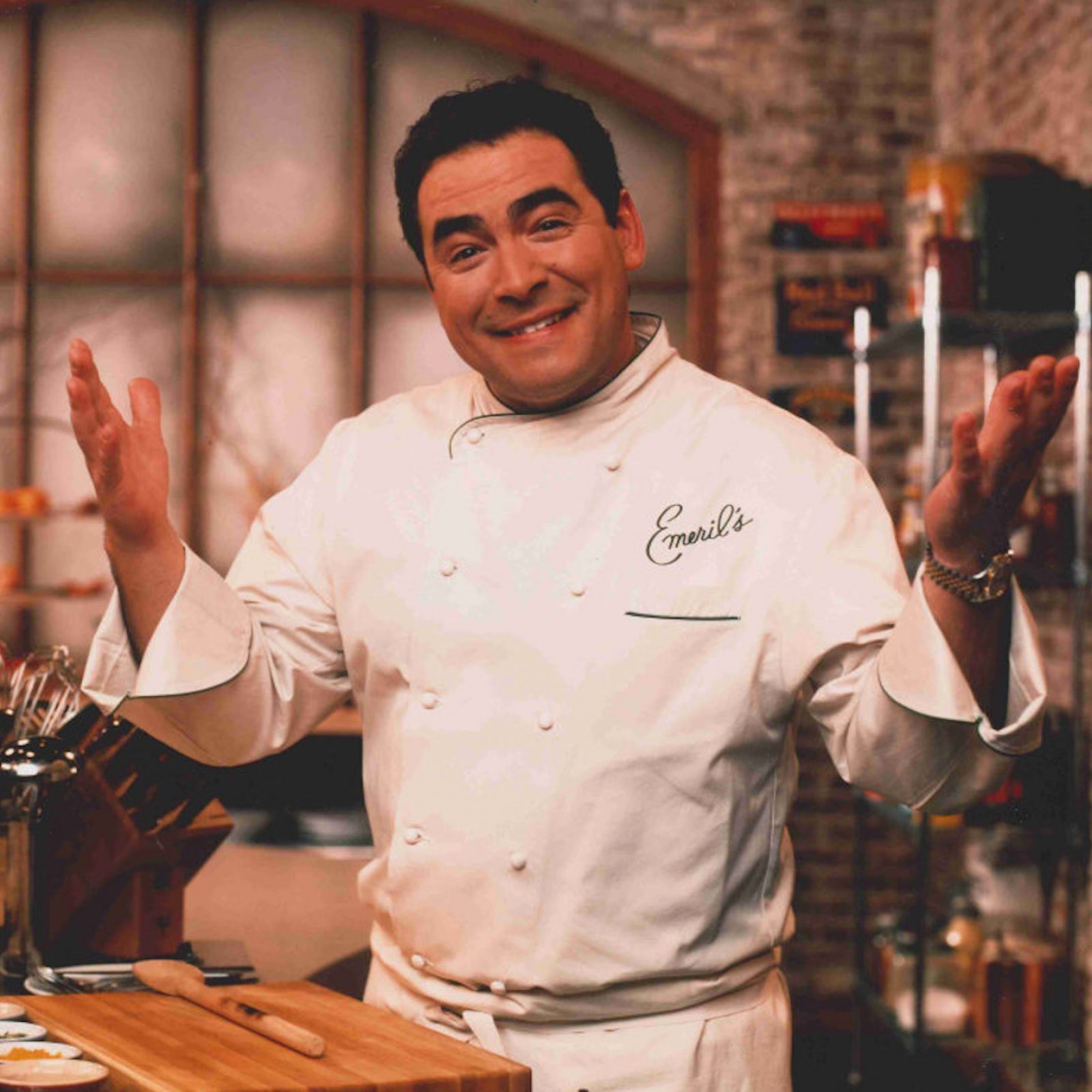
Christopher Kimball: Hi. This is Milk Street Radio from PRX. I'm your host, Christopher Kimball. Today we're going behind the scenes of Food TV. Emeril Lagasse tells us about his rise on the Food Network. We also find out about who Emeril is in real life
Emeril Lagasse: People you know watching on television, they feel like they know me, and they feel like they can touch me, and they feel like this ordinary guy is just going to have a conversation with you. You would think that I would have hundreds and hundreds of friends I don't. And my wife, you know, she, she has dump trucks full of friends, and you know, I I can't fill the Volkswagen up with them. So
CK: Emeril Lagasse, on and off camera. That's coming up later in the show. Right now, we'll hear about another pioneer of Food TV, according to historian Michelle King, anyone from Taiwan associates this song with a woman named Fu Pei-Mei over 40 years, food presented more than 4000 recipes on Taiwan television, from braised sea cucumber to squirrel fish. To hear about the life and TV stardom of Fauci may I'm joined now by Michelle King. She's the author of Chop, Fry, Watch, Learn. Michelle, welcome to Milk Street
Michelle King: Thank you very much for having me.
CK: So let, let's describe the show. I've watched a few of them, and it's, it's quite different than what you know, you'd see in the Food Network today. The set was very simple. There was a banner behind her, just a basic table with a tablecloth, two burners and two woks. So, it was a very simple, basic set, right?
MK: Yes, absolutely. And you know, when she debuted in 1962 it was even simpler in the fact that there weren't even gas burners at that time. At that time, she was actually cooking on a charcoal brazier, which is like a clay bucket with a hole in the side where you stick in the charcoal, and then the wok was sitting on top, and there was no running water, and she had to bring all the ingredients and all her implements, including her cleaver and everything, to the studio, and she would start the fire in the brazier in the hallway, and then bring it into the studio to actually do the cooking. But maybe what's more impressive is despite what Americans would probably consider to be very basic conditions. The kinds of dishes that she could turn out with just a wok and her cleaver are really pretty spectacular and amazing.
CK: Well, as I understand it, though there was more to it than that. It was a five-minute program every single day, right? (That's right) I mean, I watched you do the squirrel fish, where you diagonally hatch it and then fry it, and it looks great. But there she is with a whole fish. She has one of them ready to be fried, but she does one from scratch. She talks the whole time. It's like a freight train, (yeah) Like, she gets the thing started and she's going to get to that five-minute mark with the dish finished, and you're absolutely confident she can do it, but it has, it has a little gimmick to it, which is the five minutes. Now let's go back to talk about Fu Pei-Mei and how she learned to cook. You said that she saw chefs from several well-known restaurants, and she sent a note that said, I love this, seeking famous chefs to learn cooking from Pei-Mei. So, she spent good money to get top chefs to teach her, right.
MK: That's right. So, when she got married, you know, basically, like in her early 20s, she was a terrible cook, and her husband would complain about her cooking. He liked to bring his buddies over to the house to play Mahjong, and she was expected, as all good housewives of the time would have been to cook for them. And so, she would just make what she could, you know, fried noodles or fried rice or something. And he was from the north, so she would try to make dumplings for him, but the dumplings always were waterlogged, and so at one point, she just decided that she would use her dowry, sell her jewelry, and hire chefs to teach her how to cook. Again, attesting to the fact that there were not many ways for a grown woman to learn how to cook, especially a woman who had left behind her own mother, her own mother was still back in mainland China at the time, as were so many older generation. You know that the war split up families by generation. So, she hired local restaurant chefs to teach their specialty dishes to her, and eventually she got so good at it that some of the mahjong players began to say to their wives, hey, you should go learn how to cook from Fu Pei-Mei. And she set up a tent in the backyard and started to teach other women how to cook. And shortly after that, was invited to be on television. She wrote dozens of cookbooks. She had her own successful cooking school. She traveled around the world during the decades of the Cold War, kind of promoting Chinese cuisine all around the world. And so, whereas in the US, you say, oh, Fu Pei-Mei was the Julia Child of Chinese cuisine in Taiwan, you would say, you know, so and so is the Fu Pei-Mei of finished cuisine, or British cuisine, or something like that.
CK: I guess my question, I mean, it's the same question I would have for Julia, you know, why you I mean, there's something about them. And I my answer is curiosity. Like some people, just Julia was immensely curious and liked to talk to people. And I assume that Fu Pei-Mai also was curious and had a great appetite for learning, but she also must have been incredibly disciplined and had amazing energy and forward momentum to go from being a horrible cook with watery dumplings or whatever to being on television every day for five minutes. Did you get a sense of her character and what made her successful?
MK: Yeah. I mean, I think you could call it hustle. Like she she was not afraid to hustle. You know, when she first started her cooking class, for example, she wrote in a pedicab to put up little handwritten notices on lamp posts and stuff. She had the combination of all the things necessary to become a television star. She was attractive, she did know how to cook, but she also spoke Mandarin and Taiwanese and Japanese and English, so she was really quite amazing, and could teach in all of those languages. (Wow) yeah. She had her own TV program in Japan for a couple of years where she'd fly to Japan and teach Japanese housewives how to cook Chinese food.
CK: You said something really interesting here about Chinese cookbooks. You said, in China, they were all about cooking for the masses, like 20 or 30 people, and not about home cooking for individual families, because that was seen as bourgeois. So, there were no, you know, household cookbooks in China, I guess.
MK: Well, this is for the period after 1949 when mainland China becomes fully under control of the Communist Party. They wanted everyone to be able to contribute to agricultural revolution and industrial revolution. So, they didn't want housewives to cook at home for their families. They wanted them out, you know, working. And that's when all those cookbooks that I mentioned in the book were published, where they're intended for communal canteens or places where you would be cooking for 20 or 30 people at a time, you know, or even more so, in a lot of ways, you know what the saying was at the time, and people like Fu Pei-Mei were very proud that in Taiwan, in the Cold War, they had preserved a lot of the traditions. A lot of the chefs had gone over with Chiang Kai Shek. So, there were some really great local, regional culinary traditions that were really preserved in Taiwan. And so Fu Pei-Mei in her cookbooks, even says, like, if you really want to try and sample Chinese cuisine, and this is her writing in the 60s and 70s, when it was really true, you should come to Taiwan.
CK: So, what was the end of the story for fu Pei Mei, you said she taught on Japanese television briefly. What happened in the last 10 or 15 years of her career?
MK: Yeah, she, I mean, she tried to retire after 30 years of being on television, but basically, Taiwan television, she was too successful. They're like, no, you can't retire. And one of the things she insisted upon was changing away from that five-minute format and returning to a longer 30-minute format where she could just do one or two dishes. But what is interesting is what happens, is the shift in Taiwanese audiences, right where, just like with everything else, people are much more interested in learning to cook Taiwanese foods, and much more interested in speaking Taiwanese, and much more interested in learning about foreign foods. So today, I don't know there are interested home cooks, but a lot of people watch cooking programs just because they want to see people make food, not because they actually intend on making those particular dishes. You know, housewives who were watching in the 1960s actually wanted to learn how to make the dishes. So, a lot of her viewers would write in and say, thank you so much for explaining it so clearly. You know (she was good at that) yeah, telling people exactly what all the points are in a way that she never held anything back. You know, she wanted people to have it be successful every time she just was kind of no nonsense.
CK: You really trusted her, right? I mean, I did especially when she did a ____ braised duck in five minutes in a wok. I'm going like, okay, I was (impressed) I'm impressed, (right) Michelle, thank you. It's been a great pleasure. Thank you so much.
MK: Thanks for having me.
CK: That was Michelle King, author of Chop, Fry, Watch, Learn Fu Pei-Mei and the Making of Modern Chinese Food. Now it's time to take your questions with my co-host, Sara Moulton, a food television pioneer in her own right. Her TV career began in 1979 when she was hired to work behind the scenes on Julia Child and More Company. She went on to become the On Air food editor for Good Morning America, and then host of Cooking Live, Sara’s Secrets, and now Sara's Weeknight Meals.
Sara Moulton: So, Chris, today, we're talking about food TV. And I was just wondering, you know, you've been doing it for a very long time, and before you were doing it yourself, you were on many other people's shows. How do you think it's changed?
CK: When I interviewed Emeril, I went back and looked at his early shows. It was really interesting. What he did was he talked to people he looked them in the eyes with the audience. He would do the intro of the show in the audience. So, the show was about interaction with other people. It wasn't standing at a counter and pontificating about how to cook. He was there for you. You thought he was talking to you. It was just an amazing show. It was very much ahead of its time.
SM: You know, it was interesting because I was at the Food Network for the first 10 years, and they knew they had talent right off the bat. They knew, you know, he was it, and all the men who came after him tried to be him. And is sort of one of the older people there, one of the grand dames, sort of mom to everybody, I used to say to them, please stop pretending you're Emeril. Please just be you. And the ones who ended up being them are still,
CK: Well, that's the best advice for television. Well, my director, when I first started 2000, I said, should I take acting lessons? You know? He just laughed. He thought that was the funniest thing he'd ever heard. He said, now let me just explain this to you. You're not an actor. You're just this guy. Either people are going to like you, or they’re going to hate you, and we're going to hope for the former, but if it's the latter, we'll do one season. He just said, be yourself and let it happen. And if it's good, it's good. Bobby Flay, Bobby Flay. Emeril is Emeril. Julia was Julia. All the successful people on TV were just themselves, and you can't hide who you are anyway. Enough on the thespian or the non-thespian art of food shows. Time to take some calls. (Yes) Welcome to Milk Street who's calling?
Caller: Hi there. This is David. I'm calling from Brackney, Pennsylvania.
CK: How can we help you?
Caller: Well, I have kind of an odd conundrum. My oven seems to work differently based on whether I'm cooking savory foods like stews or roasts, or when I'm baking. So, when I'm baking, everything's done early, no matter what the cooking time is, cookies could be a minute or two. A pie could be five or 10 minutes early. Everything's done fast. If I cook like a piece of fish or a piece of chicken or something like that, it seems to take 10 or 15 minutes longer than the recipe. I have no idea what's going on
CK: Other than the fact your oven's haunted, of course, which is definitely a possibility. I have an idea. There are two kinds of heat here, right? There are three kinds, actually, but there is radiant heat. So, this is an electric oven.
Caller: It is electric
CK: So, when the thing gets hot, it radiates heat. Then there is also convection heat, which is the temperature of the air in the oven, right? And then there's conduction, where the food is directly in contact with, let's say, a metal pan or whatever it's conducted heat from substance to substance. I think your radiant heat is cooking the sweet desserts having a different effect, as opposed to the convection heat. I think maybe desserts are more affected by radiant heat than convection heat, and therefore may cook faster. You have three types of heat in that oven, and radiant heat and convection may cook savory foods differently than sweet foods, and that is the best answer I've ever made up in my entire life for radio. But I think it actually might actually be true. But by the way, so are you using the same setting on the oven both times just bake?
Caller: I am
CK: Okay. And do you have a top and a bottom element?
Caller: I have a top and a bottom element
CK: Well, I think that's it. A number of levels in it as well. I think when the top element goes on, it has a greater effect on the desserts than it does on the savory food. Yeah. Yeah,
SM: Chris, if this is true for David, why isn't it true for everybody else?
CK: It may be because the nature of the oven cycles on differently, and maybe because his oven, if you set the oven at 350 you know it cycles, his oven may be cycling from 300 to 400 instead of from 335 to 365 so if you have a wider range, you might be getting more radiant heat at the top end, which really transforms that sugar more quickly.
SM: Alright, now I'm buying in a little I think the good news is that you know how to adjust. So, although it's baffling, I agree with you very strange electric ovens, and I didn't really understand this, but they do cycle on and off. So, they're never you know how? Sometimes you preheat it and then you turn it off, and then, oh, no, I actually want to turn it back on again. And you it was at 350 but then when you turn it back on, suddenly it said 300 you're like, wait a second, I just turned it off. How could it only be at 300 and that's because it does cycle.
CK: If you bake a sweet dessert, like a cake in a convection oven with a convection on it's not a good idea, because what happens is it will cook it fast and set that structure in the cake before it fully rises, whereas, if you put a chicken or a pot roast or anything else in an oven and turn on the convection, it's going to be fine. That's a little clue, that the same oven on the same setting will cook something sweet differently than something savory. I think that might give us a clue.
SM: So, are you suggesting that David use the convection function if he has it?
CK: No, I'm just saying. I'm saying the same oven with the same setting can cook a savory dish differently in different timing than a dessert. (Okay) I think on that I rest my entire case.
SM: Okay, well, David, any rate, it sounds like the first thing that Chris said is probably the most accurate. You have a ghost, but yes, you're managing it.
Caller: I am.
CK: Thank you for calling all the best.
SM: Yes, thank you.
Caller: Thank you.
CK: Yeah, thanks.
SM Same to you. Bye, bye.
CK: This is Milk Street Radio. If you need a bit of culinary inspiration, give us a ring. Any time, 855-426-9843 one more time, 855-426-9843, or just email us at questions at Milk Street radio.com.
SM: Welcome to Milk Street. Who's calling?
Caller: Hi. This is Deborah from Los Angeles
SM: Hi, Deborah, how can we help you today?
Caller: Well, thanks so much for taking my call. So I have a family with two young kids, and we really enjoy quiche for breakfast.
SM: Ooh they’re spoiled
Caller: And yeah, so we got a Trader Joe’s and and just get their quiches from there, and we just pop it in the air fryer. And we love them, but they stopped making them, or they stopped selling them, and the kids have been wanting quiche, so I'm going to attempt to make my own quiche. I've never done it before. Currently, all I have is a nine-inch cake pan, and so when I'm doing the research, it seems like there's a strong recommendation for a spring form pan, although they're quite deep and you lose the kind of nice crinkle edge, which I think is important part of the quiche experience. And then there's __ pans. And then I also read, I should definitely not use a pie pan because it's too angled. So, I wanted to ask you all, what pan do you think I should use for my first foray into quiche, or can I just use my cake pan?
SM: Well, you can certainly use your cake pan. There's nothing to say not it's just will be like when you serve pie, you know, at a holiday, and the first piece always gets sacrificed because it's a mess to get out of the pan. That's really the main problem. And I totally get what you're saying about the ratio of crust to filling. I like crunch, I really do, and I would miss that. You know, in a spring form pan, you're going to have much more filling than crust. But the thing about a spring form is it's just so easy to take it out, and you don't lose any part of the crust, and it looks beautiful. And for those who like more filling, you get more filling. But I think especially since you've never done it before your first time around. Go ahead, use the pan you have, and just understand you're going to lose the first piece. Chris?
Caller: Okay
CK: You know, I don't have a problem with using a pie plate. Or, you know, you can get ceramic quiche dishes which have straight sides, and they have fluted edges, so it looks really nice. You know, getting it out is more problematic than with a cake pan that has a removable bottom. But I think quiche is one of those things that should look great when you serve it. So yeah, I don't care about the heat properties of the pan or anything else. I would just buy a quiche pan and go whole hog. And
SM: And you don't think she should use her nine-inch cake pan because she has it already, and she's
CK: but you're not, but you're not going to get that nice edge to it. The visuals of quiche are part of quiche, and the French would, I think absolutely agree with that. So, I'm standing… you can tell Sara's fluent. I wouldn't worry about how hard it is to get out or anything else. I just buy quiche band. Okay, it's more fun. It's a little bit more special.
SM: Also, I'm very impressed. Let's just pause, aren't we impressed with this woman doing this for her children? This is amazing.
CK: No, I'm impressed by her kids.
SM: Oh, all right,
CK: I will give you great credit. You have raised children who will eat quiche at a very young age, and that is almost an insurmountable obstacle. Anyway, good for you. I’d buy a quiche pan.
SM: Okay,
CK: There you go.
Caller: Okay,
CK: Alright, and congratulations by the way
SM: Really, we're both jobs.
CK: Mother of the year,
SM: Yes, that's right. Bye.
Caller: Thanks so much, guys,
CK: Sure.
SM: Welcome to Milk Street. Who's calling
Caller: Hi. This is Joanne from Albany, New York.
SM: Hi, Joanne, how can we help you?
Caller: Well, I received a bottle of a pepper oil that has a tingly flavor rather than a spicy flavor, and I'm trying to figure out how to pair it with food without it being overwhelming, and if I can pair it with other spices or something to because it kind of numbs my tongue out. So, I was wondering if you could help with that.
SM: Well, I think you must be talking about Szechuan peppercorns
Caller: Szechuan peppercorn, that's the one. Yes, thank you
SM: Right, and that is what they indeed do. They have sort of a numbing, tingly taste. That's their MO you're not a fan?
Caller: No, it almost numbs my tongue out. And like I said, it was a gift, and I tried it a little on broccoli and maybe put it on a potato. But even just the drop of it seemed overwhelming to me, and I wasn't sure if there was some way that I could get it to marry more with other flavors, rather than be such a standout experience.
SM: Well, it's used a lot in Sichuan cooking, and what people often associate it with very spicy food, and that's because it's often paired up with these little dried chilies that are indeed very hot. It sounds like your oil is just as you said, oil, and these little aromatic guys called Szechuan peppercorns, so you don't have the heat in there, but you could try combining them with chilies. And other ingredients that they play nicely with are any kind of citrus, ginger, garlic, onions. I worked at a restaurant here in Boston, actually, or in Cambridge, and we had two dishes on the menu. One was crab Rangoon. I can't remember what all was in that, but we served it, put it into a dumpling and put it into a dipping sauce, and the dipping sauce consisted of nothing more, and this was killer than apricot jam, white vinegar and toasted Szechuan peppercorns, and it was wonderfully citrusy. I have a recipe for duck breast with a similar sauce like I just described, that involves Sichuan peppercorns, apricot and vinegar, and it's absolutely delicious
CK: Sichuan peppercorns as an ingredient in a recipe I get, but the oil I don't get
SM: Okay. Well, we can agree on that one. I did want to ask you one question, though, how long have you had that bottle of oil?
CK: Yeah, it could just be an old bottle too.
SM: You know, it is possible that it wasn't that fresh. People don't realize how quickly even vegetable oils go bad
CK: A couple months.
Caller: Yeah, I actually really liked the thought that the one last ditch effort I think I am going to try is the apricot jam. And you said white vinegar, yeah. And did you say ginger?
SM: Ginger is a nice combo with it. Yeah, you could add ginger too. That would be lovely
Caller: Because I happen to be a really big fan of apricot jam, so I think that I may give that a shot. Just for giggles.
SM: Joanne, do let us know this is definitely
CK: This is definitely a callback situation.
Caller: Yeah, absolutely
CK: All right, okay,
Caller: I will do that. Thank you both so much I appreciate it
SM: Thank you.
Caller: Bye, bye.
CK: You're listening to Milk Street Radio up next another side of Emeril Lagasse. This is Milk Street Radio. I'm your host, Christopher Kimball, at its height, Emeril live drew in millions of viewers at home, as well as an enthusiastic studio audience on the show. Emeril appears larger than life. And then a little bit more chocolate like this here on the top, okay, and then just a little, bam, bam, bam, bam. But before that success, he struggled to find his place on the brand-new Food Network. Its founder Reese Schonfeld just couldn't find the right fit for him.
Reese Schonfeld: First, I had in the schedule of how to boil water, and that had been promised on the air, so I put him to do that, and that wasn't his thing. Next,
CK: Next, they shot a pilot called Emeril and friends that paired Emeril with other chefs because they were worried he wouldn't have enough recipes.
RS: And that show didn't do anything, but Emeril was clearly a star, and I saw that, and I went down to New Orleans.
CK: Finally, in 1994 they landed on a whole new concept, Essence of Emeril, where Emeril could just be himself,
RS: let Emeril be Emeril, and that was the one winning show
CK: Right now, Emeril’s joins me to reflect on his career, both TV and beyond. His latest venture is his first Portuguese restaurant called 34. Emeril welcome to Milk Street.
Emeril Lagasse: Well. Thank you so much, Chris.
CK: You know, we've only met twice. I met you back in the 90s at Emeril’s over a slice your banana cream pie, which I still remember to this day, by the way. Thank you. And a couple years ago in New York, yep. So, here's a quote from you. Let's start with this. “At age 63 he is no longer angry. The world has changed. He said, I don't know about you, but I know it. I can feel it. What does that mean?
EL: Well, I mean, I think as we get older, Chris, as you know, you seem to settle down, particularly in our profession of being a chef, a restauranteur. You know, when I was younger, I was, I was very hyper. I was, I'm still very demanding, but I was very demanding in a different way. You know, when COVID hit, it gave me a lot of time to really kind of think about what we were doing. Emeralds is 34 years old. And after COVID reopened, and then I realized that, you know, I'm going to finally do something the way that I wanted to do it, and I've been wanting to do it for a long time. Closed the restaurant. I brought my son back from Europe, who was training over there, so we totally renovated the restaurant. And now, when we reopened, we only have 11 tables in the dining room at Emeril’s, uh, tasting menu only, and we just opened a new restaurant here in New Orleans called 34 EJ is the fourth and I'm the third. So, 34 is the name, and together we pay tribute to Portugal and where I grew up, in Fall River, which I know you're familiar with. Chris,
CK: Yeah, I looked at the menu for that. It looked fabulous.
EL: I had five people in R&D for about eight months before the restaurant even opened. We went several times to Portugal, Fall River, New Bedford, Westport, Providence, because I wanted this to be the real deal. I didn't want this to be some makeshift Portuguese stuff. I wanted to pay tribute to my mom and where I grew up,
CK: I found this interesting. You got a scholarship to the New England Conservatory of Music because of your percussionist skills, and I've seen you play drums and a couple YouTube things. By the way, you're pretty good, but then you decide to go to Johnson & Wales, so how did you go from music to cooking?
EL: Well, I did both when I was at a young age, working weekends in the Portuguese bakery. You know, I worked from 11 o'clock at night to seven in the morning, and then I'd go to school. I went to, you know, a cooking High School, and then I would go home and sleep, and then my mom would make dinner, and then my dad would drop me back off until I got my own driver's license. So, I was playing music, not only in a Portuguese band that played for a lot of Portuguese boom festivals, but I played in, you know, some rock and roll bands, some jazz bands, and enjoyed it, but then I realized they interfered with each other. People want music on the weekends, the restaurant businesses, that's when it's the busiest, Thursday, Friday, Saturday nights. So, I received a scholarship. I went and did two summers at the New England Conservatory, but there was just something that overcame me that was, you know, that was basically this cooking thing. And I'll never forget when I told my mom that I was not going to go to the university. She was devastated. My dad, he understood more, but my mom was devastated.
CK: So, your father worked at Emeril for 32 years?
EL: Yeah, my father worked in a textile factory in Fall River for 40 some years, and then when he retired, he didn't know what not working was. And I told him, I said, dad, why don't you and mom just moved to New Orleans and then just come work for me. So, he would open the restaurant pretty much every morning, just until about a year before he passed, he did that every day. He was happy and he lived, he lived a really good life, a simple but really good life.
CK: You have 11 restaurants. You're either chef proprietor of 11 restaurants, you've obviously had a long stint on TV, and we'll get to that, but it does remind me of a scene from the TV show Treme. You had a walk on part playing Emeril yourself, and I remember another character asks you for advice about being a chef. The question was, you know, is it better to stay small or become, you know, big and famous?
EL: Yeah, you see Annie and Gail made a choice to stay on Barone Street and keep their hands on what they were serving. They cooked every day they cooked until they could cook no more. That was great, but it was one choice.
Voice: And the other choice is, what? Getting bigger, more tables, more restaurants, less time at the stove, more time in the past, other people cooking?
EL: Well, the other choice is that you can build something big but keep it the way that you want to keep it, take those ideas and try to execute them to the highest level.
Voice: So, is it worth it? (yeah) compared to something like this, something that's just cooking
EL: Hey, some days yes, some days, hey.
CK: So, I'll ask you, is it worth it?
EL: Yeah, I mean, it's, you know, Chris, it's, it's my life. It's what I've been doing since I was 12 years old. You know, went to school and studied a little bit in Europe with some great mentors, and finally, had the opportunity to come and take over Commander's Palace for the Brennans. You know, Ella was such a great mentor, and Dick, her brother was as well. And when the Brennans had that comfort level maybe about six months into the game, then they allowed me to have a window to really express myself creatively. I remember when I told Ella, I said, you know, I'm going to put lamb on the special a rack of lamb Creole mustard crust and she was like, lamb will never sell in this town. It will just never sell. And so, I said, well, I'm going to give it a shot, Ella. And sure enough, it became one of the best sellers on the menu. And so, I, you know, I brought a lot of those things to when I, when I opened Emeril’s, and then it just kind of went from there. And, you know, television came on. I I never thought in a million years that I would do TV and have a successful show or shows. When I got it called, I'll never forget it Emeril’s, I guess, was about maybe two years old, and I got called from this production company in Nashville, and they said, hey, would you come to Nashville and do a pilot? And I didn't even know what a pilot was, except for flying. And I said a pilot. And they said, yeah, there's a gentleman who started CNN, and he's starting a network all about food. And I was like, okay, I did a pilot. They offered me this show called How to Boil Water and I thought, that's not really me. And then they wanted me to do a show called Emeril and Friends, or something like that. I don't even remember, but that didn't last very long. I got fired from that, and then the gentleman that was starting the network. (This is Reese Schonfeld) yep, Reese. And felt called one day out of the blue, and he said, look, we just got to find the right mix for you. And basically, that's how it evolved. The evolution of Essence of Emeril came then, and was very successful. And towards the end of that, I was beginning to get frustrated. And just the restaurants really meant more to me than doing anything else, particularly the amount of time that I was taken to do these shows.
CK: Yeah, you said you go to New York one week each. Month. I'm not, I don't know which show this is and shoot eight shows a day.
EL: Yep, that was Essence of Emeril.
CK: Given the success of that show, I don't know. I mean, you really carried, to some extent, the Food Network in the early days, right? I mean, that show was really important to them
EL: Yeah, I mean, it was, it was part of the success for the network that went from from zero viewers to 100 million viewers, but it was really Emeril Live that really stimulated the network.
CK: Well, here's my my theory about that show. So, I have a theory about everything, by the way. So, here's my theory about your show. I went back and watched it again, and it really struck me that on most cooking shows, there's a gap between the person in front of the camera the people watching the show, right? There's a distance. It's usually the counter right. You're on one side of the counter. Everybody's another side. You walk around, you shake people's hands, you say hello, and then the intro to the show is actually filmed while you're standing in the audience.
EL: Excellent. Excellent, you know why? This is probably the loudest audience we've had all week.
CK: The intimacy between you and the people, it just you completely took that barrier away, and then, of course, the band, but it gave it an entirely different feel, because you were in the audience, essentially in that show. Is that? I mean, that's what was so unique at that time. I think,
EL: Yeah, well, other than Chris, other than the 10 or 15 second dialog in the beginning of the show, there was no script. So, it was me and, God, no script at all. And including the music part of it, of the show. You know, I have this connection with music. Thank God I had Doc Gibbs and some very talented musicians, and even them, there was no script. It was just like we just went out and did it. That's it. Only, only God knew where we were going. I knew what I was going to cook. I would have a theme, and I would try to bring that ingredient or that element to the set to educate people without intimidating them.
CK: Yeah, you were also really good. I mean, that's what's so interesting. You educated people. It was like Julia. But you could also have some fun. I mean, when you were making the French onion soup in one segment, you were putting a little Worcestershire sauce in it, right, and then a little more. And then, I think you put about a quarter cup in time you were done. And then Julia, you did a hamburger segment with Julia, which was, I think, one that my favorite part. She said, the ___ is not toasted. And so you put it on the grill, which obviously was not lit at the time.
Julia Child: They should be toasted, but we'll say that they're toasted,
EL: I’m toasting them right now, all right, they're toasted now they're toasted.
JC: They're toasted.
CK: It was that warmth with the audience, and that playing with the audience, which I think, yeah, I think that was really unique at that time and still is unique.
EL: Yeah, I had a lot of fun doing it.
CK: People obviously come up to you all time, and there's obviously a difference between the Emeril on television and Emeril off television. First time I had a chance to really talk to you a couple years ago. I mean, if I didn't know who you were, I would say you are a very kind, gentle family man, you know, you're very proud of working with your son, just very easy-going warm guy. Do you think that people see you one way, but you see yourself a very different way?
EL: Yeah. I mean, I think that people, you know, watching on television, they feel like they know me, and they feel like they can touch me, and they feel like this ordinary guy is just going to have a conversation with you. And then there's a little bit of truth to that, and there's a lot of truth to what you said about the other side of Emeril which is, you know, family, guy, husband, father, friend. You know, I don't have, you would think that I would have hundreds and hundreds of friends. I don't, because I'm very close kind of person, but the friends that I do have, it's very sincere and very deep relationship.
CK: Yeah, well, my wife and I talk about this all the time. I have like five or six friends very close, and she has like 50, you know
EL: Yeah, I'm in the same boat as you. And my wife is, you know, she, she has dump trucks full of friends.
CK: Was she? Does she always tell you, you need more friends, by the way.
EL: Yeah, I can't. Yeah, I can't fill a Volkswagen up with them. So,
CK: Yeah. So, what I hear all the time, you need more friends. No, I've just, I have five. They're great.
EL: No, I don't need any more friends, exactly.
CK: So, when you sit down with your son now, who's coming into the business with you, what advice do you give him? Are there things you want him to avoid mistakes you made, or things that he should do more of. I mean, based on your experience.
EL: Well, we have an incredible relationship, first of all, and he pretty much has grown up in the business since he was, you know, knee high. And then, you know, when he told his mom and I that, you know, he wanted to be a chef. I'll never forget it. We were having this dinner at Cafe Blue in New York, and he was probably 13. He said to us, he said, you know, I decided what I want to do, what I want to be. And I said, what is that? And he said, I want to be a chef. And I looked at my wife, kind of we rolled our eyes, and we were like, are you sure you want to do that? You're very smart, you know, you can sing, you can play guitar. It's just like, you know, amazing musician. You sure you don't want to? No, I want to be a chef. So, I just, I'm in the bleachers, just kind of mostly watching now. Chris
CK: Emeril, thank you. It's been a lovely chat, and I hope to catch up with you soon.
EL: Hey, Chris, thank you so much. Thanks for having us. And take care.
CK: That was Emeril Lagasse. You're listening to Milk Street radio up next. We enter kitchen stadium.
Voice: Settle in, everyone. This is going to be special out of kitchen. Opening gong and okay
CK: Adam Gopnik weighs in on the original Iron Chef that's coming right up. I'm Christopher Kimball, and you're listening to Milk Street Radio. Now let's check in with Adam Gopnik. Adam, how are you?
Adam Gopnik: I am fine, Chris. How are you?
CK: I'm pretty good.
AG: I have a confession to make, Chris, which is kind of surprising coming from someone like me who obsesses about food and who cooks almost literally every night dinner for his family, and that is, I do not like food television isn't that surprising. And I've been thinking hard about why I don't love it as much as you might expect.
CK: Well, I don't this is strange coming for me, because I actually you do it, I do it. I think because cooking at home is not first and foremost entertainment. When you turn cooking into entertainment, it can work, but it's a pretty big shift from what it actually is. That's my take. I think
AG: I think that's essentially right. I think that cooking, for us folks who are obsessed with it and do it every night is closer to a form of meditation than to a form of entertainment. It's a way we unlock our own anxieties through chopping and stirring, and it's also a way of giving, of making something for someone else. But I also think that there are times when I've liked cooking on television I don't, and I feel terrible saying this like the unduly solemn and sort of romantic in the wrong way TV things, I think in part because one of my theories about television, and I think Julia Child, who was the first great TV cooking figure, is a wonderful demonstration of this unselfconsciousness is a key to being good on television. And I have seen so many very smart people do badly on television, because if your self-conscious television camera is like an x ray of your self-consciousness, that's
CK: That’s really smart. You know, James Beard tried out on television, as you know, and it never worked, (yes) and yet, here was a guy in person, you know. He was. Physically larger than life, but he had a tremendous personality in person, but he shrunk on the TV screen, yes.
AG: Yes, but with all of that said, there is one classic cooking show that I am still addicted to after all these years, and oddly enough, that is the original Japanese Iron Chef, that Takeshi Kaga, oh yeah, invented and promoted. Do you remember it?
CK: I remember shots from it. I don't remember sitting down and seeing a whole show.
AG: It was, in one way, I said self-consciousness kills good TV. In one way, it was the most crazily self-conscious television show that there's ever been, because the whole premise was that we were in the cooking stadium. And Takeshi Kaga had invented this whole world where these four iron chefs, Iron Chef France, Iron Chef Chinese, Iron Chef Japanese and so on, were in constant battle with great cooks from around the world. And the whole thing was done with a kind of fake solemnity that made it seem as though something enormous was at stake with kind of Hans Zimmer music. And there was always one ingredient that they were working on. And yet, with all of that said, I find it irresistible. And to this day, when I am suffering from insomnia and I want something that will delight me without overly agitating me to watch, I find an old original Iron Chef. They later tried to make it work in America, but it was never as much fun as the original. And I thought about it. And so, here's why I think it's so good and works so well. First, there's a nice literary term, which is mock epic that though was being presented as this enormously solemn and serious cooking war that was going to be judged. Nonetheless, we understood that it was all being done with a kind of ironic wink, and that made it irresistible. It made it huge fun. Because the truth, exactly as you were saying, Chris, is that those of us who love food and live for cooking take it at one level, very seriously, but the things that you and I obsess over every night, I don't have any ground cumin, for the Europa vieiras that I'm trying to make and I go crazy for the absence of ground cumin is really not that important in the grand scheme of things. So those of us who love food are always naturally operating in a mock epic mode. And I thought that Iron Chef, the original one, captured that very well
CK: A wink and a nod, unless it's Monty Python is really hard to pull off, because being slightly off is just going to make it unwatchable, right?
AG: I think that's true, and that was something sort of miraculous about Takeshi Kaga and the original Iron Chef. They pulled it off somehow. They found that miraculous balance between presenting your material seriously and not taking it too seriously, having a constant sense of irony about it that was immensely appealing, as you say, hard to do. And here's the reason, I think may be the secret that enabled them to do it, everything we do is always rooted in the time that we do it in. And the original Iron Chef, though it bent over into the arts, as I said, was very much a fixture of the 90s, and I think in ways that were unselfconscious to use that word, it reflected the happy, optimistic vision of globalization that was available to people. Then, if you recall that time, it was one when it seemed as though the world going planetary would be a completely positive thing. And so, the idea that you would have within one Japanese stadium, an Iron Chef France who was Japanese, an Iron Chef Chinese who was also Japanese, and an Iron Chef Japanese who was also Japanese, implied a kind of connectivity around the world, sense that everything was available to us. I loved, as you gather, Chris the 1990s and just like the 1890s of the previous century which seemed, in retrospect, a time of enormous optimism and possibility, the 1990s had some of that, and it was very much reflected in that series.
CK: Well, James Beard is gone. Julia Child is gone, but I guess Julia lives on, as does the original Iron Chef. Julia will always be with us, right?
AG: Yes, Julia, and you can watch her on YouTube. It's one of the strangest things about a time that's supposed to be devoted to instant amnesia is that we have perpetual memory. Everything is still available to us, even in the midst of our amnesia. Did I ever tell you, by the way, about my dinner with James Beard? It was in the early 1980s we went to An American Place
CK: Larry Forgione
AG: Exactly.
CK: He was very he was very good friends with him
AG: And I was thrilled to meet James Beard. And he told stories about eating in the nude with a woman he called. Called Mary Fisher, and I realized only halfway through that he was referencing one of my heroines, MFK Fisher, and that image of never, has never left my mind in all these years. Well,
CK: Well, maybe would have made it made a really good cooking show. Who knows> that? Ah,
AG: Ah, the naked chef. Well, we had one, but not nearly as appealing as the idea of Beard naked.
CK: All I can say is that anybody who says before show begins, whether it will be successful has no idea there is a magic to all of this that is totally unknowable. Nobody thought Julia would be successful on television, right?
AG: And no one would have imagined that a dubbed Japanese cooking show would become a phenomenon. This we can take some little comfort in this uncomfortable time from the idea that certain things are subject to serendipity, not to planning.
CK: Adam thank you very much. The future is unknowable,
AG: but cookable, but cookable.
CK: Thank you. Adam. That was Adam Gopnik, staff writer at The New Yorker. His latest book is The Real Work on the Mystery of Mastery. That's it for this week's show. Please don't forget, you can hear more than 300 episodes of Milk Street Radio at our website, Milkstreetradio.com or wherever you get your podcasts, you can find out more about us at 177 Milkstreet.com there, you can become a member and get 1000s of recipes, access our online cooking classes and get free shipping on all orders from the Milk Street store. Plus, we have a complete collection of all of our favorite [email protected] and slash best recipes. Please check us out on Facebook, at Christopher Kimball's Milk Street. On Instagram at 177 Milk Street. We'll be back next week, and thanks, as always, for listening.
Christopher Kimball's Milk Street Radio is produced by Milk Street in association with GBH co-founder Melissa Baldino, executive producer Annie Sensabaugh, senior editor Melissa Allison, senior producer Sarah Clapp, Associate producer Caroline Davis with production help from Debby Paddock. Additional editing by Sidney Lewis, audio mixing by Jay Allison and Atlantic Public Media in Woods Hole Massachusetts. Theme music by Toubab Krewe, additional music by George Brandl Egloff, Christopher Kimball’s Milk Street Radio is distributed by PRX.
ADVERTISEMENT

Simple, Bold Recipes

Digital Access
12 weeks for$1
- EVERY MILK STREET RECIPE
- STREAMING OF TV AND RADIO SHOWS
- ACCESS TO COMPLETE VIDEO ARCHIVES

Insider Membership
12 weeks for$1
- EVERYTHING INCLUDED IN PRINT & DIGITAL ACCESS, PLUS:
- FREE STANDARD SHIPPING, MILK STREET STORE,
to contiguous US addresses - ADVANCE NOTIFICATION OF SPECIAL STORE SALES
- RECEIVE ACCESS TO ALL LIVE STREAM COOKING CLASSES (EXCLUDING WORKSHOPS & INTENSIVES)
- GET YOUR QUESTIONS ANSWERED BY MILK STREET STAFF
- PLUS, MUCH MORE

Print & Digital Access
12 weeks for$1
- EVERYTHING INCLUDED IN DIGITAL ACCESS, PLUS:
- PRINT MAGAZINE SUBSCRIPTION
- 6 ISSUES PER YEAR

