


As Alfonsina Cortegiani dragged her raschietta across the wooden table, she pulled together flour and eggs in a delicious alchemy she’s been working for nearly 65 years, ever since she was 6 years old. The raschietta—a rustic spade-like bench scraper forged from wrought iron—has been at it far longer.
The tool, smooth and comfortably heavy, was made by a distant relative sometime in the mid-1800s and has been used for pasta making by the women of Cortegiani’s family ever since. I don’t think I’ve ever coveted a kitchen tool quite so much as that raschietta. Its heft and ease in the hand spoke volumes of its history. As did its simple, beautiful utility.
I was visiting Cortegiani at the farm-guesthouse she and her husband run in Mompeo, a hillside town 45 kilometers northeast of Rome. Population: 500, give or take. As logs crackled in the fireplace behind her, she walked me through innumerable hand-shaped pastas and the sauces they love.
“I didn’t want to study,” she said, chuckling. “So I gave up school when I was 12 years old and started working in the fields and cooking. None of the pastas was difficult to learn, so I make them all.”
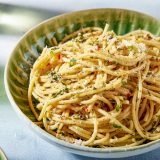
Splendidly so. By far my favorite was the simplest—maccheroni a fezze con aglio e maggiorana—or simply, macaroni with garlic and marjoram. It’s one of those beautiful, too-easy-to-be-so-good sauces Italians toss together seemingly without thought, as though the recipe is baked into their DNA and they have no choice but to make it.
The pasta making was a showstopper, a process inspired by and named for the looping of wool to make yarn. Formed into a thin doughnut, the loop of dough was rolled and stretched, folded over itself, then rolled, stretched and folded over again on repeat until it formed a tangle of long, thick noodles. It reminded me of Chinese pulled noodles.
Cortegiani’s assurances aside, I was pretty sure I couldn’t manipulate pasta dough nearly as dexterously as she did. But the sauce? A no-cook wonder anyone could master. She started by mashing a head of garlic with a heap of fresh marjoram and coarse salt. Olive oil from their 1,200 trees went in next, plus a generous sprinkle of red pepper flakes and black pepper.
When the pasta was cooked, it and some of its water were married to the sauce off heat. A generous amount of briny pecorino Romano cheese melted into it all, thickening it. The taste far exceeded its six-ingredient simplicity, at once herbal, garlicky and cheesy with mild pops of heat. You don’t need a nearly 180-year-old bench scraper to make it, but it certainly would enhance the experience.
Lazio’s Easiest, No-Cook Pasta Sauce
By
J.M. Hirsch
In a hillside village north of Rome, we learned the delicious simplicity of herbs and garlic
Photo: Christopher Warde-Jones




